

Key Takeaways
Our Verdict
Most drivers can handle a handful of basic maintenance tasks safely at home with minimal tools. But jobs that touch safety systems - brakes, steering, suspension, fuel - belong with a qualified mechanic. The dividing line isn't about confidence; it's about what goes wrong if the job isn't done right.
| Best for | Recommended |
|---|---|
| Drivers comfortable with basic tools and simple procedures | DIY maintenance tasks |
| Jobs involving brakes, fuel, suspension, or alignment | Professional shop service |
| Infrequently driven vehicles with complex maintenance needs | Professional shop service |
| Routine upkeep on a tight budget with time to learn | DIY maintenance tasks |
Why the DIY Line Matters
The appeal of doing your own car maintenance is real - it saves money, builds familiarity with your vehicle, and gives you control over what gets done and when. But not every task is created equal. Some are genuinely low-risk and require little more than the right part and a few minutes. Others look approachable on video but can leave you with a vehicle that isn't safe to drive.
The goal here isn't to talk you out of doing your own work. It's to help you figure out which category a given job falls into - before you're midway through it. The same logic applies across home repairs: see how a similar framework plays out with home repair decisions.
Tasks Most Drivers Can Handle at Home
These jobs are generally low-stakes, require basic tools, and don't affect safety-critical systems directly. That said, always consult your owner's manual before starting - procedures vary by vehicle.
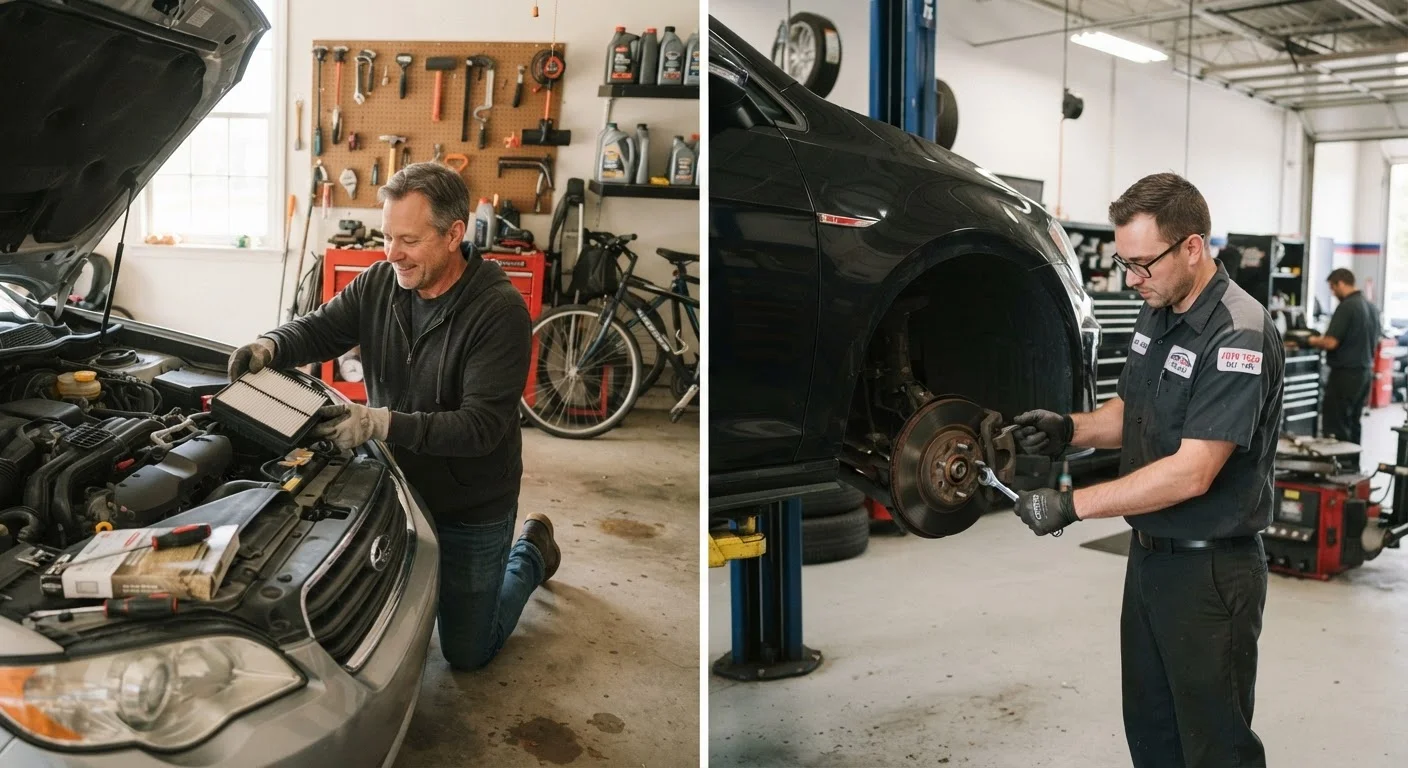
- Engine air filter replacement: Usually accessible without tools or with a simple screwdriver. A clogged filter reduces engine efficiency. Your owner's manual will show you the location and replacement interval.
- Cabin air filter replacement: Often located behind the glove box. Straightforward on most vehicles, though some require more disassembly.
- Wiper blade replacement: Clips on and off in minutes. The packaging often includes model-specific instructions.
- Checking and topping off fluids: Windshield washer fluid, coolant (when the engine is cold), and power steering fluid are all checkable via clearly marked reservoirs. Do not open the radiator cap on a hot engine.
- Battery terminal cleaning: Corrosion on terminals can cause starting problems. A wire brush and a paste of baking soda and water can clean terminals safely - with the battery disconnected first.
- Tire pressure checks: A basic tire gauge is inexpensive. Keeping tires at the manufacturer-specified pressure (found on the door jamb sticker, not the tire itself) improves handling and fuel efficiency.
If your vehicle sits unused for long stretches, some of these checks become even more important. Maintaining a car you rarely drive requires its own attention to fluids and seals.
| Task | DIY-Friendly | Shop Recommended | |
|---|---|---|---|
| Engine/cabin air filter | Yes - minimal tools, low risk | Not necessary | |
| Wiper blade replacement | Yes - simple clip mechanism | Not necessary | |
| Tire pressure checks | Yes - requires only a gauge | Not necessary | |
| Oil change | Possible with proper setup | Preferred if not fully equipped | |
| Spark plug replacement | Possible on simple engines | Recommended on complex layouts | |
| Brake pad/rotor service | Not recommended | Yes - safety-critical | |
| Wheel alignment | Not possible without equipment | Yes - requires computer tools | |
| Timing belt/chain | Not recommended | Yes - engine damage risk | |
| Fuel system repairs | Not recommended | Yes - fire and injury risk | |
| Suspension (struts/springs) | Not recommended | Yes - spring compression hazard |
Jobs That Belong in a Shop
These tasks either require specialized tools, involve safety-critical systems, or can cause expensive damage if done incorrectly. This isn't a knock on your abilities - it's about what the consequences look like if something goes wrong.
- Brake work: Brake pads, rotors, calipers, and brake lines require precise installation. An improperly seated caliper or incorrectly torqued lug nut can cause brake failure. This is a non-negotiable shop job for most home mechanics.
- Wheel alignment: Alignment requires computerized equipment that measures wheel angles in fractions of a degree. Even if you can swap wheels, you can't replicate that at home. Understanding what alignment actually involves helps explain why.
- Timing belt or chain service: If the timing belt breaks or is installed incorrectly, it can destroy the engine. The procedure is complex and the margin for error is extremely small.
- Fuel system repairs: Working on fuel injectors, fuel pumps, or fuel lines involves flammable material under pressure. This work carries real fire and injury risk without proper equipment and ventilation.
- Suspension components: Struts and control arms involve compressed springs that can release with serious force if handled incorrectly. Special spring compressor tools are required.
- Transmission service (beyond fluid checks): Internal transmission work is specialized enough that even many general mechanics refer it to transmission specialists.
The Gray Zone: Tasks That Depend on Your Setup
Some jobs land in the middle - manageable for someone with the right tools and patience, but risky without them.
Oil changes are a common example. They're within reach if you have the right drain pan, a proper jack with stands (never work under a vehicle supported only by a floor jack), and the correct filter wrench. But improper drain plug torque or a misaligned filter can cause oil leaks or engine damage. If you're not set up for it, a shop oil change is inexpensive enough to be worth it.
Spark plug replacement is similar. On many older or simpler engines, it's a straightforward job. On modern V6 or V8 engines with rear-bank plugs or coil-on-plug designs, access is difficult and the risk of cross-threading a plug is real.
Tracking everything - whether you do it yourself or have it done professionally - is worth the effort. A car maintenance log helps you know what's been serviced and when, which also matters if you ever sell the vehicle.
Asking the Right Questions Before You Start
Before taking on any maintenance task, run through a quick mental checklist:
- Do I have the right tools? Substituting tools (like using pliers instead of a torque wrench) is one of the most common sources of DIY damage.
- Is my workspace safe? Working on a level surface with proper lighting, wheel chocks if needed, and no fire hazards nearby is a baseline.
- What's the cost of getting it wrong? A misinstalled wiper blade is annoying. A misinstalled brake caliper is dangerous. That asymmetry should guide your decision.
- Have I read the vehicle-specific procedure? Generic tutorials can miss model-specific quirks. Your owner's manual and reliable vehicle-specific forums are better sources than a generic YouTube video.
The same honest self-assessment applies in other areas of home maintenance - DIY electrical work follows a nearly identical logic. Know the limits, and the jobs you do take on will go better.