

Key Takeaways
Our Verdict
Neither generic nor name brand wins across the board. Research points to genuine parity in many categories - particularly over-the-counter medications and pantry staples - while meaningful differences may exist in categories where formulation, materials, or manufacturing consistency matter more. Defaulting to name brands for perceived safety or status typically costs more than it delivers.
| Best for | Recommended |
|---|---|
| Everyday staple purchases where active ingredients are standardized | Generic |
| Over-the-counter medications with regulated active ingredients | Generic |
| Categories with significant formulation complexity or variable manufacturing standards | Name Brand (evaluate case by case) |
| Readers who want to systematically reduce spending without sacrificing quality | Generic-first with selective exceptions |
The Price Gap Is Real - But What Drives It?
Name brand products consistently command price premiums that can range from 20% to well over 100% compared to their generic equivalents. Understanding what actually creates that gap is the first step toward spending it wisely - or not at all.
The premium typically reflects marketing expenditure, packaging design, retail positioning, and brand equity - not necessarily superior raw materials or production processes. Companies that build national brands invest heavily in advertising, and those costs are baked into every unit price. Generics skip most of that overhead, which is how they undercut on price without necessarily underperforming on substance.
As the evidence on premium pricing makes clear, higher cost is a reliable quality signal in some categories and almost pure marketing noise in others. The challenge is knowing which is which before you pay.
What Studies Actually Find
The most rigorous comparisons come from two areas: pharmaceutical research and consumer product blind testing.
Pharmaceuticals: Generic drugs in the U.S. are required by the FDA to contain the same active ingredient at the same dosage and deliver equivalent bioavailability as their brand-name counterparts - a standard known as bioequivalence. Multiple independent studies have confirmed that, for most drug classes, clinical outcomes between generic and name brand are statistically indistinguishable. This is one of the clearest cases where research supports choosing generic without meaningful tradeoff.
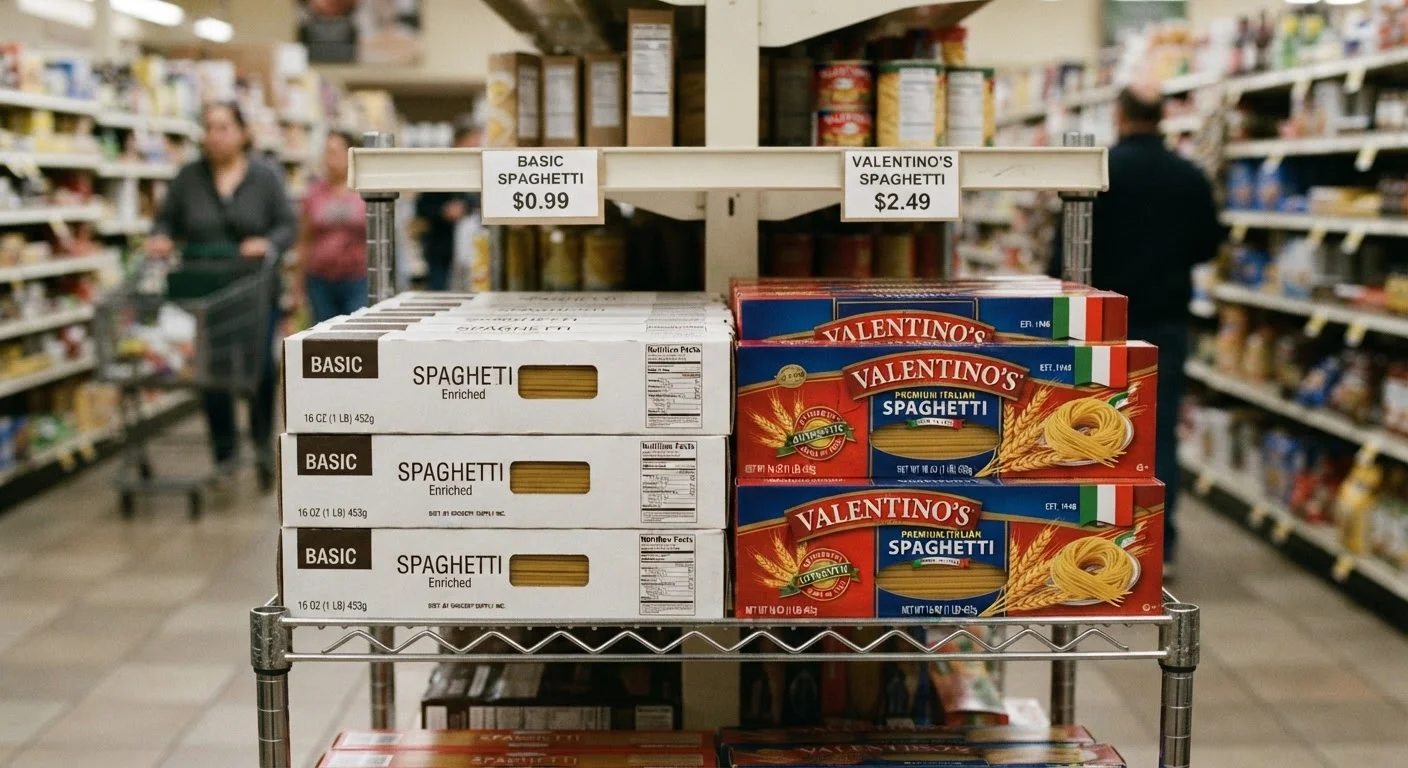
Food products: Blind taste tests - including studies published in peer-reviewed consumer research journals - routinely find that participants cannot reliably identify which sample is name brand versus store label when visual and packaging cues are removed. In commodity categories like canned vegetables, flour, sugar, and basic dairy, the formulations are often identical because the underlying ingredient is itself standardized.
Household and personal care products: Results here are more mixed. Active ingredient concentrations can vary, and some categories - particularly those without regulatory standardization - show more meaningful differences in formulation.
| Category | Generic | Name Brand | |
|---|---|---|---|
| OTC Medications | Bioequivalent by FDA standard | Same active ingredient, higher price | |
| Pantry Staples | Often identical formulation | Marketing premium, similar quality | |
| Personal Care Products | Variable; check ingredients | May have proprietary formulations | |
| Household Cleaners | Usually comparable efficacy | Branded scent/packaging premium | |
| Complex Electronics | Manufacturing consistency varies | Brand may reflect tighter QC | |
| Specialty Skincare | Simpler formulations typical | Delivery systems may differ |
When Generic Makes Straightforward Sense
Generic choices tend to deliver full value in categories characterized by standardized inputs, regulatory oversight, or commodity-grade ingredients. This includes:
- OTC medications with the same active ingredient and dosage (pain relievers, antihistamines, antacids)
- Pantry staples - salt, sugar, flour, dried pasta, canned beans
- Basic cleaning supplies where the chemistry is simple and standardized
- Private-label versions of name brand products manufactured in the same facilities (a common retail practice)
In these spaces, store brand evaluation is relatively straightforward: check the active or primary ingredients, compare them to the name brand label, and make an informed call. If the ingredient list is essentially identical, the premium is hard to justify on quality grounds.
When the Brand Premium May Be Warranted
Generic isn't universally superior value. There are legitimate categories where manufacturing consistency, proprietary formulations, or quality-control investments create genuine differences worth considering.
Complex electronics components, specialized adhesives, and products where tolerances and materials matter at a technical level are areas where brand reputation can proxy for manufacturing rigor in ways that are harder to verify independently. Similarly, some skincare formulations involve delivery systems, preservative choices, or ingredient stability considerations that go beyond a simple active-ingredient comparison.
The practical test: ask whether the quality difference is demonstrable and observable in use, or whether it's primarily felt through packaging and marketing. Understanding how quality claims work helps separate legitimate differentiators from buzzwords.
Don't Assume Identical Labels Mean Identical Quality
Even when active ingredients match, some product categories involve inactive ingredients, manufacturing environment, or shelf-stability factors that can differ between generic and name brand. This is particularly relevant for certain medications where inactive ingredients may affect tolerability in sensitive individuals. When in doubt - especially for health-related purchases - consult a qualified professional rather than relying solely on label comparisons.
For a broader framework on when paying more actually pays off, see our analysis of upfront spending decisions. The logic overlaps: premiums are defensible when they translate to durability, efficacy, or meaningful performance differences - and harder to justify when they don't.
A Practical Framework for Deciding
Rather than a blanket rule, use a category-by-category approach anchored in a few questions:
- Is the product regulated for equivalence? If yes (pharmaceuticals, certain food standards), generic is likely safe to choose.
- Can you compare the ingredient or specification list directly? Identical inputs are the clearest evidence of equivalent quality.
- Is there verifiable blind-test or independent review data? Consumer research organizations periodically test product categories - their findings are more reliable than marketing claims from either side.
- What is the actual cost of being wrong? For low-stakes purchases, generic trial is low-risk. For high-durability purchases where failure is costly, more scrutiny is warranted.
This connects directly to the broader concept of price versus value: the goal isn't to minimize spend, it's to maximize what you actually receive for what you pay. Informed generic buying is one of the most reliable ways to do that - but only when applied with the right criteria, not as a reflex.