

Key Takeaways
Why 'Quality' Is a Meaningless Word Without Evidence
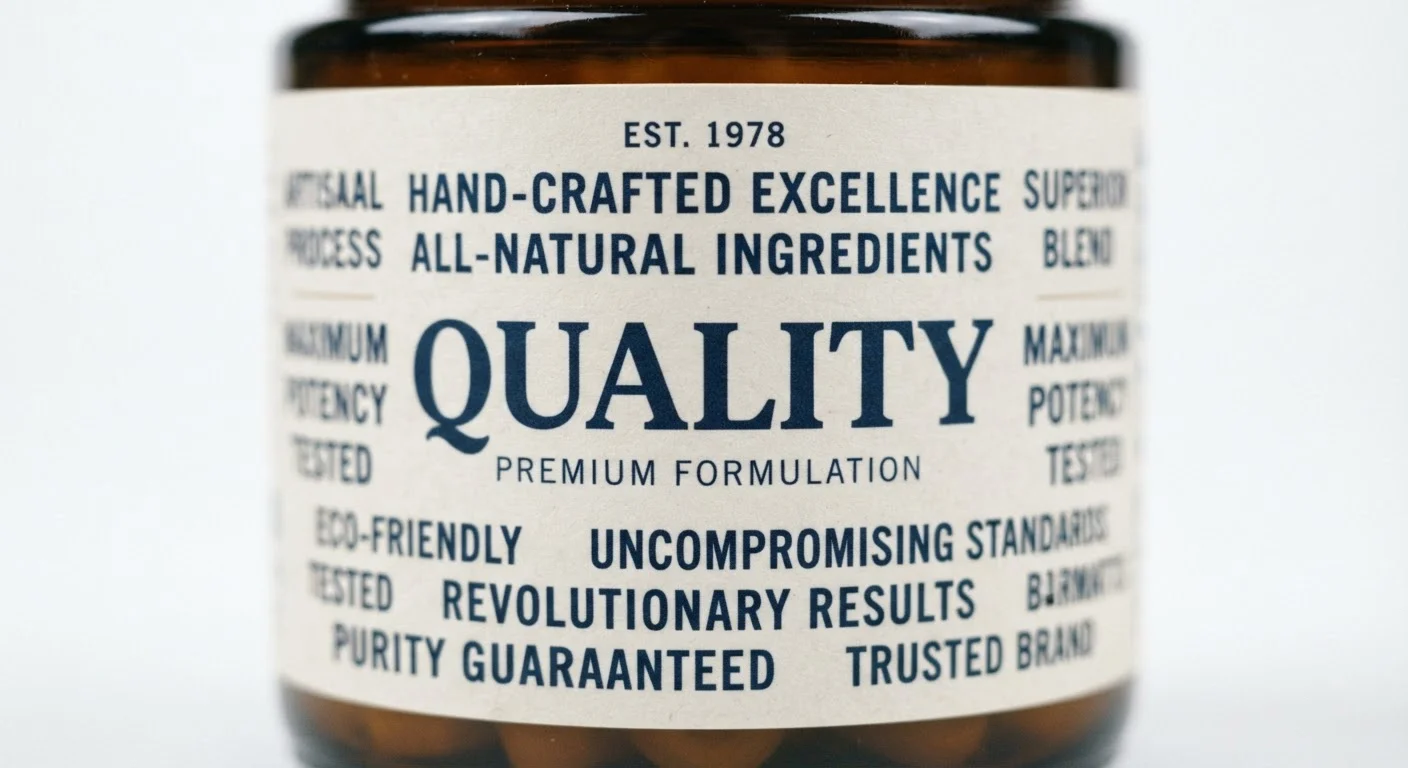
Walk through any retail aisle or product listing and you'll encounter the word quality dozens of times. It's on packaging, in brand taglines, and threaded through product descriptions. Yet despite its ubiquity, the word commits to nothing. There is no federal standard, no industry body, and no certification that the mere word "quality" implies.
This matters because consumers reasonably assume that widely used marketing language carries some accountability. It often doesn't. Understanding the gap between a quality claim and a quality indicator is one of the most practical consumer skills you can develop.
Genuine quality indicators share three characteristics: they are specific (a measurable attribute, not a feeling), verifiable (a third party can confirm them), and relevant (they connect to how you will actually use the product). A claim that something is "crafted with precision" fails all three tests. A claim that a stainless steel product uses 18/8 grade steel passes all three.
Myth
If a product is labeled 'high quality,' it must meet some standard that protects me as a buyer.
Fact
The term 'quality' carries no regulated meaning in U.S. consumer marketing. Any manufacturer can use it without meeting a defined benchmark.
Unlike claims such as "organic" or "UL Listed," the word quality is what regulators call a puffery term - a vague, subjective boast that cannot be proven false because it asserts nothing specific. The Federal Trade Commission's guidelines on advertising require that factual claims be substantiated, but terms so broad that no reasonable consumer takes them literally fall outside that protection.
Useful signals are specific and verifiable: a yarn weight in ounces per yard, a thread count confirmed by an independent lab, or an IP rating for water resistance. Vague superlatives are marketing decoration, not product data.
Myth
A higher price reliably means a higher-quality product.
Fact
Price reflects many factors beyond materials and construction - brand positioning, retail markup, packaging, and advertising spend among them.
Pricing strategy and product quality are separate decisions made in separate departments. A brand may charge a premium because of its heritage, its shelf placement, or simply because its customer base expects to pay more. That markup does not flow back into the product's components or durability.
Research in consumer psychology has repeatedly shown that perceived quality rises with price - a phenomenon sometimes called the price-quality heuristic. Marketers know this and use pricing itself as a quality signal, independent of what's inside the box. Our related article on why paying more doesn't guarantee a better product examines this dynamic in detail.
Myth
Words like 'premium,' 'artisan,' and 'professional-grade' indicate a product is made to a higher standard.
Fact
These terms are unregulated descriptors with no minimum production standard attached. Their use is a marketing choice, not a quality classification.
"Artisan" originally implied small-batch, hand-crafted production. Today it appears on mass-manufactured goods with no meaningful distinction from the standard line. "Professional-grade" similarly suggests a product built for demanding use - but there is no certification body defining what that means across industries.
When you encounter these labels, replace them with specific questions: What is the gauge of the steel? What is the tensile strength? What warranty does the manufacturer stand behind? If the product page cannot answer those questions, the label is doing work the product cannot.
Myth
Third-party reviews are sufficient to confirm a product's quality claims.
Fact
Consumer reviews measure satisfaction with expectations, not objective quality. They are valuable but must be interpreted carefully alongside harder evidence.
A product with thousands of five-star reviews may simply have been priced low enough that buyers felt they got what they paid for - or it may have attracted reviews through incentive programs. Satisfaction is relative to expectation, which sellers can manage through careful product positioning.
More reliable third-party signals include: testing by independent organizations such as UL, NSF, or ASTM-certified labs; editorial testing by consumer-focused publications that disclose their methodology; and professional trade certifications relevant to the product category. Evaluating quality without physical inspection requires layering several of these sources together.
Myth
Detailed product specifications always give you the full picture of quality.
Fact
Specs are often selectively presented to highlight flattering numbers while omitting the metrics that would reveal a product's weaknesses.
A manufacturer might tout a speaker's peak wattage rather than its continuous RMS rating, or advertise a mattress's coil count without disclosing coil gauge (thickness), which is a more meaningful durability indicator. Understanding which metrics actually matter in a given category is the first step to reading specs honestly.
Our guide on reading between the lines of product specifications walks through how to identify which numbers are meaningful and which are padding designed to impress without informing.
How to Ask Better Questions Before You Buy
Cutting through marketing language is a skill, and it starts with replacing vague descriptors with concrete questions. Before accepting any quality claim at face value, consider asking:
- What materials are used, and to what specification? Generic terms like "solid wood" or "genuine leather" can obscure meaningful variation. Ask which species, which grade, which tannery process.
- Who tested it, and what did they test for? Look for certification marks from recognized bodies - not the brand's own quality seal, which is self-issued.
- What does the warranty actually cover? Warranty terms are one of the clearest signals a manufacturer can give about how long they expect their product to perform.
- What do professional users - not casual consumers - say about it? Tradespeople, hobbyists, and professionals with high usage rates surface durability issues that casual reviewers miss.
~80%
Consumers who equate price with quality
Multiple consumer behavior studies have found that a large majority of shoppers use price as their primary quality signal, despite limited correlation between the two in many product categories.
0
Regulated definitions for 'premium' or 'artisan' in U.S. retail
The FTC does not define or enforce standards for terms like 'premium,' 'artisan,' or 'professional-grade' in general consumer product marketing.
Approaching purchases this way shifts the burden back to sellers: marketing language that cannot answer specific questions should lower your confidence, not raise it.