

Key Takeaways
Why Tires Deserve More Attention Than They Usually Get
Tires are the only part of your vehicle that actually touches the road. Everything your car does — accelerating, braking, turning — depends entirely on four patches of rubber roughly the size of your hand. Yet most drivers pay little attention to tires until something goes wrong.
That's a costly habit. The consequences of a tire failure at speed can be severe, and many failures are preventable with basic monitoring. Tire condition also affects fuel economy and handling in ways drivers feel every day without realizing the cause.
The good news: tire maintenance doesn't require tools, mechanical knowledge, or much time. It comes down to three habits — checking pressure, inspecting tread, and rotating on schedule.
Tire Pressure: The Number You're Probably Getting Wrong
Many drivers assume the number molded into the side of a tire is the correct inflation target. It isn't. That number is the maximum pressure the tire can safely hold — not the recommended operating pressure for your vehicle.
The right number is found on a sticker inside the driver's door jamb or in the owner's manual. It's specific to your vehicle and load, and it's often different for front and rear tires. Most passenger cars fall in the 32–36 PSI (pounds per square inch) range, but check your specific vehicle's spec rather than guessing.
~1 in 4
Passenger vehicles with at least one significantly underinflated tire
According to National Highway Traffic Safety Administration (NHTSA) data, a substantial share of vehicles on U.S. roads are operating with underinflated tires at any given time.
Up to 0.5%
Fuel economy lost per 1 PSI drop below recommended pressure
The U.S. Department of Energy estimates that keeping tires properly inflated can improve gas mileage by a small but meaningful margin across the life of the tires.
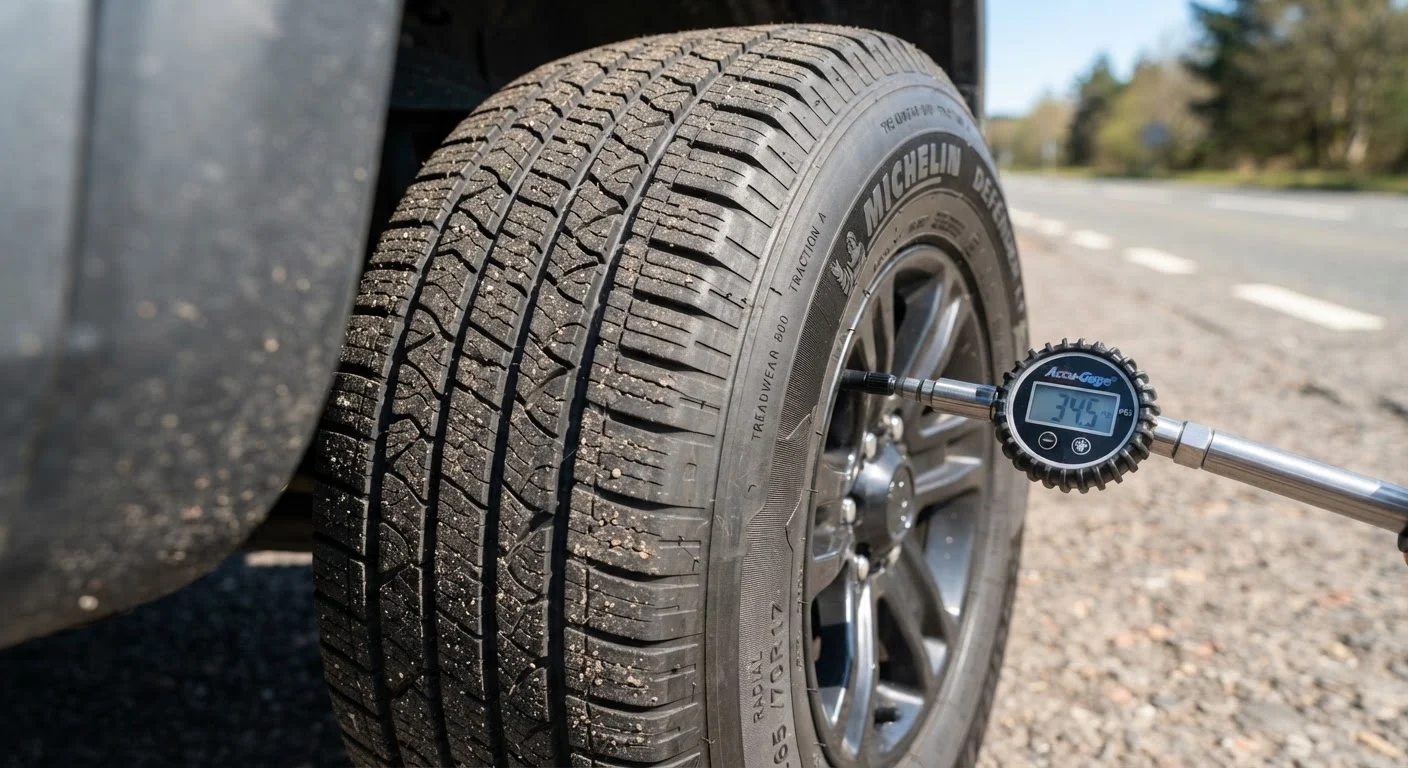
Check pressure when tires are cold — meaning the car has been parked for at least three hours or driven less than a mile. Heat from driving temporarily raises pressure, which can give a misleading reading. A quality digital gauge costs a few dollars and is far more accurate than the dial-type gauges at most gas stations.
Temperature swings matter too. In cold weather, tire pressure drops roughly 1 PSI for every 10-degree Fahrenheit decrease in ambient temperature. That means a tire properly inflated in summer may be noticeably underinflated by January without you ever having a slow leak.
Tread Depth: How to Know When You're Running Out of Grip
Tread is what channels water away from the contact patch and keeps your tires gripping the road in wet conditions. As tread wears down, that ability diminishes — stopping distances increase and hydroplaning risk rises significantly.
The legal minimum tread depth in the U.S. is 2/32 of an inch. A quick way to check: insert a penny into the tread groove with Lincoln's head pointing down. If you can see the top of his head, the tread is at or below 2/32 — time to replace. For a more conservative and safety-conscious benchmark, use a quarter instead: if the top of Washington's head is visible, you're at about 4/32 and should start planning for replacement.
Many tires also have built-in wear indicator bars — small raised ridges molded into the tread grooves. When those bars become flush with the surrounding tread, the tire has reached the legal minimum. Look for them by checking across several grooves around the tire's circumference.
Uneven wear patterns are also informative. Wear concentrated on the center suggests chronic overinflation. Wear on both edges points to underinflation. Wear on one edge often indicates an alignment issue. If you notice any of these patterns, a wheel alignment check may be warranted alongside tire replacement.
Rotation: The Step That Makes Your Tires Last
Front and rear tires wear at different rates. On front-wheel-drive vehicles — the most common configuration in the U.S. — the front tires handle acceleration, steering, and a larger share of braking, so they typically wear faster. Rotation moves tires between positions so wear distributes more evenly across all four.
Most manufacturers and tire industry guidelines recommend rotating every 5,000 to 7,500 miles, though your owner's manual will specify the interval for your vehicle. Many drivers find it convenient to rotate at every other oil change.
Skipping rotation doesn't just shorten tire life — it means you'll likely need to replace tires in mismatched pairs or singles rather than as a full set, which can create handling imbalances and cost more over time. Regular rotation is one of the simplest ways to extend what you've already paid for.
If you drive infrequently, mileage-based intervals still apply, but time matters too. Low-mileage vehicles have their own maintenance considerations, and tires that sit for extended periods can develop flat spots or degrade from age rather than wear.
For a broader look at keeping your vehicle in shape, the fluid maintenance side of the equation pairs well with these tire habits as part of a complete routine.
Building a Simple Tire Check Into Your Routine
None of these checks require a lift or specialized equipment. A tire pressure gauge, a penny or quarter, and about five minutes is all it takes. The challenge isn't technical — it's remembering to do it.
A reliable approach: check pressure and do a visual tread inspection once a month and before any long drive. The pre-road-trip safety check is a natural moment to make this a habit. Schedule rotation when you schedule oil changes so it doesn't slip through the cracks.
Tires aren't glamorous, but they're fundamental. Getting these three basics right — pressure, tread, and rotation — costs almost nothing and pays off in fuel savings, handling confidence, and a reduced chance of being stranded or worse.