

Key Takeaways
Why the Owner's Manual Is the Right Starting Point
Walk into almost any quick-lube shop and you'll see sticker reminders telling you to come back in 3,000 miles. That number isn't pulled from your car's engineering specs - it's a generic interval that predates modern synthetic oils and engine technology. Your vehicle's actual needs are documented in the owner's manual, and they're often less demanding than those reminders suggest. See our breakdown of common maintenance myths for context on how outdated advice costs drivers money.
The manual is written by the engineers who designed the vehicle. It accounts for your specific engine, transmission, and cooling system - not a hypothetical average car. Using it as your primary guide keeps you on schedule without over-maintaining or under-maintaining.
What You Need Before You Start
Gather these items before working through the steps below.
What you will need
How to Find and Use Your Maintenance Schedule
The steps below walk you through locating the right section of your manual and interpreting what it says. Most drivers can complete this in under 20 minutes.
Locate the Maintenance Section
Open your owner's manual and look in the table of contents for terms like Maintenance Schedule, Scheduled Maintenance, or Service Intervals. In most manuals this section falls roughly in the middle or toward the back. Some manufacturers label it under a broader heading like Caring for Your Vehicle.
Identify Which Schedule Applies to You
Most manuals present two service tracks: Normal and Severe (sometimes labeled Special Operating Conditions). Read the descriptions for each. Normal typically means mostly highway driving in moderate climates with few short trips. Severe covers city driving, towing, extreme temperatures, and frequent short trips. Pick the one that honestly matches how you drive.
Read the Interval Table
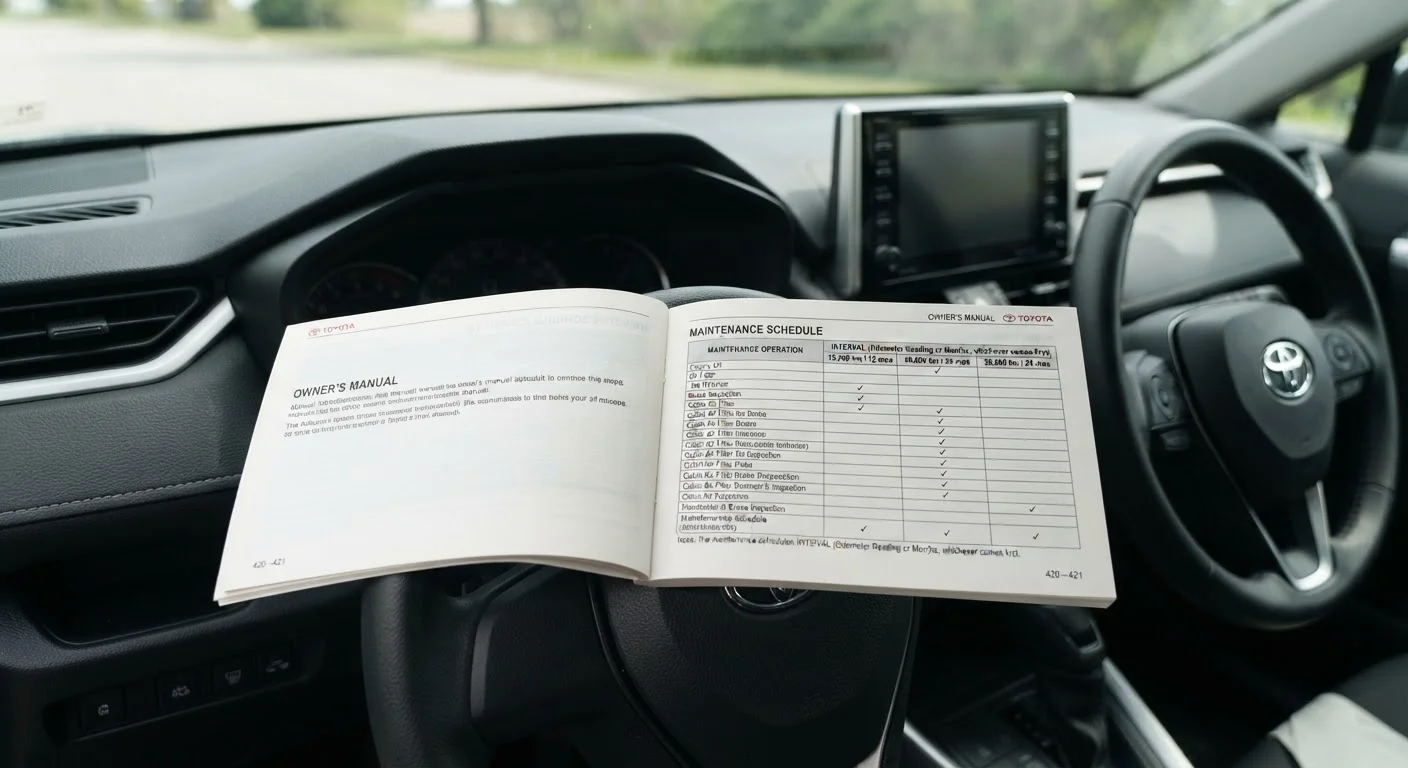
Your schedule will list services in a table or grid, typically organized by mileage milestones (such as every 5,000, 15,000, or 30,000 miles). Each row shows a specific service - oil change, tire rotation, air filter, spark plugs, coolant flush, and so on. Some entries will show both a mileage interval and a time interval (e.g., every 7,500 miles or 12 months, whichever comes first). Note both numbers for each item.
Check Your Current Mileage Against the Schedule
Write down your odometer reading, then compare it to the intervals in the table. Calculate which milestones are approaching. For example, if you're at 28,500 miles and the manual calls for a transmission fluid inspection at 30,000 miles, that service is roughly 1,500 miles away. Flag anything due within the next 3,000 miles so you can schedule it proactively.
Note Any One-Time or Conditional Services
Some items in the schedule only appear once at a specific mileage - timing belt replacement is a common example, often falling between 60,000 and 105,000 miles depending on the manufacturer. Others are conditional, like inspecting brake lines only if you drive in areas where road salt is used. Read through the full table and note any one-time milestones you may be approaching or may have missed.
Can't Find Your Physical Manual?
Most manufacturers post free PDF versions of their owner's manuals on their official websites. Search for your vehicle's year, make, and model plus 'owner's manual PDF.' You can also check the automaker's owner portal, where registered vehicles often have documents stored digitally. Some automakers include a digital manual through an in-vehicle touchscreen or companion app.
Applying What You've Found
Once you've identified your intervals, the practical challenge is staying on top of them over time. Both mileage and time thresholds matter - whichever arrives first triggers the service. A car driven only 4,000 miles in a year may still need an oil change because most manufacturers set a 12-month maximum interval regardless of miles.
If your car is approaching or past 100,000 miles, some maintenance needs shift. High-mileage vehicles often require additional attention to components like spark plugs, coolant, and transmission fluid that earlier intervals may not have addressed as frequently.
For drivers who don't cover much ground each year, time-based intervals become even more important. Low-mileage vehicles have their own maintenance considerations - sitting unused creates problems that mileage-based thinking can miss.
Consider pairing your schedule with a simple service log. Tracking completed maintenance protects your car's value and helps any mechanic understand your vehicle's history quickly. Knowing what a mechanic checks during a routine inspection also helps you follow along and ask informed questions.
Severe vs. Normal Driving Conditions
Many drivers qualify as 'severe' without realizing it. Frequent short trips under 5 miles, stop-and-go city driving, towing, driving in extreme heat or cold, or operating on dusty roads all count. If this describes your daily routine, follow the severe-duty schedule in your manual - it calls for more frequent service intervals and genuinely reflects what your engine is experiencing.