

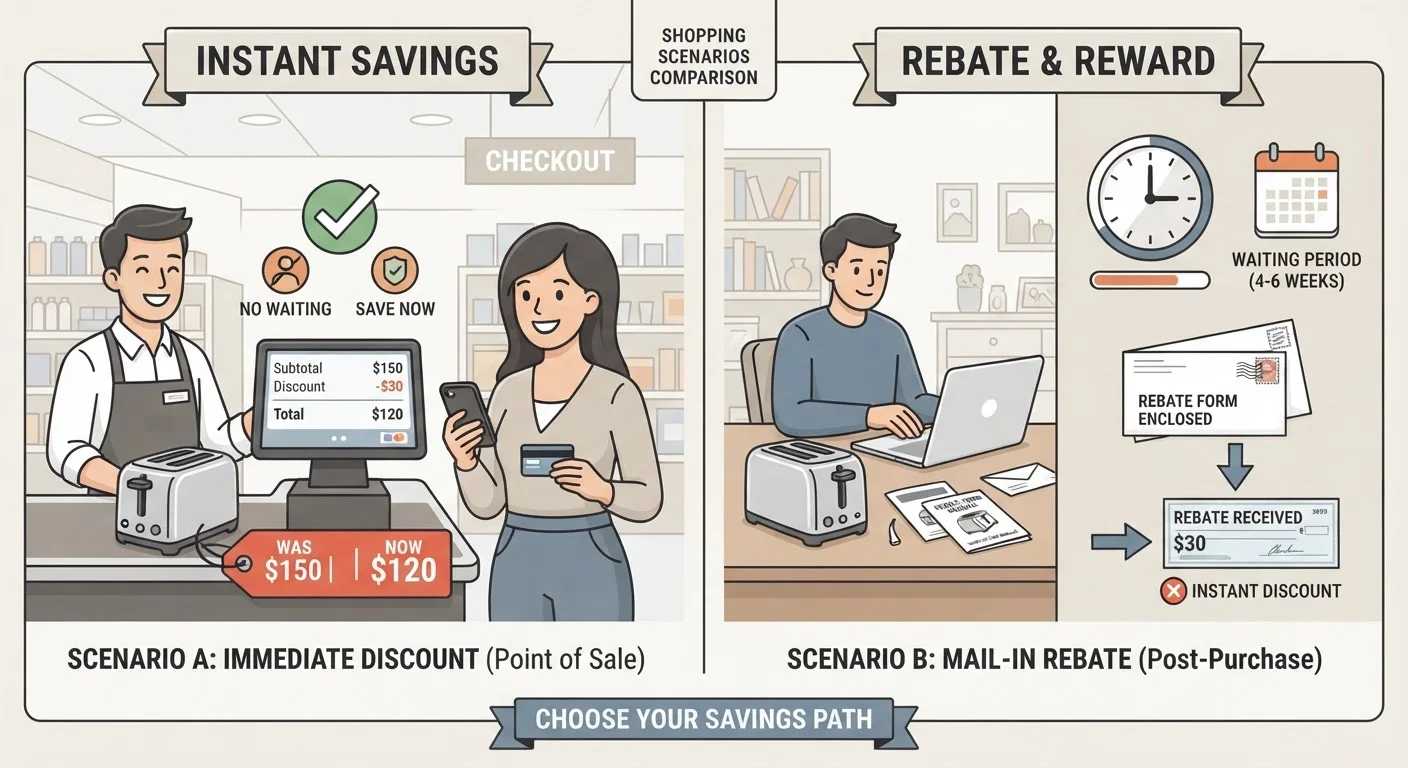
Key Takeaways
Option A
Rebate
The delayed savings that require your participation.
Best for: Shoppers who are organized, patient, and willing to complete post-purchase steps to recover money.
Option B
Instant Discount
The straightforward price reduction applied at point of sale.
Best for: Shoppers who want a lower price immediately, with no follow-up required after checkout.
If you want certainty about the price you'll pay
Instant Discount
The savings are immediate and unconditional - no claim process, no waiting, no risk of missing out.
If you're organized and willing to follow through on paperwork
Rebate
Rebates can offer meaningful savings, especially on big-ticket items, as long as you meet all submission requirements.
If you're comparing two similar offers from different sellers
Instant Discount
An instant discount makes price comparison straightforward; a rebate price requires factoring in redemption likelihood, which isn't guaranteed.
If the rebate amount is substantial and the process is digital
Rebate
Online rebate submission has fewer friction points and less loss risk than traditional mail-in methods, making it worth pursuing for larger amounts.
What Each One Actually Means
Both rebates and instant discounts are mechanisms retailers and manufacturers use to lower the effective price of a product - but they work in fundamentally different ways, and confusing them can cost you.
An instant discount is exactly what it sounds like: the price is reduced before or at the point of sale. You see a lower price on the shelf tag or at checkout, and that reduced price is what gets charged to your card. No action required after you walk out the door.
A rebate is a partial refund paid after you've already purchased at the higher price. You typically pay full retail, then submit a claim - via mail, an online portal, or an app - to receive money back. The savings are conditional on completing that process correctly and on time.
This distinction matters because the advertised price on a rebate offer can look identical to a straight discount, but the actual cash in your pocket depends entirely on what happens after the transaction. As advertised prices don't always reflect what you'll pay, it's worth understanding exactly what type of savings you're being offered.
How They Compare Side by Side
The practical differences go beyond timing. Rebates and instant discounts diverge on risk, effort, and how they affect your immediate cash flow.
| Criterion | Rebate | Instant Discount |
|---|---|---|
| When savings are received | Weeks or months after purchase | Immediately at checkout |
| Upfront cost to buyer | Full price paid first | Reduced price paid directly |
| Buyer effort required | Claim submission required | None after purchase |
| Risk of not saving | High - missed deadlines or errors void claim | None - savings are automatic |
| Cash flow impact | You're out-of-pocket until refund arrives | No float period |
| Certainty of savings | Conditional on successful redemption | Guaranteed at point of sale |
One underappreciated factor is the concept of breakage - an industry term for rebates that are offered but never successfully redeemed. Some estimates suggest a significant share of mail-in rebates go unclaimed, either because buyers forget, miss deadlines, or have submissions rejected on technicalities. That unredeemed value stays with the seller, not you.
Instant discounts carry none of that risk. The savings are locked in at checkout. This is especially relevant if you're trying to make an accurate price-versus-value assessment before buying.
The Hidden Complexity of Rebates
Rebates are not inherently bad - they can represent genuine savings, particularly on large purchases like appliances, electronics, or automotive products. But they come with conditions that shoppers often underestimate.
Common rebate requirements include: submitting within a narrow window (sometimes as short as 30 days from purchase), providing original receipts or UPC barcodes, registering on a specific platform, or purchasing a qualifying combination of products. Missing any single requirement can void the entire claim.
Watch for Expiration Dates and Fine Print
Rebate offers frequently include submission windows, product eligibility restrictions, and limits on the number of claims per household. These terms are typically disclosed in the offer's terms and conditions, not the headline advertising. Before purchasing based on a rebate price, read the full requirements to confirm you can realistically complete the claim. If the process feels overly complicated, factor that friction into your decision.
It's also worth noting that rebates often serve a strategic purpose for sellers: they allow a product to be marketed at a lower "after-rebate" price while the seller collects full revenue from buyers who don't complete the process. This is why pricing psychology matters - the advertised savings figure can feel more concrete than it actually is.
If you do pursue a rebate, treat it like a task with a deadline: photograph all required documents immediately, submit as early as the window allows, and follow up if confirmation isn't received within the stated timeframe.
Making the Right Call for Your Situation
Neither format is universally superior - context determines which one works in your favor. An instant discount is always simpler and more certain. A rebate can be worth pursuing when the dollar amount justifies the effort and you have the organizational discipline to see it through.
Where shoppers go wrong is treating the after-rebate price as equivalent to an instant discount. They're not the same. One is a guarantee; the other is a best-case outcome dependent on your follow-through and the seller honoring the terms.
Be especially cautious when comparing a rebate offer against a competitor's instant discount. The rebate price is a conditional projection; the instant discount is a fact. That asymmetry is easy to overlook in the moment - particularly when reference prices are used to make a deal look more compelling than it really is.
If you're prone to reactive purchasing decisions, a rebate adds another layer of risk: you may buy based on the anticipated savings, then never complete the claim. Intentional shoppers who plan ahead are better positioned to benefit from rebate structures.