

Key Takeaways
The Reference Price Problem
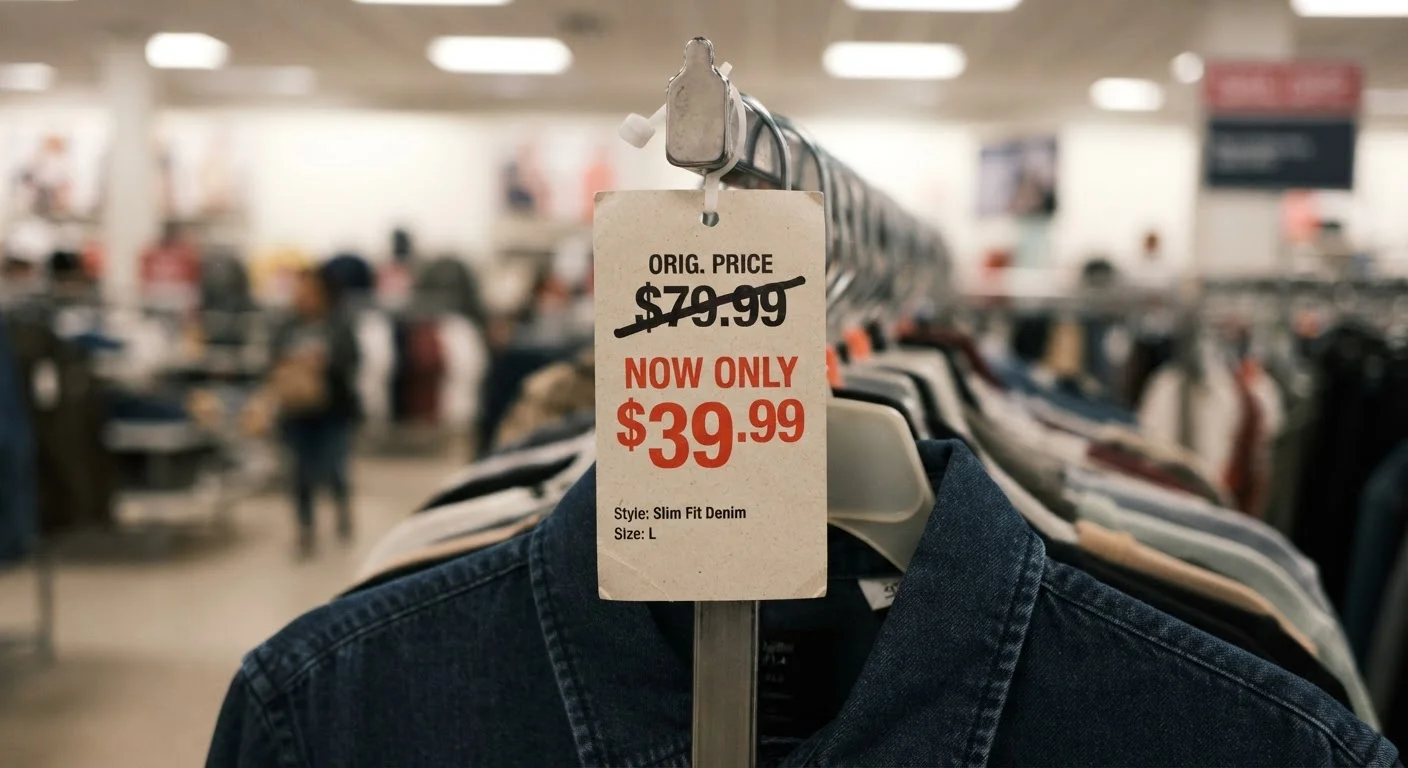
Walk through any major retailer and you'll see them everywhere: price tags with a high number crossed out and a lower "sale" price printed boldly beneath it. The implicit promise is simple - you're saving the difference. But that crossed-out number, often labeled "regular price," "original price," or "compare at," is frequently not what most shoppers ever paid. In many cases, it was set high specifically to make the discount look impressive.
This practice - sometimes called reference pricing or price anchoring - works because the human brain instinctively treats the first number it sees as the benchmark for value. Once you see $200 struck through, $120 feels like a genuine gain even if the item has sold at $120 or below for most of its market life. Understanding this mechanism is the first step toward evaluating deals on their actual merits. For a deeper look at how this works psychologically, see how anchoring and decoy pricing shape perceived value.
Common Myths - and the Reality Behind Them
Shoppers carry several persistent assumptions about sale pricing that retailers, sometimes unintentionally and sometimes by design, allow to persist. The myth-and-fact pairs below address the most consequential ones.
Myth
If a tag shows a crossed-out price, that was the price shoppers actually paid before the sale.
Fact
Many reference prices are set at a level the item was rarely or never sold at, functioning primarily as a visual anchor.
Retailers can legally set a "regular" price by briefly offering an item at that level - sometimes for only a short window - before immediately discounting it. The resulting tag looks like a markdown from normal retail reality, but the high price was never the actual market price. Shoppers have no straightforward way to verify this from the tag alone.
Myth
"Compare at" prices mean the store verified what competitors charge for the identical product.
Fact
"Compare at" typically references a similar or comparable item, not an identical one, and the comparison methodology is rarely disclosed.
Stores use "compare at" tags with significant flexibility. The referenced product may differ in construction quality, features, or brand tier. Without transparency about the comparison methodology, shoppers have little basis to treat these figures as reliable market benchmarks. They are better read as aspirational framing than verified data.
Myth
Government regulations prevent retailers from inflating reference prices deceptively.
Fact
Rules exist, but enforcement is inconsistent, and many practices that feel deceptive remain technically compliant.
FTC guidance and various state laws do prohibit clearly fictitious reference prices, but regulators typically respond to patterns of complaints rather than monitoring individual tags proactively. Legal thresholds - like how briefly an item must be offered at the original price to count as a "former price" - vary by jurisdiction and are not always strict. The result is a patchwork of protection that places significant responsibility on the individual shopper's skepticism. Sale pricing psychology explains the broader retail tactics at play.
Myth
A bigger percentage discount always means a better deal.
Fact
Percentage savings are only meaningful if the reference price reflects genuine market value.
A 60% discount from an inflated anchor can leave you paying more than you would at a competing store with no sale at all. The percentage figure amplifies whatever number it starts from - so an inflated starting point produces an inflated-sounding discount. The relevant question is not "how much off?" but "compared to what?" and whether that comparison reflects real transaction history.
Myth
If a sale has been running for weeks, the discount must be legitimate.
Fact
Extended "sales" are a common signal that the sale price is actually the everyday price, with the higher reference figure maintained for framing purposes.
Perpetual sales - promotions that roll over week after week without meaningful interruption - effectively redefine the regular price downward while preserving the appearance of a deal. If you notice an item is always on sale whenever you check, the sale price is almost certainly the market price, and the crossed-out figure is structural rather than historical.
What the Rules Actually Say
The Federal Trade Commission (FTC) publishes guidance stating that a "former price" comparison is deceptive if the item was not actually offered at that price for a reasonably substantial period. Many states have their own reference-pricing statutes on top of that. The challenge is that enforcement is reactive - regulators typically act after complaints accumulate, not before a tag is printed. Retailers also exploit grey areas: an item briefly offered at a high price, then marked down immediately, may technically satisfy the letter of the law while violating its spirit.
"Compare at" tags add another layer of ambiguity. These don't claim the store ever sold the item at the higher price - only that a comparable item sells elsewhere for more. The comparison item may differ in materials, features, or quality, making a direct apples-to-apples assessment difficult. This is a separate but related issue covered in why advertised prices don't always match the checkout total.
How to Evaluate Whether a Price Drop Is Real
The most practical approach is to stop comparing the sale price to the crossed-out number and instead compare it to independent market data.
- Use price-tracking tools. Several browser extensions and websites log historical pricing for online retailers. If an item has sold at or near the "sale" price for months, the discount framing is largely cosmetic.
- Search the model number or item name directly. A quick search often surfaces the same or equivalent product at competing retailers, giving you a real market reference point rather than a store-constructed one.
- Note how long the sale has run. A "limited time" sale that appears unchanged week after week is a signal that the sale price is effectively the regular price.
- Evaluate cost over time, not just sticker price. A lower sale price on an item with high ongoing maintenance costs may not represent genuine savings. Hidden costs that make a good deal expensive over time explores this in detail.
Ultimately, a deal is only real if the price is genuinely below what you would otherwise pay for comparable quality and utility - a point developed further in price vs. value.