

Key Takeaways
Option A
Tankless Water Heater
The on-demand, space-saving modern option.
Best for: Homeowners who want long-term efficiency and have consistent hot water demand from multiple fixtures.
Option B
Traditional (Storage Tank) Water Heater
The reliable, familiar workhorse of American homes.
Best for: Homeowners seeking lower upfront costs and straightforward installation with predictable maintenance.
If you want lower upfront installation costs
Traditional (Storage Tank) Water Heater
Tank water heaters typically cost significantly less to purchase and install, making them the more accessible option for budget-conscious homeowners.
If you want the unit to last as long as possible
Tankless Water Heater
With proper maintenance, tankless units commonly last 20 years or more - roughly twice the lifespan of a traditional tank heater.
If you have a large household with simultaneous hot water needs
Traditional (Storage Tank) Water Heater
A properly sized tank can supply multiple fixtures at once without flow-rate limitations that can challenge single tankless units.
If energy efficiency and long-term operating costs matter most
Tankless Water Heater
Tankless heaters eliminate standby heat loss - the energy wasted keeping a tank hot around the clock - which can meaningfully reduce utility bills over time.
If you're a new homeowner who wants simple, low-complexity upkeep
Traditional (Storage Tank) Water Heater
Tank heaters involve straightforward annual maintenance tasks, such as flushing sediment, that careful homeowners can often handle themselves.
How Each System Works
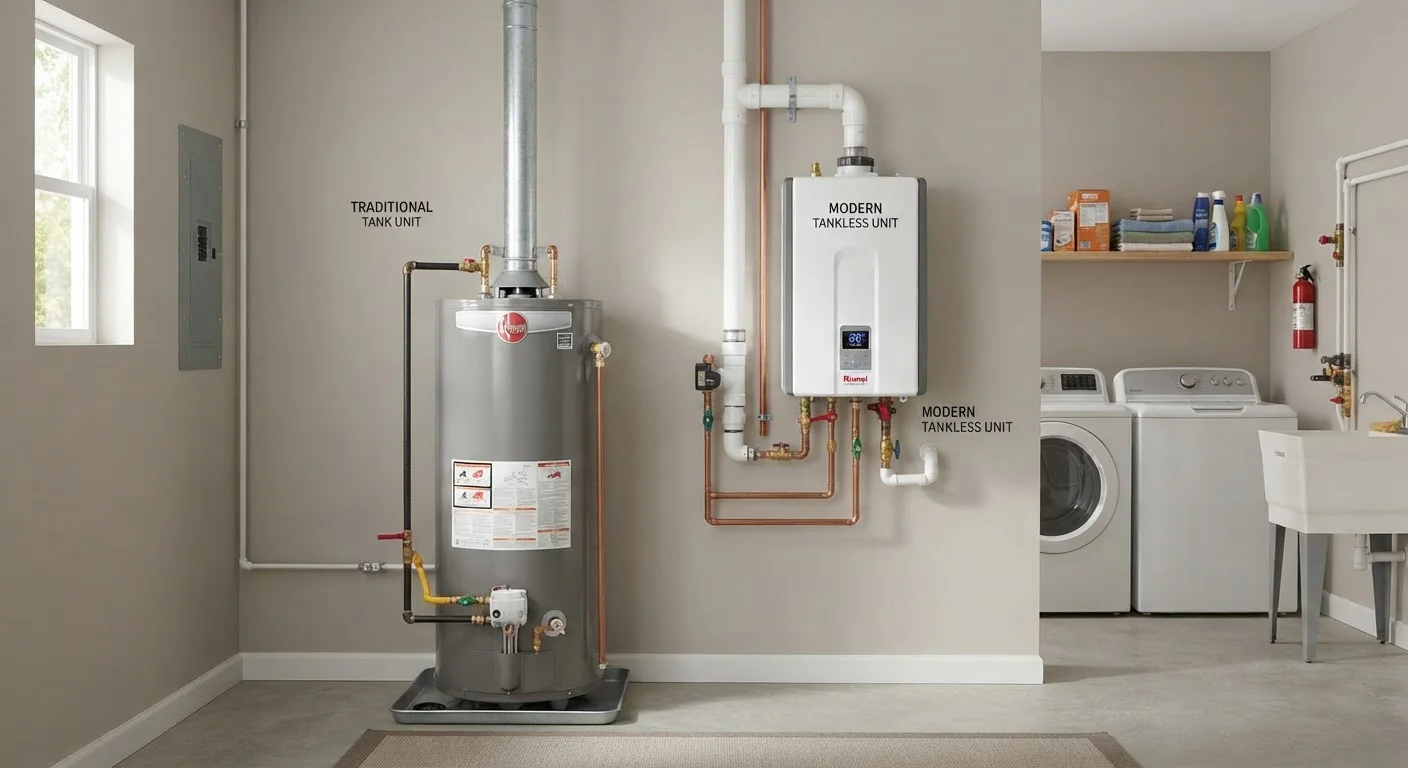
The most fundamental difference between these two systems is when they heat water. A traditional storage tank water heater maintains a reservoir - typically 30 to 80 gallons - at a set temperature continuously, so hot water is ready whenever you turn on a tap. The trade-off is standby heat loss: energy is consumed around the clock simply to keep that stored water hot, even when no one is home.
A tankless water heater (also called an on-demand or instantaneous heater) has no storage reservoir. Instead, cold water flows through a heat exchanger - powered by gas or electricity - and is heated only when a hot water tap is opened. Once the tap closes, the heater shuts off entirely. This eliminates standby heat loss but introduces a potential limitation: flow rate. A single tankless unit has a maximum gallons-per-minute (GPM) output, which can be strained when multiple fixtures run simultaneously.
Understanding this core difference sets the stage for every other trade-off covered below. For a broader look at how two technologies can serve the same purpose in different ways, see our article on how hybrid and plug-in hybrid vehicles compare.
Maintenance Requirements: What Each System Demands
Both types of water heaters require routine upkeep - skipping it shortens lifespan and increases the risk of failure. The tasks differ, though, so it helps to know what each system expects of you.
| Criterion | Tankless Water Heater | Traditional Tank Heater |
|---|---|---|
| Upfront cost | Higher ($800-$1,500+ installed) | Lower ($400-$900 installed) |
| Typical lifespan | 20+ years | 8-12 years |
| Standby energy loss | None | Continuous |
| Hot water supply | Unlimited (within flow rate) | Limited to tank capacity |
| Key annual maintenance | Descaling, filter cleaning | Flushing, anode rod check |
| Installation complexity | Higher (may need upgrades) | Lower (straightforward swap) |
| Space required | Minimal (wall-mounted) | Significant floor footprint |
Traditional Tank Heater Maintenance
- Annual flushing: Sediment - especially calcium and magnesium minerals - settles at the bottom of the tank over time. Flushing the tank once a year removes this buildup, which can otherwise insulate the heating element and force the unit to work harder. Our guide on plumbing maintenance tasks homeowners can handle themselves covers how to flush a tank safely.
- Anode rod inspection: A sacrificial anode rod (a metal rod inside the tank) corrodes in place of the tank lining. It should be inspected every 2-3 years and replaced when significantly corroded - typically every 4-5 years.
- Temperature and pressure (T&P) relief valve test: This safety valve releases pressure if the tank overheats. It should be tested annually per manufacturer guidance. If it sticks or leaks, have a licensed plumber replace it.
Tankless Unit Maintenance
- Annual descaling (vinegar flush): In hard-water areas, mineral scale builds inside the heat exchanger. Descaling with a diluted vinegar solution - using a pump flush kit - is recommended annually. Skipping this can significantly reduce efficiency and eventually damage the unit.
- Inlet filter cleaning: Tankless units have small screens at the cold-water inlet that catch debris. These should be checked and rinsed every 6-12 months.
- Venting inspection (gas units): Gas-powered tankless heaters require proper venting. Inspect vent pipes annually for blockages, corrosion, or disconnection, and have a licensed technician service the burner assembly periodically.
These tasks are easy to overlook - water heater upkeep is among the maintenance items new homeowners most commonly miss.
Lifespan, Costs, and Practical Trade-Offs
Lifespan is one of the clearest differentiators. Traditional tank water heaters typically last 8 to 12 years with proper maintenance, while tankless units commonly reach 20 years or more. That longer life can offset the higher upfront cost of a tankless system, though the math depends on your local energy costs, water hardness, and how well you maintain the unit. Our framework for weighing long-term durability against upfront cost can help you think through that trade-off more systematically.
8-12 yrs
Average lifespan of a storage tank heater
The U.S. Department of Energy notes that storage water heaters typically last 8 to 12 years, depending on maintenance and water quality.
20+ yrs
Expected lifespan of a tankless unit
The U.S. Department of Energy indicates that tankless water heaters can last more than 20 years when properly maintained.
Up to 34%
Potential energy savings for homes using under 41 gallons daily
According to the U.S. Department of Energy, tankless heaters can be 24-34% more energy efficient than conventional storage tank heaters in homes with lower hot water demand.
Installation cost is a significant factor when switching systems. Replacing a tank unit with another tank unit is generally straightforward. Converting to tankless, however, often requires upgrades to gas lines or electrical panels, which must be performed by licensed professionals. Permits and inspections are typically required - always verify local code requirements before starting any water heater project.
It's also worth noting that a water heater replacement can have ripple effects on a home's overall value and appeal. For a grounded perspective on which home upgrades actually move the needle, see common myths about what adds home value.