

Key Takeaways
Option A
Standard Hybrid (HEV)
The self-sufficient fuel-saver that charges itself.
Best for: Drivers who want better fuel economy without changing any habits or installing charging equipment.
Option B
Plug-In Hybrid (PHEV)
The bridge between a conventional car and a full electric vehicle.
Best for: Drivers who can charge at home and want to run primarily on electricity for shorter daily trips.
If you want better fuel economy with zero lifestyle changes
Standard Hybrid (HEV)
It requires no charging equipment and no new habits - just fill up with gas as usual and let the car manage its own battery.
If you have a short daily commute and can charge at home
Plug-In Hybrid (PHEV)
You could complete most weekday driving on electricity alone, dramatically cutting fuel costs for everyday use.
If you frequently drive long distances without predictable charging access
Standard Hybrid (HEV)
Without reliable charging opportunities, the PHEV's larger battery goes underused, and you lose the cost advantage without gaining much.
If you want a stepping stone toward full electric vehicle ownership
Plug-In Hybrid (PHEV)
A PHEV lets you get comfortable with electric driving and home charging while retaining a gas engine as a backup safety net.
The Core Difference: Where the Energy Comes From
Both types of hybrids combine a gasoline engine with an electric motor, but the way they manage energy is fundamentally different - and that difference shapes everything about how you'd live with each one.
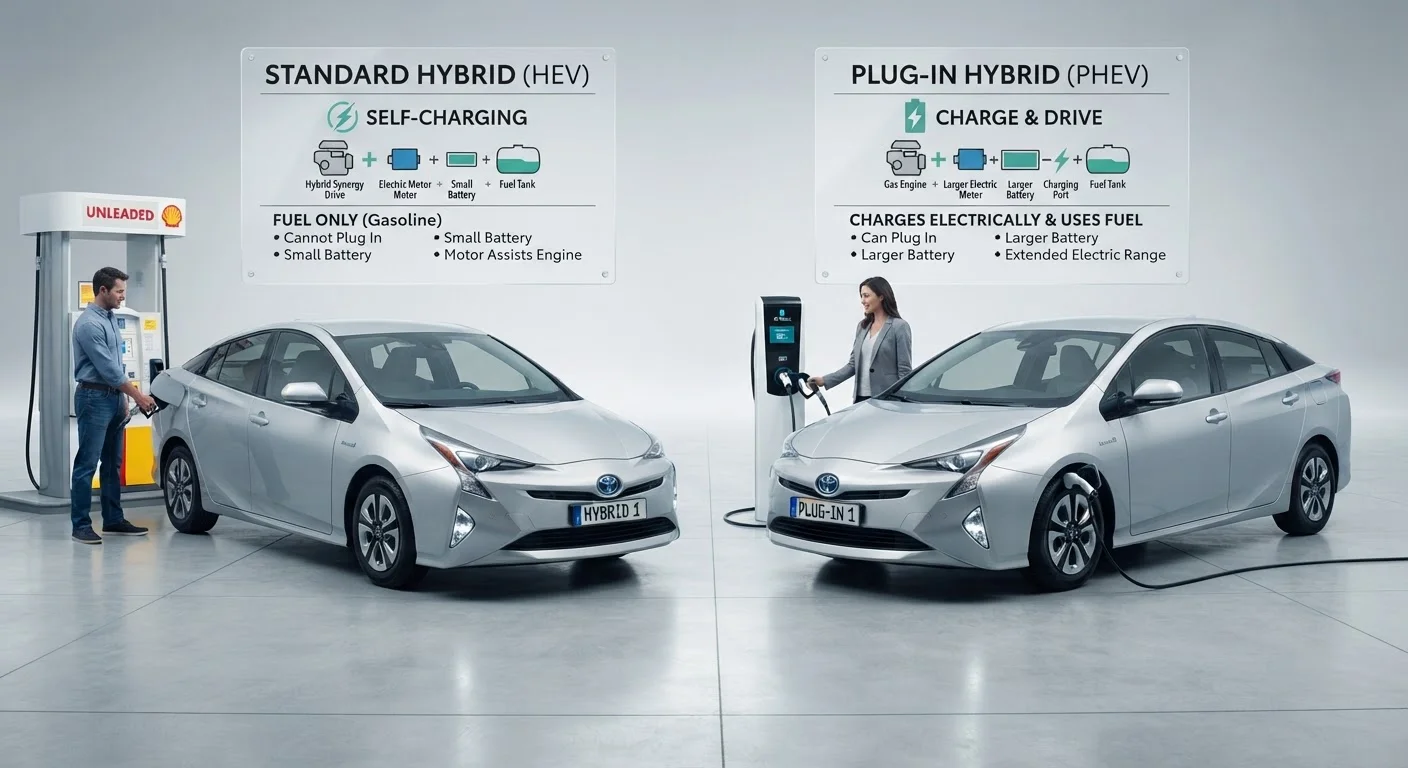
A standard hybrid (sometimes called an HEV, or hybrid electric vehicle) generates all of its own electricity internally. The battery charges through two main processes: the gas engine itself powers a generator while driving, and regenerative braking captures kinetic energy when you slow down and converts it back into electricity. You never connect it to a power outlet. The system manages the battery automatically, and the electric motor assists the gas engine to improve efficiency - especially in stop-and-go traffic.
A plug-in hybrid (PHEV) does everything a standard hybrid does, but it carries a significantly larger battery pack that can also be charged from an external power source - a standard household outlet or a dedicated EV charger. That bigger battery enables something a standard hybrid can't offer: a meaningful stretch of all-electric driving, typically somewhere between 20 and 50 miles depending on the vehicle, before the gas engine activates.
Think of it this way: a standard hybrid uses electricity as a fuel-economy helper, while a plug-in hybrid uses electricity as a primary fuel source - with gasoline serving as a long-range backup.
How Each One Handles Real-World Driving
In day-to-day use, a standard hybrid feels completely conventional. You fuel up at a gas station, and the car quietly shuffles power between the gas engine and electric motor without requiring any input from you. Fuel economy improvements are real and consistent - hybrids tend to shine most in city driving, where frequent stops feed regenerative braking.
A PHEV behaves differently depending on how you use it. If you charge it regularly and your daily driving falls within its electric range, you may go days or even weeks between gas fill-ups. Once the battery depletes, it operates essentially like a standard hybrid, so long trips are never a problem. The catch is that you need to actually plug it in to get the full benefit. A PHEV that's never charged is just a heavier, more expensive standard hybrid.
| Criterion | Standard Hybrid (HEV) | Plug-In Hybrid (PHEV) |
|---|---|---|
| Battery charging method | Self-charging via engine and braking | External outlet plus self-charging |
| All-electric driving range | None (electric assists only) | Typically 20-50 miles |
| Battery size | Small | Larger |
| Requires home charging | No | Optional but recommended |
| Upfront cost | Lower than PHEV | Higher than HEV |
| Fuel savings potential | Moderate, consistent | High, if charged regularly |
| Best driving environment | City stop-and-go traffic | Short daily commutes with charging access |
It's also worth noting that both technologies use the same general drivetrain approach. If you're curious how that interacts with transmission design, see our guide to transmission types - many hybrids use CVT or electronically controlled automatic systems specifically tuned for hybrid operation.
Cost, Charging, and Practical Considerations
Standard hybrids typically cost less upfront than comparable PHEVs. The larger battery in a plug-in hybrid adds manufacturing cost, and that's reflected in the sticker price. However, PHEVs have historically been eligible for federal tax credits in the U.S. - something worth researching based on current tax law, since eligibility rules and credit amounts change over time. Consult a tax professional or official IRS guidance for current details.
Charging a PHEV at home is straightforward for most people. A standard 120-volt household outlet (called Level 1 charging) will recharge most PHEV batteries overnight. A 240-volt Level 2 charger speeds that up significantly. If you live in an apartment or lack a dedicated parking spot with outlet access, a PHEV's core advantage largely disappears.
What Happens If You Never Plug In a PHEV?
A plug-in hybrid will still function if you never charge it - it simply operates as a less efficient standard hybrid, because the larger battery adds weight without contributing much fuel-saving benefit. The vehicle won't be harmed, but you won't be getting the value you paid for. If reliable charging access isn't realistic for your situation, a standard hybrid may be the more practical choice.
Maintenance is broadly similar for both. Neither requires the specialized high-voltage battery service that a full electric vehicle might need on a shorter cycle, and both retain conventional components like a gas engine, exhaust system, and standard brakes (though the regenerative braking system does reduce brake wear). If you're weighing the full electric path, our introduction to electric vehicles covers what changes when you remove the gas engine entirely.