

Key Takeaways
Start here
How an Electric Vehicle Actually Works
Next
The Battery Pack: The Heart of the EV
Then
Charging at Home and on the Road
When you're ready
What Ownership Actually Feels Like
Wrap up
Common Concerns, Honestly Addressed
How an Electric Vehicle Actually Works
A conventional gasoline car burns fuel inside an engine to create the force that moves the wheels - a process covered in detail in our explanation of the four-stroke engine cycle. An electric vehicle skips all of that. Instead of an engine, an EV uses one or more electric motors that are powered directly by electricity stored in a large battery pack.
When you press the accelerator, the motor converts electrical energy into rotational force almost instantly. That's why EVs feel so responsive off the line - there's no delay waiting for an engine to rev up. The absence of a traditional multi-speed transmission (see our overview of transmission types) also simplifies the drivetrain considerably.
One distinctive feature is regenerative braking. When you lift your foot off the accelerator or apply the brakes, the motor runs in reverse - acting as a generator that converts the vehicle's momentum back into electricity and sends it to the battery. This is why EV brake pads tend to last longer than those on gas vehicles.
Electric motor
A device that converts electrical energy into mechanical rotation. In an EV, it replaces the internal combustion engine as the source of driving force.
Kilowatt-hour (kWh)
The unit used to measure how much energy an EV battery can store. A higher number generally means more range, similar to a larger fuel tank.
Regenerative braking
A system that recovers energy during deceleration by running the electric motor in reverse, acting as a generator that recharges the battery.
Level 2 charging
A 240-volt charging setup - the most common home option - that can fully charge most EVs overnight and is much faster than a standard wall outlet.
DC fast charging
High-powered public charging stations that can add significant range in under an hour, making them useful for long-distance travel stops.
Battery thermal management
The system inside an EV that heats or cools the battery pack to keep it within its ideal operating temperature range, protecting longevity and performance.
The Battery Pack: The Heart of the EV
The battery pack in an EV is not a single battery - it's a large assembly of thousands of individual lithium-ion cells arranged into modules. This pack is typically mounted flat under the floor of the vehicle, which lowers the center of gravity and frees up interior space.
Battery capacity is measured in kilowatt-hours (kWh) - think of it like a fuel tank, except instead of gallons it holds a unit of electrical energy. A larger kWh number generally means more range, but weight and efficiency matter too.
Battery packs are built to last well beyond the initial ownership period. Manufacturers typically warrant them for eight years or 100,000 miles, and real-world data suggests most packs retain the large majority of their capacity over that time. Extreme heat and frequent use of the fastest charging speeds can accelerate wear, which is why most EVs have thermal management systems that regulate battery temperature automatically.
Charging at Home and on the Road
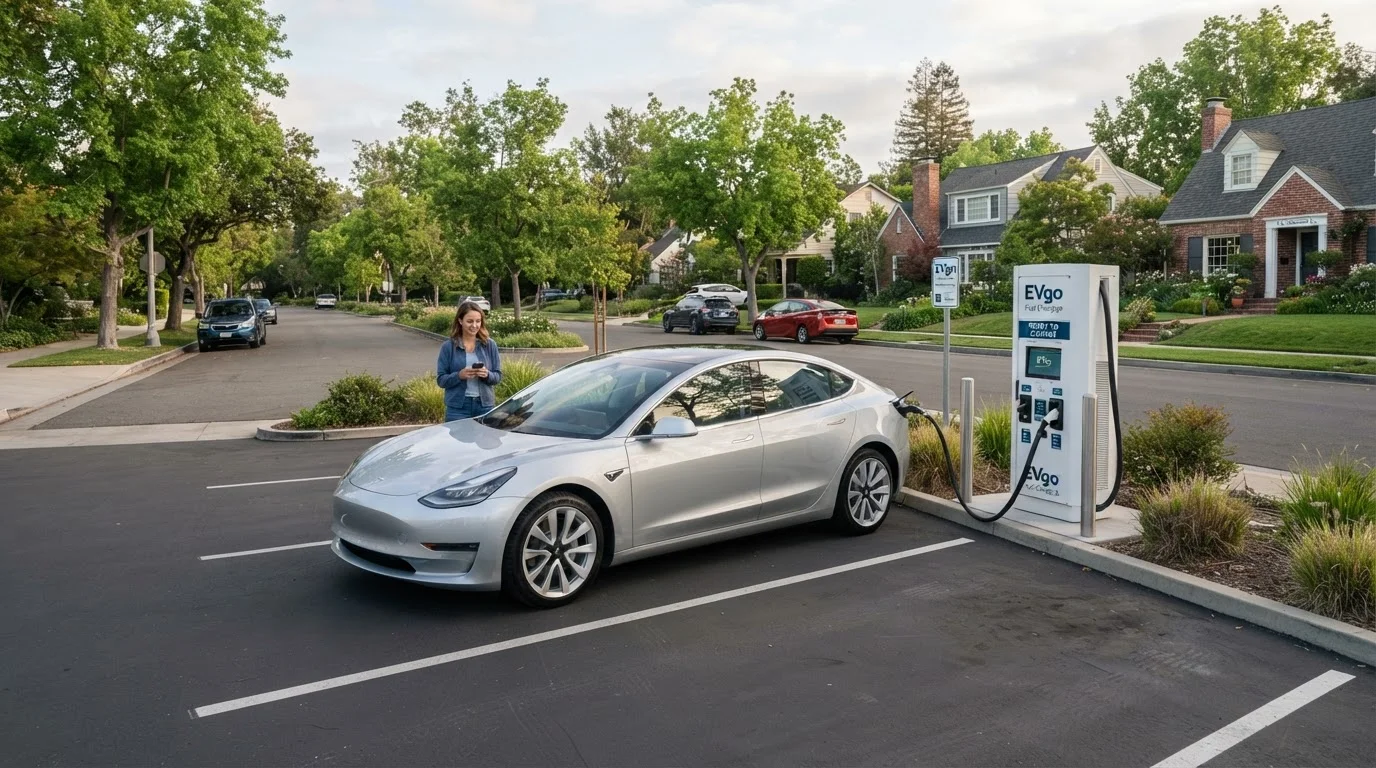
Charging is where EV ownership diverges most sharply from the gas station experience - and for most drivers, that turns out to be a good thing. The three levels of charging differ mainly in speed:
- Level 1 (120V): A standard household outlet. Adds roughly 3-5 miles of range per hour. Slow, but workable if you don't drive far each day.
- Level 2 (240V): A dedicated home charger or public station. Adds 15-30 miles per hour. Most home EV owners install one of these.
- DC Fast Charging (Level 3): Found at public charging stations along highways. Can add 100-200+ miles in 20-40 minutes depending on the vehicle.
For everyday driving, most EV owners simply plug in overnight and wake up to a full charge. Long road trips require more planning - particularly identifying fast-charging stops along your route. Our road trip planning primer includes practical advice on route preparation that applies whether you're driving gas or electric.
Make Charging Part of Your Parking Habit
The easiest way to adapt to EV ownership is to treat charging like locking the doors - just something you do when you park. Plug in whenever you're home for an extended period, and you'll rarely need to think about range. Most EV owners find they visit public chargers far less often than they expected.
What Ownership Actually Feels Like
Day-to-day EV ownership is quieter - literally. Without an engine firing cylinders, the cabin is noticeably more hushed at lower speeds. Acceleration is smooth and linear. Many drivers describe the experience as simpler, particularly since there are no gear shifts and far fewer decisions to make about the powertrain.
Maintenance is genuinely reduced. There's no oil to change, no spark plugs to replace, and no exhaust system to worry about. You'll still rotate tires, replace cabin air filters, and top up windshield washer fluid. Brakes last longer due to regenerative braking, but they still need periodic inspection. For a broader look at routine vehicle upkeep, the car maintenance hub is a useful reference.
One area requiring adjustment is how you think about fueling. Rather than visiting a gas station once a week, you integrate charging into your parking routine - at home, at work, or at public locations while shopping or dining.
Common Concerns, Honestly Addressed
Range anxiety - the fear of running out of charge - is the most commonly cited hesitation about EVs. It's worth taking seriously rather than dismissing. The practical reality is that the average American drives fewer than 40 miles per day, well within the range of virtually every EV on the market. Anxiety tends to decrease significantly once drivers have a few weeks of real-world experience and understand their own patterns.
EVs are also not the same as hybrids. A hybrid pairs a gasoline engine with an electric assist system; it never needs to be plugged in. A plug-in hybrid can run on electricity for a limited range but also has a gas engine for longer trips. A fully electric vehicle has no gasoline engine whatsoever. If you want to explore those middle-ground options, our comparison of hybrid and plug-in hybrid technology breaks down how those systems differ.
Finally, the electrical grid question comes up often. EVs do shift energy consumption from oil to electricity, and the environmental impact depends in part on how that electricity is generated regionally. This is a legitimate consideration, and honest EV conversations acknowledge it rather than glossing over it.
For anyone curious about the terminology involved - kilowatt-hours, torque, drivetrain - our guide to commonly misunderstood automotive terms can fill in the gaps.