

Key Takeaways
Four-Stroke Engine Cycle
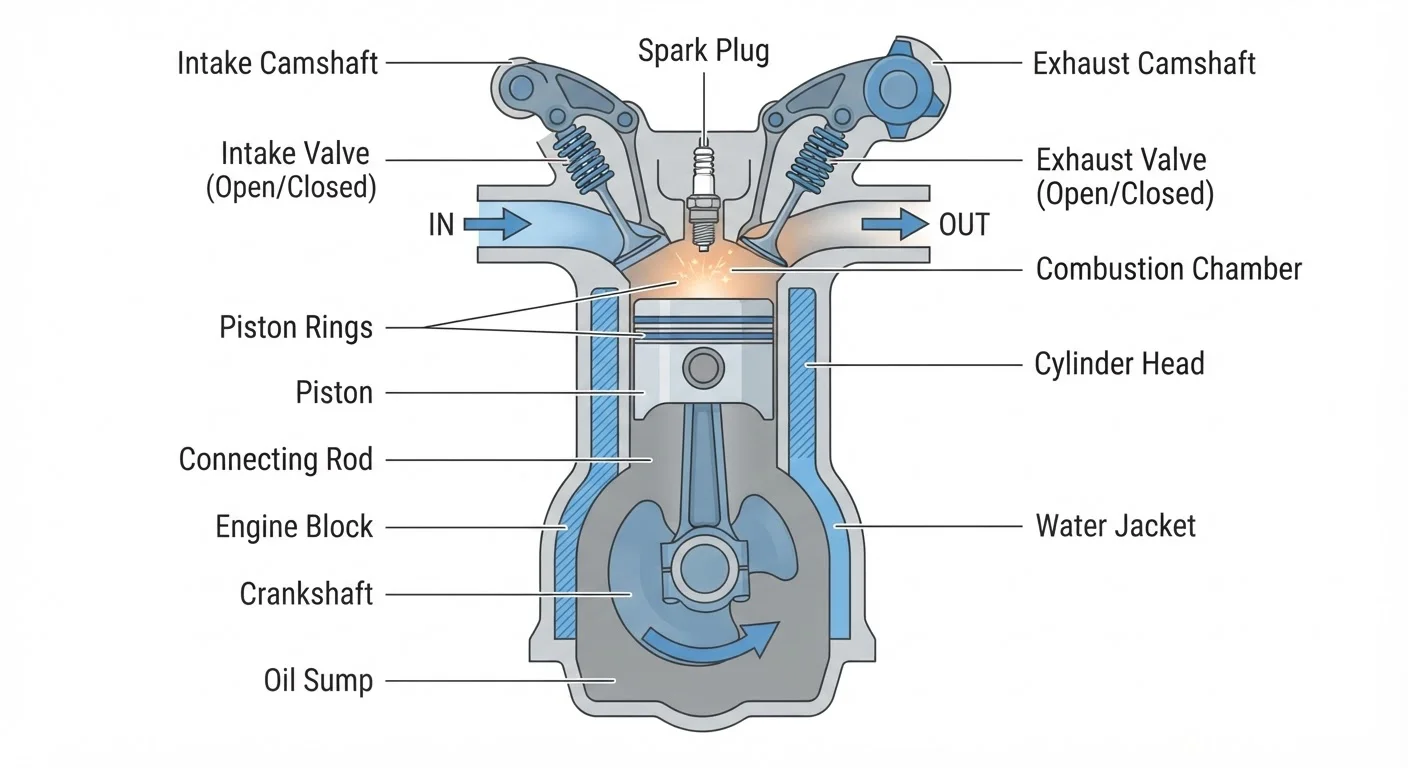
A four-stroke engine cycle is the repeating sequence of events that converts gasoline and air into the mechanical energy that moves your car. It happens inside each cylinder of your engine, thousands of times every minute. The four strokes are intake, compression, combustion (also called power), and exhaust - and they repeat continuously as long as your engine is running.
Each 'stroke' refers to one complete up-or-down movement of the piston inside the cylinder; two full rotations of the crankshaft complete all four strokes.
Why This Matters to You as a Driver
You don't need to rebuild an engine to understand how one works. But having a basic mental picture of what's happening under your hood pays off in practical ways - it helps you understand why maintenance matters, what warning signs mean, and how engineers arrive at numbers like horsepower and torque.
Gasoline engines have been refined for over a century, but the fundamental process hasn't changed much. Every time you turn the key or press the start button, your engine begins spinning through the same four-step cycle across multiple cylinders, producing the power that eventually reaches your wheels. Here's what's actually going on.
If you want to see how power gets from the engine to the road after that, our guide to transmission types picks up right where this article leaves off.
The Four Strokes, One at a Time
Stroke 1: Intake
The piston starts at the top of the cylinder and moves downward. As it does, an intake valve opens and the cylinder draws in a carefully measured mixture of air and gasoline. Think of it like inhaling - the cylinder is pulling in its 'breath' before any work happens. The intake valve then closes, sealing the mixture inside.
Stroke 2: Compression
With both valves closed, the piston moves back up, squeezing the air-fuel mixture into a much smaller space. This compression is critical - a tighter squeeze means a more powerful explosion when ignition happens. This is what your engine's compression ratio measures: how much the mixture is compressed before ignition. Higher compression generally means more power and efficiency, though it also means the engine typically needs higher-octane fuel.
Stroke 3: Combustion (Power)
At the top of the compression stroke, the spark plug fires a tiny electrical spark. That spark ignites the compressed air-fuel mixture, causing a rapid, controlled expansion - not quite an explosion in the dramatic sense, but a fast burn. The expanding gases push the piston forcefully downward. This is the only stroke that actually produces power; the other three exist to set it up and clean up after it.
A Quick Way to Remember the Sequence
Many mechanics remember the four strokes with the phrase 'Suck, Squeeze, Bang, Blow' - informal, but effective. It maps directly to intake (suck in the mixture), compression (squeeze it), combustion (the controlled bang), and exhaust (blow out the spent gases). It's not polished, but once you hear it, you won't forget the order.
Stroke 4: Exhaust
With the power stroke complete, the exhaust valve opens and the piston travels back up, pushing the spent gases out of the cylinder and into the exhaust system - which eventually routes them through your catalytic converter and out the tailpipe. The exhaust valve closes, the intake valve opens again, and the whole cycle begins anew.
How Multiple Cylinders Work Together
A single cylinder firing once every two crankshaft rotations would produce very rough, choppy power - like pedaling a bike with only one leg. Real engines solve this with multiple cylinders, each at a different point in the cycle at any given moment.
A four-cylinder engine, for example, staggers the firing of each cylinder so that one is always in the power stroke. Six- and eight-cylinder engines spread the firings even more evenly, which is why they tend to feel smoother. The order in which cylinders fire is called the firing order, and it's engineered to minimize vibration.
4
Cylinder strokes per complete power cycle
Standard across nearly all gasoline-powered passenger vehicles sold in the United States.
2 rotations
Crankshaft turns needed to complete one full cycle
This is why engine speed (RPM) and cylinder firing rate are related but not identical figures.
1 of 4
Strokes that actually produce power
Only the combustion (power) stroke generates force; the other three strokes support and sustain the cycle.
Understanding cylinder count also helps you make sense of engine displacement - the total volume swept by all pistons in one cycle, usually measured in liters. A 2.0-liter four-cylinder simply has cylinders that add up to 2.0 liters of total displacement.
What Can Go Wrong - and Why It's Useful to Know
Every stroke in the cycle depends on components working correctly. When something fails, knowing the cycle helps you understand why symptoms appear.
- Dirty air filter: Restricts airflow during the intake stroke, reducing the air-fuel mixture and lowering power and efficiency.
- Worn spark plugs: A weak spark during the combustion stroke causes a misfire - the mixture doesn't ignite properly, leading to rough idling, reduced power, and worse fuel economy.
- Low compression: Worn piston rings or a damaged head gasket let pressure escape during the compression stroke. A mechanic can diagnose this with a compression test.
- Clogged exhaust: A blocked catalytic converter can restrict the exhaust stroke, causing back pressure that fights the engine and reduces performance.
Regular maintenance - fresh spark plugs, clean air filters, timely oil changes - keeps each stroke running as designed. For a broader look at the terminology that shows up in maintenance discussions, see our article on automotive terms new drivers frequently misunderstand.
If you're curious how turbocharged engines build on this same cycle to extract more power, our explanation of turbocharging walks through what changes when forced air is added. And if you've ever wondered why electric vehicles feel so different to drive, the short answer is that they skip this entire cycle - our EV introduction explains what replaces it.