

Key Takeaways
Turbocharging
Turbocharging is a method of forcing more air into an engine's cylinders than the engine could pull in on its own. More air means more fuel can burn, which produces more power. A turbocharger uses the engine's own exhaust gases to spin a turbine that compresses the incoming air before it enters the engine.
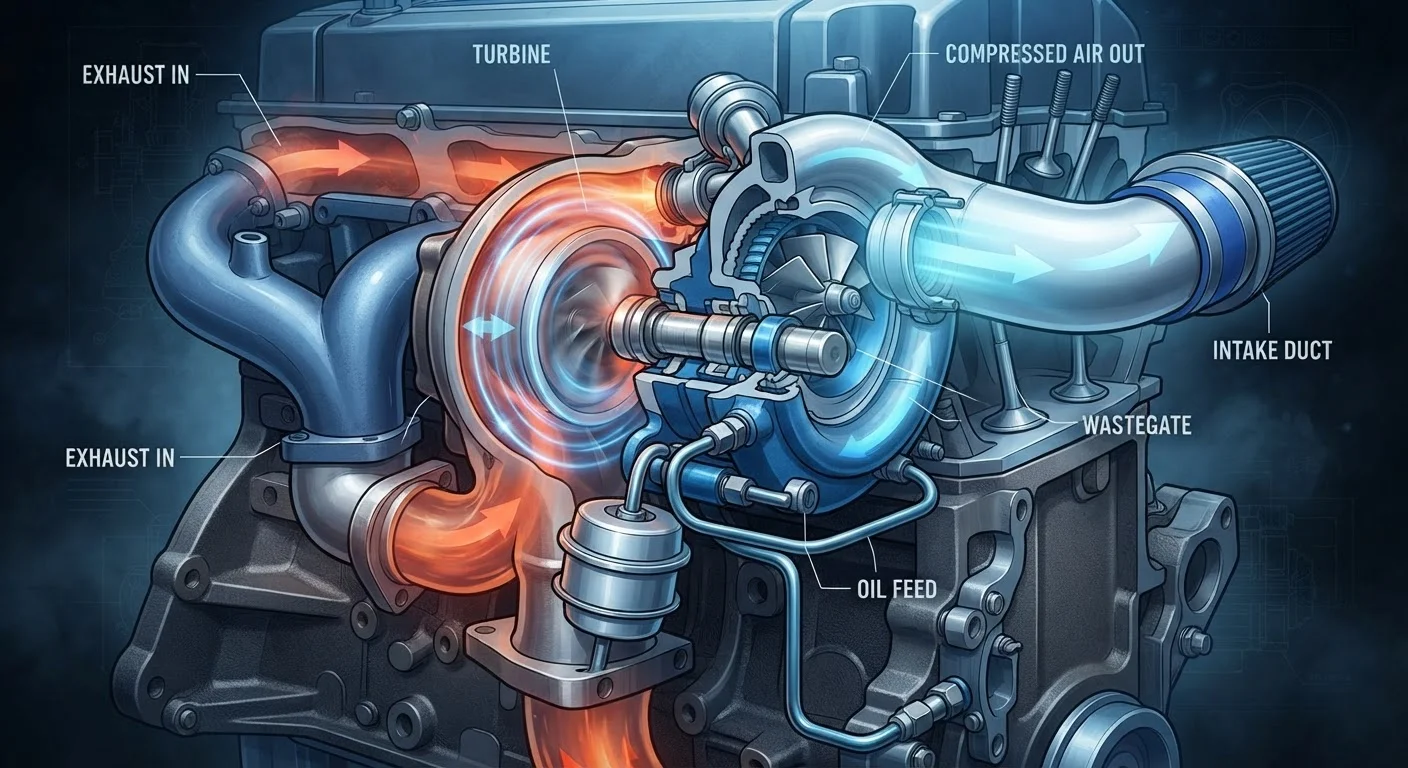
Turbochargers operate via a shaft connecting two impellers: a turbine wheel driven by exhaust flow and a compressor wheel that pressurizes intake air. Boost pressure - typically measured in PSI - indicates how much extra air density the compressor delivers above atmospheric pressure.
How a Naturally Aspirated Engine Works (and Why That Limits Power)
To understand turbocharging, it helps to first understand what happens without one. In a standard gasoline engine - called a naturally aspirated engine - each cylinder draws in air on its own as the piston moves downward. That air mixes with fuel, ignites, and pushes the piston back down to create power.
The limitation is atmospheric pressure. At sea level, air has a fixed density. Your engine can only pull in so much air per stroke, which puts a ceiling on how much fuel can burn and therefore how much power the engine can produce. The only way to get more power out of a naturally aspirated engine is to make it physically bigger - add more cylinders or increase displacement.
That's exactly the problem turbocharging was designed to solve. For more background on automotive terms like displacement and horsepower, it's worth revisiting the basics.
What the Turbocharger Actually Does
A turbocharger is essentially an air pump powered by waste energy - specifically, the hot exhaust gases that would otherwise exit through the tailpipe unused. Here's the basic chain of events:
- Exhaust gases leaving the engine spin a turbine wheel inside the turbocharger housing.
- That turbine is connected by a shaft to a compressor wheel on the other side of the housing.
- The spinning compressor draws in fresh air and squeezes it - raising its density - before pushing it into the engine's intake.
- Denser air means more oxygen per cylinder fill, so more fuel can be burned per combustion cycle.
- More combustion energy means more power, without changing the engine's physical size.
The compressed air gets warm during this process, which reduces its density. That's why many turbocharged engines also use an intercooler - a small radiator-like device that cools the compressed air before it enters the cylinders, recovering some of that density gain.
100,000+
RPM a turbocharger can spin at
Turbocharger turbines routinely spin at speeds exceeding 100,000 RPM, far beyond what any mechanical engine component achieves, which is why oil quality is so critical.
~30%
Potential power increase from turbocharging
Depending on boost levels and engine design, turbocharging can increase an engine's power output by roughly 30-40% compared to the same displacement naturally aspirated.
1908
Year the turbocharger was patented
Swiss engineer Alfred Büchi received an early turbocharger patent in 1905-1908; the technology was first applied commercially in aircraft and diesel engines before reaching passenger cars.
The Real-World Trade-Offs You Should Know About
Turbocharging isn't a free lunch. Understanding the trade-offs helps you maintain your vehicle properly and set realistic expectations.
Turbo Lag
Because the turbo needs exhaust flow to build speed before delivering full boost, there's a brief delay between pressing the gas pedal and feeling the surge of power. Engineers call this turbo lag. Modern designs - including twin-scroll turbos and variable geometry turbines - have reduced this considerably, but it still exists to varying degrees.
Heat and Oil Demands
Turbochargers spin at speeds that can exceed 100,000 RPM and run at temperatures that would damage less hardened components. Engine oil is what lubricates and cools the turbo's central shaft bearing. Letting oil degrade between changes is one of the fastest ways to shorten a turbocharger's life. Always follow the manufacturer's recommended oil type and change interval - this is especially non-negotiable on turbocharged vehicles.
Fuel Economy: The Real Story
Automakers often use small turbocharged engines - a 1.5-liter four-cylinder instead of a 2.5-liter, for example - with the claim of delivering equivalent power at better fuel economy. That's true under light throttle. But if you're frequently demanding full boost, the economy advantage shrinks. Your throttle foot matters as much as the technology under the hood.
How Turbocharging Fits Into the Broader Automotive Picture
Turbocharged engines have become the default in most mainstream vehicle segments because they allow manufacturers to meet fuel economy and emissions standards while still delivering the performance drivers expect. You'll find them in compact sedans, pickup trucks, SUVs, and sports cars alike.
Interestingly, turbocharging occupies a middle ground in the automotive landscape. Unlike electric vehicles, which eliminate combustion entirely, turbocharged engines are still fundamentally internal combustion - just working more efficiently. And how power from a turbocharged engine reaches the wheels depends on the transmission, which is a separate but equally important system. If you're curious how those connect, see our overview of transmission types and how they work.
For everyday drivers, the main practical takeaways are straightforward: keep up with oil changes, warm the engine briefly in cold weather before demanding full throttle, and don't expect fuel economy miracles if you drive aggressively. Treat a turbocharged engine with the same basic respect you'd give any engine - plus a little extra attention to oil - and it should serve you well for the long haul.