

Key Takeaways
Option A
Daytime Driving
The familiar baseline most drivers are trained on.
Best for: Drivers who need full situational awareness, longer stopping distances, and maximum visibility of road hazards and pedestrians.
Option B
Night Driving
A fundamentally different risk environment that demands adjusted habits.
Best for: Experienced, alert drivers who actively compensate for reduced visibility, impaired depth perception, and increased hazard uncertainty.
If you're a new or inexperienced driver
Daytime Driving
Build your foundational skills in daylight first. Night driving adds enough complexity that it should be approached gradually, with supervised practice.
If you must drive at night regularly
Night Driving (with adjusted habits)
Slowing down, increasing following distance, and ensuring clean headlights and windshield dramatically reduce your night-driving risk profile.
If you're older or sensitive to glare
Daytime Driving
Age-related changes in the eyes - slower pupil response and increased glare sensitivity - make nighttime conditions measurably more challenging for older adults.
If you're planning a long-distance trip
Daytime Driving
Fatigue and night-driving risks compound over long distances. Daytime travel gives you better hazard visibility and a lower likelihood of drowsy driving.
Why Darkness Is More Than Just Lower Visibility
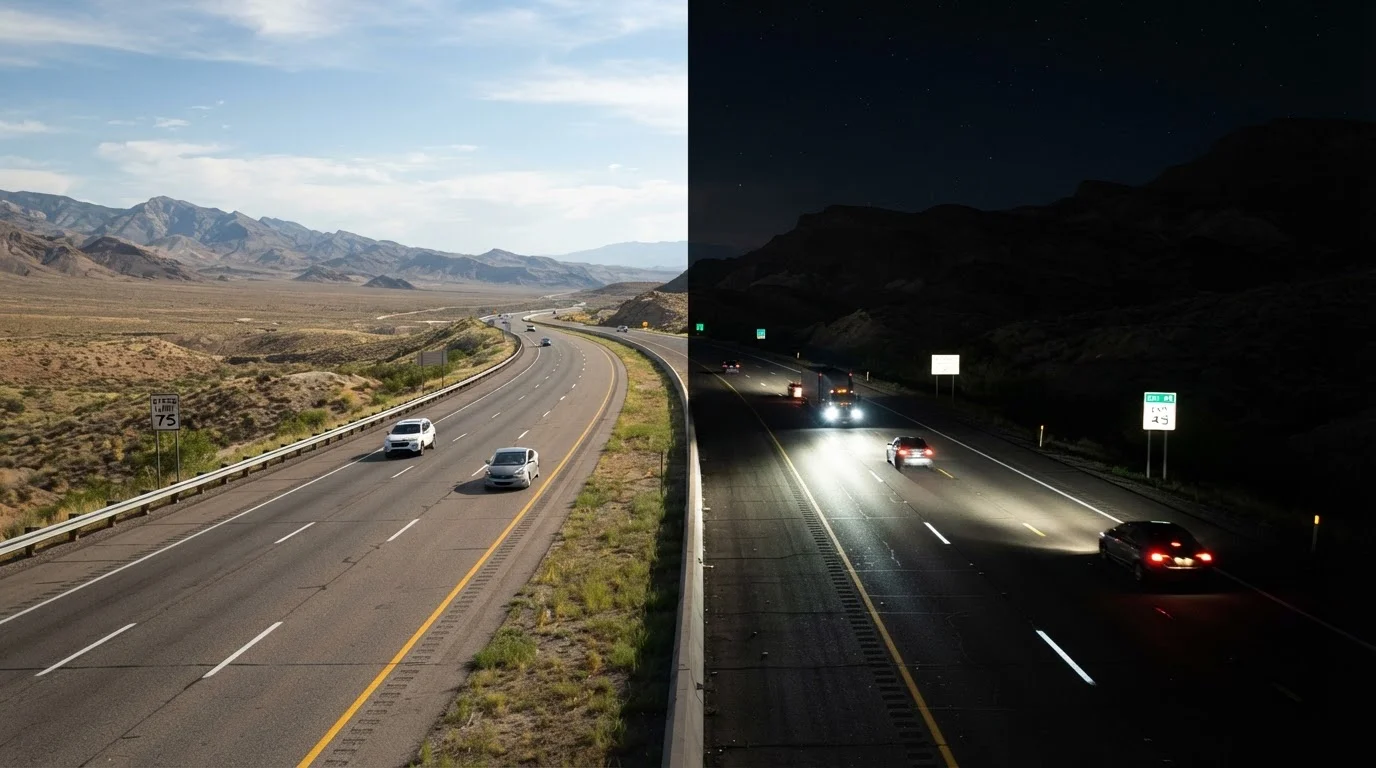
Most drivers think of night driving as daytime driving with the lights on. That framing understates the problem. After dark, your visual field shrinks dramatically, your eyes work harder to process contrast, and your brain receives less environmental information per second. The result is that hazards appear later - and your available reaction time shrinks correspondingly.
According to the National Safety Council, traffic fatalities are roughly three times greater at night than during the day on a per-mile-driven basis. That gap is not explained by traffic volume alone. It reflects a genuine shift in how much information a driver can gather and how quickly they can act on it. See the Complete Guide to Safe Driving in America for a broader look at how these factors fit into overall road safety.
Daytime driving gives you ambient light from all directions, which reveals road-edge details, pedestrians, animals, and surface changes well ahead of your vehicle. At night, you're largely dependent on your own headlights - and standard low beams illuminate only about 160 feet ahead, while highway speeds can require 300 feet or more of stopping distance. That gap between what you can see and what you need to stop is called overdriving your headlights, and it's a core reason night crashes are so severe.
| Criterion | Daytime Driving | Night Driving |
|---|---|---|
| Visibility range | Hundreds of feet in all directions | Limited to headlight beam (~160 ft low) |
| Hazard detection time | Early - well ahead of vehicle | Late - often only seconds before impact |
| Glare risk | Low (sun visor typically sufficient) | High (oncoming headlights cause flash blindness) |
| Fatigue likelihood | Lower during peak hours | Higher - aligns with body's sleep cycles |
| Wildlife hazard frequency | Lower | Significantly higher at dusk and night |
| Pedestrian visibility | Generally clear | Poor - especially in dark clothing |
| Fatal crash rate (per mile) | Lower | Roughly 3x higher than daytime |
Key Risk Differences: A Side-by-Side Look
The contrasts between daytime and nighttime driving span visibility, physiology, hazard types, and driver condition. Understanding each helps you make smarter decisions about when and how to drive.
Glare and Eye Adaptation
In daylight, your pupils stay relatively constricted and your eyes adapt rapidly to changing light. At night, your pupils dilate to gather more light - but oncoming headlights can temporarily overwhelm that adaptation, causing momentary vision loss. Older drivers experience this more intensely because the aging lens scatters light more readily. Looking toward the right edge of the road (rather than directly at oncoming lights) helps preserve your lane orientation during glare events.
Fatigue as a Force Multiplier
Night driving coincides with the body's natural drowsiness windows - typically between midnight and 6 a.m., and to a lesser degree in the mid-afternoon. Fatigue doesn't just make you sleepy; it degrades reaction time, narrows attention, and reduces hazard recognition in ways that mirror alcohol impairment. Our companion piece on why drivers underestimate fatigue explains why most people misjudge how impaired they actually are.
Hazard Types That Shift After Dark
Deer and other wildlife are far more active at dawn, dusk, and night. Pedestrians and cyclists are harder to spot and are more likely to be impaired themselves during late-night hours. Road debris, potholes, and lane markings become far harder to detect without ambient light. Daytime driving, by contrast, surfaces more pedestrian-heavy and congestion-related risks but with far better information available to the driver.
Adjustments That Actually Make a Difference at Night
Good night driving isn't about being fearless - it's about systematically closing the gap that darkness creates between what you can see and what you need to see. Several adjustments have a meaningful effect:
- Reduce speed below the posted limit when conditions warrant. Speed limits are designed for ideal conditions; darkness is not ideal.
- Increase following distance to give yourself more time to react to brake lights or obstacles that appear in your headlight range.
- Keep your windshield and headlight lenses clean. A dirty windshield scatters light and multiplies glare; clouded headlight covers reduce beam output significantly.
- Use high beams on unlit rural roads when no oncoming traffic is present, and dim them promptly when a vehicle approaches.
- Look for hazard cues at the edges of your headlight beam - animals' eyes reflect light before their bodies are visible; pedestrians often appear as silhouettes at the light boundary.
Developing a habit of actively scanning the road ahead matters during the day, but it becomes critical at night when your preview window is shorter and errors are less forgiving. If you also face weather on top of darkness, the challenges multiply further - see our guide on driving in rain, fog, and snow for how to layer those adjustments.
Your Headlights May Not Be Aimed Correctly
Many drivers assume their headlights are set up correctly from the factory or last service visit. In practice, headlight aim drifts over time - especially after front-end impacts or suspension work. Misaimed lights either blind oncoming drivers or point too low to be useful. A qualified mechanic can check and adjust headlight alignment quickly and inexpensively, and it's worth doing if night visibility feels worse than it used to.