

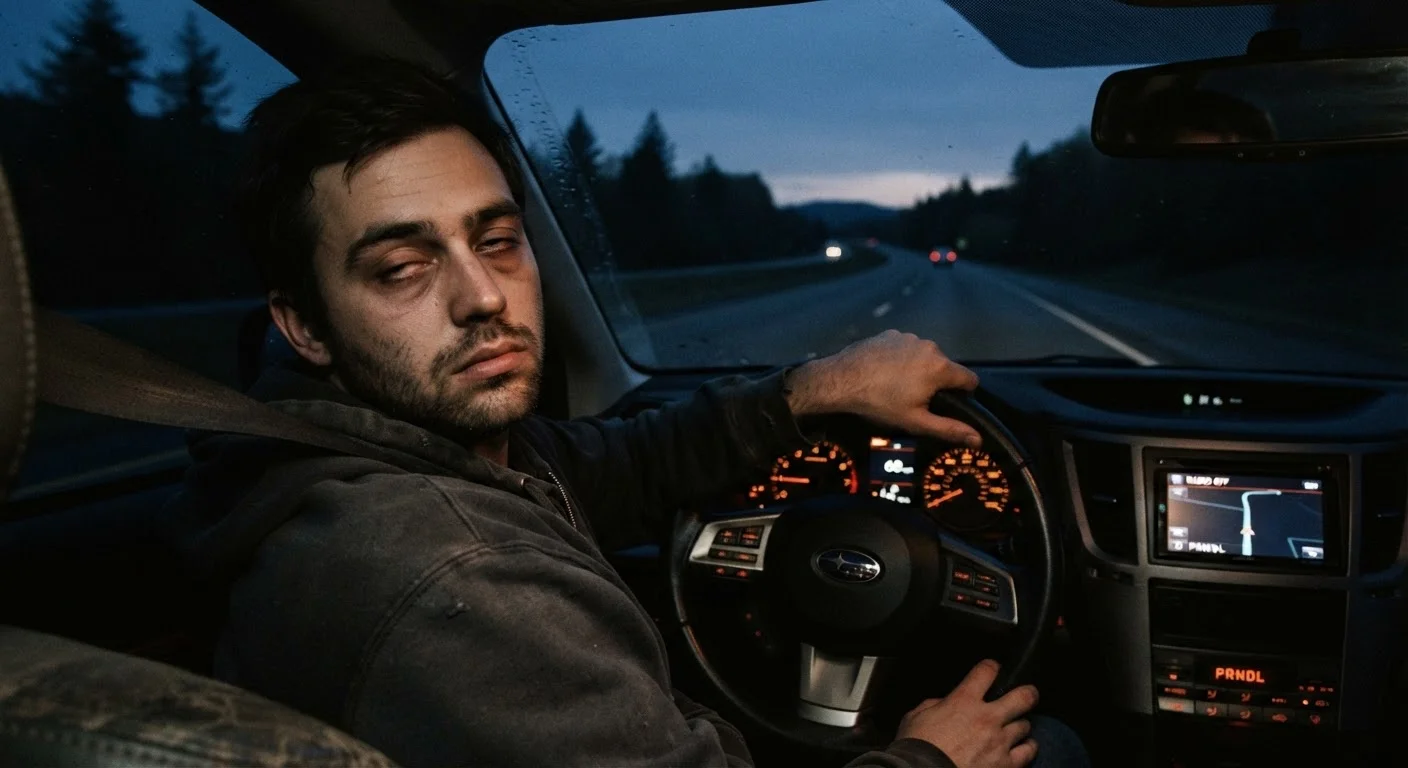
Key Takeaways
Why Fatigue Is So Hard to Self-Diagnose
One of the most counterintuitive facts about drowsy driving is that the more fatigued you are, the less accurately you can judge your own impairment. Studies on sleep deprivation consistently find that subjects rate their performance as adequate even when objective testing shows significant decline. This self-assessment gap is what makes fatigue so dangerous - it doesn't come with an obvious internal alarm.
Unlike alcohol, which drivers tend to notice and often (though not always) account for, fatigue sneaks up gradually. A driver who slept only five hours might feel fine at the start of a trip and genuinely deteriorate over the next hour without registering the change. This is especially relevant for newer drivers who haven't yet learned to recognize their own fatigue cues behind the wheel.
Fatigue Impairs You Before You Feel It
Research consistently shows that people who are sleep-deprived significantly overrate their own alertness. By the time you notice yourself struggling to keep your eyes open, your reaction time and decision-making have already been compromised for some time. Do not wait for obvious signs of sleepiness before pulling over - if you've had fewer than six hours of sleep, treat yourself as impaired from the start.
Common Mistakes Drivers Make Around Fatigue
Most drowsy driving incidents aren't caused by recklessness - they're caused by honest misjudgments that seem reasonable in the moment. Understanding exactly where drivers go wrong is the first step toward making better decisions.
Trusting how you feel rather than how much sleep you've actually had.
Why it happens: Fatigue impairs the brain's ability to accurately assess its own state, so drivers who are dangerously tired often feel 'mostly fine' - especially early in a trip.
Ignoring early warning signs like yawning repeatedly, drifting slightly, or missing an exit.
Why it happens: Drivers tend to dismiss these signals as minor annoyances rather than recognizing them as impairment indicators, often assuming they'll pass on their own.
Using caffeine, loud music, or cold air to stay awake on a long drive.
Why it happens: These tricks provide short-lived sensory stimulation that can feel like renewed alertness, leading drivers to believe they've solved the problem.
Driving during high-risk time windows without accounting for fatigue risk.
Why it happens: Most drivers think of fatigue only in terms of hours driven, not time of day. The body's circadian rhythm creates natural dips in alertness regardless of how long you've been driving.
Assuming a short trip is too brief to be affected by fatigue.
Why it happens: Drivers associate drowsy driving with long road trips, not commutes or local errands. In reality, impaired reaction time is dangerous at any distance.
It's also worth noting that fatigue compounds other driving risks. The reduced visibility and longer reaction times of night driving become significantly more dangerous when fatigue is also in the picture.
What the Data Says - and What It Means for You
1 in 25
Adult drivers who fell asleep while driving in the past 30 days
According to the Centers for Disease Control and Prevention (CDC), this rate is likely an undercount because drivers often don't remember brief microsleep episodes.
~100,000
Police-reported drowsy driving crashes per year in the U.S.
The National Highway Traffic Safety Administration (NHTSA) estimates these figures are conservative, as drowsiness is difficult to detect after a crash.
The real numbers are almost certainly higher than reported figures suggest. Unlike impaired driving from alcohol, there's no roadside test for fatigue, so crash investigators often can't conclusively attribute a collision to drowsiness after the fact. Many single-vehicle run-off-road crashes that occur late at night are suspected drowsy driving incidents but aren't recorded as such.
This matters because it means the cultural weight we assign to drowsy driving doesn't match its actual danger level. Drivers who would never consider getting behind the wheel after two drinks will routinely drive on four hours of sleep - a state that research suggests produces comparable impairment. For a broader look at how common driving assumptions can be misleading, see our piece on driving myths that could actually get you into trouble.
Building Smarter Habits Before You Drive
Preventing drowsy driving starts well before you turn the key. Prioritizing consistent sleep - particularly the night before any long drive - is the single most effective intervention. If you know a trip is coming, treat pre-trip sleep as part of your preparation the same way you'd check tire pressure or fill the tank.
On the road, plan real breaks every two hours or 100 miles on long trips, even if you feel alert. Sharing driving responsibilities with a passenger when possible removes the burden from any one person. And if you find yourself relying on tricks like opening the window or turning up the radio, take that as a signal to pull over - not a reason to keep going.
Experienced drivers develop a heightened sense of their own limits, often catching fatigue earlier through pattern recognition and honest self-monitoring. That kind of proactive hazard awareness applies equally to the driver's own state as it does to road conditions ahead.
This article is for general informational purposes. Always use your own judgment and consult relevant safety guidelines for personal driving decisions.