

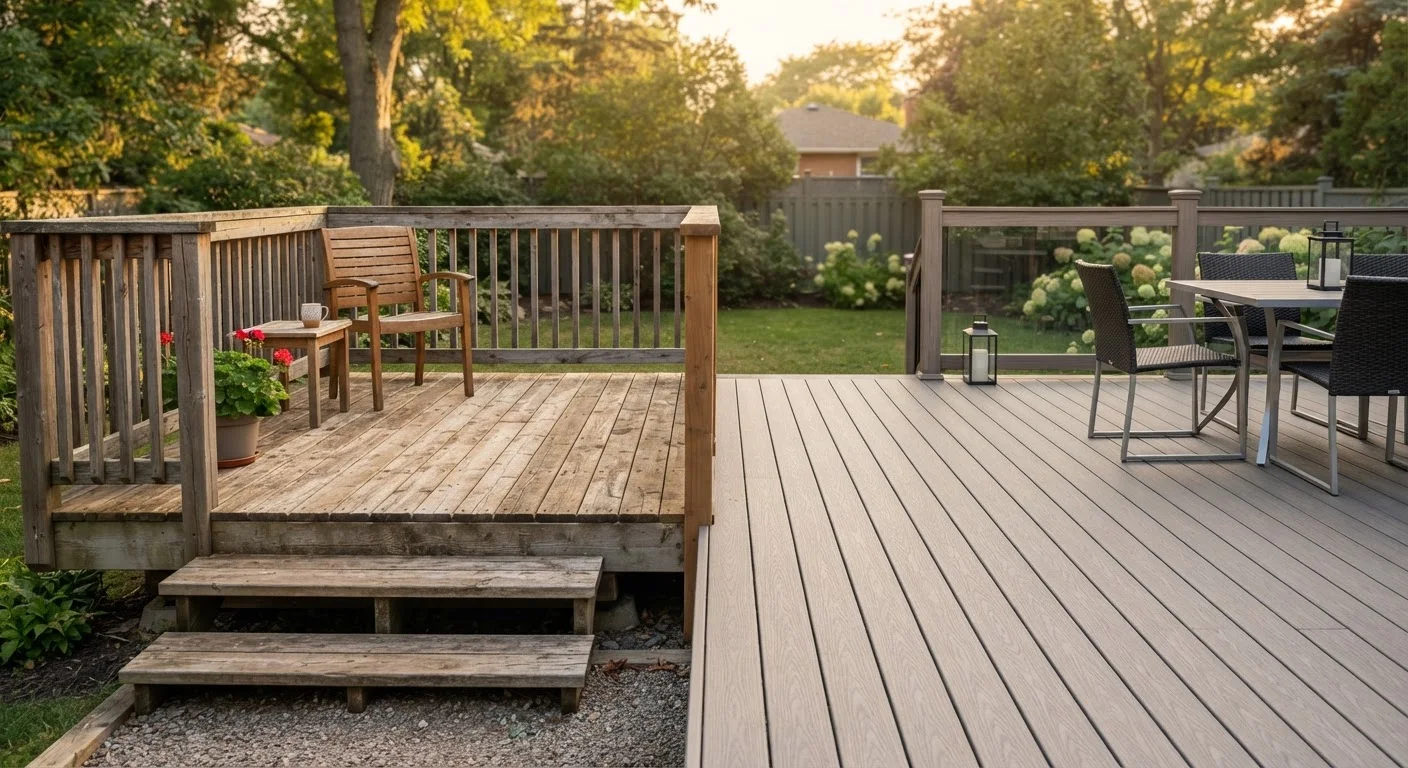
Key Takeaways
Option A
Wood Decking
The classic, high-maintenance natural choice.
Best for: Homeowners who enjoy hands-on upkeep and want a traditional aesthetic they can refinish over time.
Option B
Composite Decking
The low-maintenance, engineered alternative.
Best for: Homeowners who want minimal yearly upkeep and are willing to pay more upfront for long-term convenience.
If you prefer a hands-off maintenance schedule
Composite Decking
Composite requires only periodic washing and lacks the annual staining or sealing demands of wood, freeing up significant time each season.
If you want the lowest possible upfront material cost
Wood Decking
Pressure-treated lumber typically costs less per square foot than composite boards, making it a more accessible starting point for budget-conscious projects.
If you live in a wet or humid climate
Composite Decking
Composite materials resist moisture absorption far better than natural wood, reducing the risk of rot, warping, and mold growth in high-humidity environments.
If you value the ability to sand, stain, or refinish your deck
Wood Decking
Natural wood can be sanded down and refinished multiple times, giving you flexibility to refresh its appearance or repair surface damage over its lifespan.
If long-term durability and warranty coverage matter most
Composite Decking
Most composite products carry substantially longer warranties than natural wood, and their resistance to rot and insects reduces the likelihood of structural surface failures.
What Routine Maintenance Actually Looks Like
For wood decks, routine upkeep is an annual commitment. Each spring, homeowners should clean the deck with a deck wash or oxygen bleach solution to remove mildew, algae, and dirt. Once dry, the surface needs to be inspected for raised nails, loose boards, and early signs of rot - soft, discolored wood that compresses under pressure. After any necessary repairs, a fresh coat of stain or sealant is applied to protect against UV damage and moisture penetration. Skip a year, and wood can begin to gray, crack, and splinter noticeably faster.
Composite decking demands far less seasonal effort. Most manufacturers recommend a simple wash with soap and water two to four times per year, with a soft-bristle brush for stubborn dirt or mildew. Unlike wood, composite boards don't need staining or sealing. However, composite isn't entirely care-free: organic debris like leaves and pollen trapped in the board grooves can feed mold growth if left unchecked. Homeowners in shaded or humid areas should rinse these channels consistently.
Regardless of decking material, the structural skeleton underneath - joists, posts, and the ledger board where the deck attaches to the house - requires inspection every year. Rot or pest damage in these components is a serious safety concern and is often where costly repairs originate. This is one of the upkeep tasks new homeowners consistently overlook.
| Criterion | Wood Decking | Composite Decking |
|---|---|---|
| Annual maintenance effort | High - cleaning, sanding, staining/sealing | Low - periodic washing only |
| Upfront material cost | Generally lower per square foot | Generally higher per square foot |
| Moisture resistance | Vulnerable without consistent sealing | High resistance to moisture absorption |
| Repair flexibility | Can sand, stain, and replace boards easily | Scratches and stains harder to conceal |
| Typical warranty | Limited or none for the lumber itself | 25 years to lifetime on surface boards |
| Susceptibility to insects | Moderate to high (termites, carpenter bees) | Low - composite resists insect damage |
| Appearance over time | Grays and weathers naturally; refinishable | Fades gradually; not refinishable |
| Environmental slip/safety | Can become slippery when wet or mossy | Many products have textured slip resistance |
Common Failure Points and How to Catch Them Early
Wood decks are vulnerable to a predictable set of problems. Rot typically begins in areas where water pools - around post bases, beneath planter pots, and at deck board ends. A screwdriver test is a reliable field check: press the tip firmly into the wood surface, and if it sinks more than a quarter inch without force, the wood is compromised. Warping and cupping occur when boards absorb moisture unevenly, usually a sign that the sealant has worn away. Splintering develops as the wood surface dries and ages, posing a hazard to bare feet. Catching and addressing these issues early - replacing individual boards rather than entire sections - keeps repair costs manageable.
Composite decks have a different set of vulnerabilities. Fading and discoloration are common over time, particularly on decks with heavy sun exposure. While newer capped composite products (boards with a protective polymer shell) resist fading better than older uncapped versions, all composite will change appearance gradually. Surface scratches from furniture or grills are more difficult to repair than on wood, since composite typically cannot be sanded evenly without creating visible inconsistencies. Mold and mildew staining can penetrate porous composite if cleaning is neglected, and some staining may be permanent.
For anyone weighing how much effort they're realistically willing to invest, this comparison parallels the thinking behind durability versus upfront cost in other long-term purchases - higher initial investment in composite often reduces cumulative maintenance costs over a decade or more.
Long-Term Cost and Lifespan Considerations
Wood decking installed with pressure-treated lumber generally costs less per square foot than composite at the time of installation. However, recurring expenses accumulate: cleaning products, stain or sealant, and periodic board replacement can add several hundred dollars per year depending on deck size. Over a 10- to 15-year window, these costs often close the gap with composite or exceed it.
Composite decking carries a higher upfront price, but the reduced maintenance spend and longer product warranties - many manufacturers offer 25-year or lifetime warranties on the board surface - can make it economically competitive over time. It's worth noting that warranties typically cover manufacturing defects, not damage from improper installation or maintenance neglect, so reading warranty terms carefully matters.
Both material types are susceptible to structural deterioration if the subframe is neglected. Pressure-treated lumber is commonly used for framing under both wood and composite surfaces, and it still requires inspection for rot and pest damage. Just as engineered and solid hardwood flooring differ in how they respond to moisture despite looking similar, wood and composite decking demand different long-term care strategies even when their finished surfaces appear comparable. Building a realistic maintenance budget at the outset - and sticking to an annual inspection schedule - is the single most effective way to extend the life of either deck type.
~$700-$1,000+
Estimated annual wood deck upkeep cost
Industry estimates suggest homeowners with mid-sized wood decks may spend several hundred to over a thousand dollars annually on maintenance materials and minor repairs.
25+ years
Typical composite deck warranty length
Many composite decking manufacturers offer surface warranties of 25 years to lifetime, compared with much shorter or no warranty on standard pressure-treated lumber.
1 in 5
Decks with structural deficiencies found on inspection
Home inspection data broadly suggests a significant share of decks have at least one structural deficiency, often in subframe components regardless of surface material.