

Key Takeaways
Option A
Engineered Hardwood
The moisture-resistant, versatile performer.
Best for: Homeowners installing flooring in basements, kitchens, or regions with high humidity and seasonal temperature swings.
Option B
Solid Hardwood
The timeless, refinishable classic.
Best for: Homeowners in stable, dry climates who want a floor that can be refinished multiple times over several decades.
If you're installing flooring in a basement or below-grade space
Engineered Hardwood
Its layered plywood core resists the moisture and humidity fluctuations common in below-grade environments, where solid hardwood would likely warp or cup.
If longevity and repeated refinishing are your top priorities
Solid Hardwood
A 3/4-inch solid plank can be sanded and refinished far more times than most engineered options, extending the floor's usable life by decades.
If you live in a climate with dramatic seasonal humidity swings
Engineered Hardwood
Engineered planks expand and contract less than solid wood as humidity rises and falls, reducing the risk of gaps, warping, or buckling.
If you're renovating a main-floor living room or bedroom in a stable climate
Solid Hardwood
Above-grade, climate-controlled rooms are the ideal setting for solid hardwood, where it performs at its best and offers maximum refinishing potential.
How Each Type Is Constructed
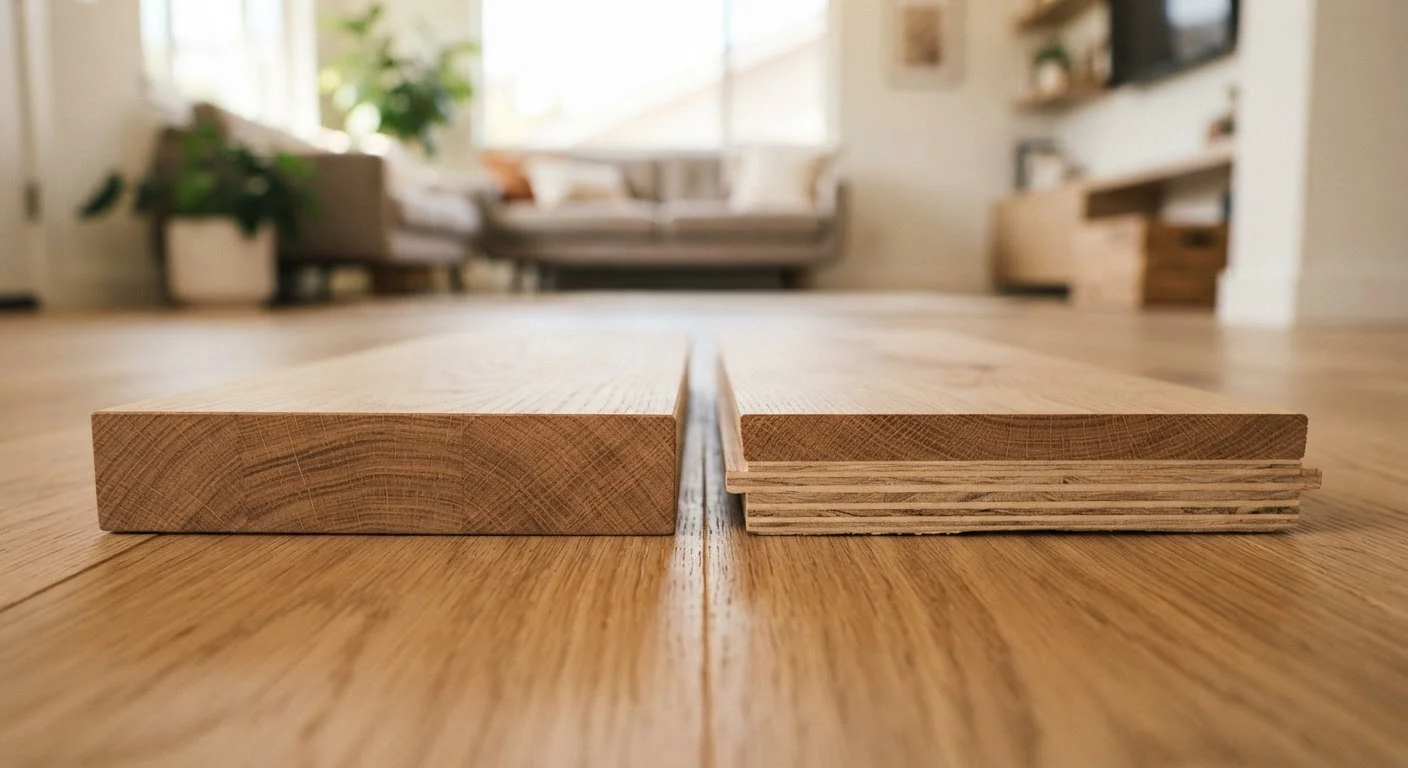
The most important distinction between these two flooring types isn't what you see - it's what lies beneath the surface. Solid hardwood is milled from a single piece of wood, typically 3/4 inch thick. Every millimeter of that plank is usable wood, which is why it can be sanded flat and refinished repeatedly over its lifetime.
Engineered hardwood, by contrast, is built in layers. A thin veneer of real hardwood - called the wear layer - is bonded to a core of plywood or high-density fiberboard (HDF). That cross-ply construction is what gives engineered flooring its key advantage: dimensional stability. Because the layers run in opposing grain directions, the board resists the natural tendency of wood to expand and contract with changes in temperature and humidity.
The wear layer thickness matters enormously. Thicker wear layers (typically 3-6 mm) allow for more sanding cycles, while thinner veneers (1-2 mm) may only tolerate one light refinish - or none at all. Always check this specification before purchasing.
Where Each Performs Best - and Where It Struggles
Moisture is wood flooring's primary enemy, and the two types respond to it very differently.
Solid hardwood is not appropriate for basements, bathrooms, or spaces that sit on or below grade. Even with careful installation, humidity fluctuations cause solid planks to expand in summer and shrink in winter, creating visible gaps or, in severe cases, buckling. It also cannot be glued directly to concrete slabs - it requires a wood subfloor with a moisture barrier.
Engineered hardwood handles these conditions far better. Many engineered products are rated for installation directly over concrete using a floating or glue-down method, and some are approved for use in below-grade rooms. This flexibility makes it a practical choice for finished basements and main-floor kitchens where plumbing leaks are a real-world concern.
That said, engineered hardwood is not waterproof. Prolonged standing water will still cause damage. For genuinely wet spaces like full bathrooms or laundry rooms, neither product is the right choice.
| Criterion | Engineered Hardwood | Solid Hardwood |
|---|---|---|
| Construction | Real wood veneer over plywood core | Single solid wood plank |
| Moisture resistance | Good - stable in humid conditions | Poor - expands and contracts significantly |
| Suitable locations | Above, on, or below grade | Above grade only |
| Installation methods | Nail, glue, or float | Nail or staple only |
| Refinishing potential | 1-3 times (wear layer dependent) | 5-8 times over its lifespan |
| Typical lifespan | 25-30+ years | 50-100+ years with refinishing |
| Subfloor compatibility | Wood or concrete | Wood subfloor required |
Just as the choice between engineered and solid wood affects how you maintain indoor flooring, the material you choose for outdoor surfaces matters equally. See how natural and synthetic materials compare in our guide on maintaining wood decks vs. composite decks.
Installation, Cost, and Long-Term Maintenance
Installation approach differs notably between the two. Solid hardwood must be nailed or stapled to a wood subfloor - it cannot float. This limits where it can go and adds to labor time. Engineered hardwood offers more installation flexibility: it can be nailed, glued, or installed as a floating floor (where planks click together without fasteners), which can reduce installation costs in some cases.
3/4"
Standard solid hardwood plank thickness
This thickness is what allows solid hardwood to be sanded and refinished multiple times without compromising structural integrity.
35-55%
Recommended indoor relative humidity for wood floors
Wood flooring associations and flooring manufacturers generally recommend maintaining this humidity range to minimize expansion and contraction in all wood floor types.
1-6 mm
Typical engineered hardwood wear layer range
The wear layer thickness directly determines how many times an engineered floor can be sanded; thicker layers support more refinishing cycles.
From a maintenance standpoint, both types benefit from the same basic care: sweep or vacuum regularly, wipe up spills promptly, use felt pads under furniture legs, and control indoor humidity year-round (generally 35-55% relative humidity is recommended for wood floors). The difference emerges over decades. Solid hardwood can typically be sanded and refinished five to eight times depending on its thickness. A quality engineered floor with a 3 mm or thicker wear layer might be refinished once or twice before the veneer is too thin to sand safely.
Neither type requires special cleaning products - a lightly dampened mop and a pH-neutral cleaner designed for wood floors is sufficient. Avoid steam mops, which force excess moisture into seams.