

Key Takeaways
Start here
What Your Electrical Panel Actually Does
Next
Anatomy of a Breaker Box
Then
Warning Signs That Deserve Attention
Apply it
What a Homeowner Can Safely Do
Know your limits
When to Call a Licensed Electrician
What Your Electrical Panel Actually Does
Your electrical panel - commonly called a breaker box or load center - is the point where electricity from the utility company enters your home and gets divided into individual circuits. Think of it as a traffic hub: power comes in on two main wires, and the panel routes that power to different areas of the house, each on its own dedicated path.
Each circuit is protected by a circuit breaker, a switch designed to cut power automatically if more current flows through the wire than the wire can safely handle. This is a deliberate safety feature, not a flaw. When a breaker trips, it's doing exactly what it was designed to do - preventing overheated wiring and potential fires.
Understanding this basic function helps you respond calmly when a breaker trips, rather than viewing the panel as a mysterious black box. It also makes you better equipped to notice when something is genuinely wrong.
Circuit breaker
A resettable safety switch that automatically shuts off power to a circuit when too much current flows through it, preventing wire damage or fire.
Circuit
A closed loop of wiring that carries electricity from the panel to a set of outlets, fixtures, or appliances and back again.
Amperage (amps)
A measure of how much electrical current a wire or breaker can safely carry. Higher-demand appliances need circuits with higher amp ratings.
Double-pole breaker
A breaker that occupies two slots in the panel and supplies 240 volts for high-power appliances like dryers, ranges, and central air conditioners.
Main breaker
The large breaker at the top of the panel that controls power to every circuit in the home. Switching it off cuts all household power except the incoming utility lines.
Service entrance
The point where the utility company's wires connect to your home, typically at a meter and then into the top of the electrical panel.
Anatomy of a Breaker Box
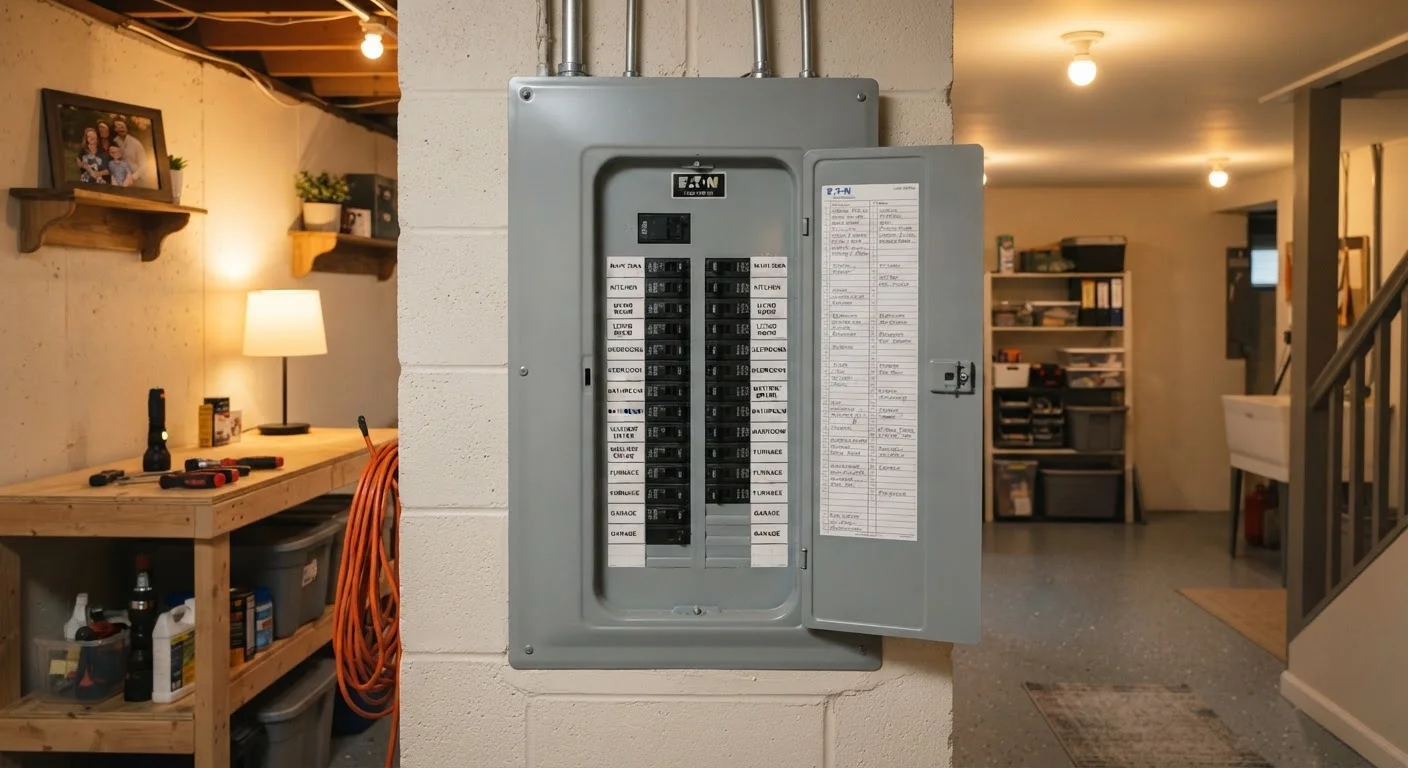
Open your panel door (the outer cover is designed to be opened safely) and you'll see a predictable layout:
- Main breaker: The large double-pole breaker at the top controls power to the entire panel. Switching it off cuts power to all circuits simultaneously.
- Branch circuit breakers: The rows of smaller switches below the main breaker each protect one circuit in your home - a bedroom, a bathroom, the kitchen outlets, and so on.
- Bus bars: The metal strips running down the center carry power from the main breaker to each branch breaker.
- Neutral and ground bars: These terminal strips connect the return paths and grounding wires for each circuit.
Breakers are typically rated at 15 or 20 amps for standard household circuits, with larger double-pole breakers (30-50 amps) for high-demand appliances like dryers, ranges, and HVAC equipment.
One of the most practical things you can do is keep your breaker labels accurate. Poorly labeled panels slow down every future repair and can create confusion in an emergency. Take 30 minutes to map each breaker by switching them off one at a time and noting which outlets or fixtures go dark.
Warning Signs That Deserve Attention
Your panel communicates when something isn't right. Learn to recognize these signals:
- Breakers that trip repeatedly - especially on the same circuit - suggest the circuit is consistently overloaded, or there may be a wiring fault.
- A burning smell or scorch marks near the panel indicate heat damage. This is urgent; do not ignore it.
- Buzzing or crackling sounds from inside the panel can signal arcing, which is a fire hazard.
- Flickering lights throughout the house (not just one room) may point to a loose connection at the panel or the service entrance.
- Breakers that won't stay reset or feel loose rather than clicking firmly into place may be worn out.
Panels are also worth examining when buying a home. A home inspection will often note panel age, type, and visible issues - see what a home inspector evaluates for a fuller picture of what that process covers.
What a Homeowner Can Safely Do
There's a meaningful difference between understanding your panel and working inside it. Here's where most homeowners can safely operate:
- Reset a tripped breaker: Push the breaker fully to OFF before switching it back to ON. A breaker in the tripped position sits between the two - you must reset it this way to restore power.
- Label your breakers: Low-risk and genuinely useful. Keep a written directory inside the panel door as backup.
- Keep the panel area clear: The space in front of your panel should be unobstructed at all times, both for safety and to comply with most local codes.
- Visually inspect for obvious problems: Look for rust, moisture intrusion, or scorch marks on the inside of the panel door during your annual review.
Staying on top of these basics fits naturally into routine home upkeep. The seasonal home maintenance calendar can help you build a consistent inspection habit alongside other tasks like checking smoke detectors and clearing gutters.
Label Your Panel Once, Benefit for Years
Use a simple map: switch off one breaker at a time, then walk the house noting every outlet, light, and appliance that lost power. Write the results on a printed template and tape it inside the panel door. Updated labels help every contractor, inspector, or family member who needs to work with your electrical system.
When to Call a Licensed Electrician
The interior of an electrical panel carries a critical risk that isn't obvious at first glance: even with the main breaker switched off, the wires feeding into the top of the panel from the utility remain energized. There is no switch a homeowner can safely use to cut that power. This is why adding breakers, replacing the panel, or addressing any wiring inside the box must be done by a licensed electrician.
Call a professional when you notice any of the warning signs described above, when your panel is more than 25-30 years old, when you're planning a significant addition or renovation, or when your home runs on an older fuse box rather than modern breakers.
Many panel upgrades and new circuit installations also require a permit and inspection from your local building department. A licensed electrician will typically handle pulling permits as part of the job - always confirm this before work begins. For a deeper look at where the DIY line falls on electrical work, see why DIY electrical work goes wrong.
Being an informed homeowner doesn't mean doing everything yourself - it means knowing what you're looking at, recognizing when something is off, and getting the right person involved before a small issue becomes a costly one.