

Key Takeaways
Option A
Debt Avalanche
The mathematically optimal, interest-minimizing approach.
Best for: Disciplined savers who want to minimize total interest paid over the life of their debts.
Option B
Debt Snowball
The motivation-driven, momentum-building alternative.
Best for: People who need early wins to stay engaged and committed to a long-term payoff plan.
If minimizing total interest cost is your primary goal
Debt Avalanche
Targeting your highest-rate debt first reduces how much interest accumulates across all accounts, saving the most money over time.
If you've struggled to stay motivated with debt repayment before
Debt Snowball
Clearing small balances quickly creates a sense of progress that research links to improved follow-through on repayment plans.
If your debts carry similar interest rates
Debt Snowball
When rates are close together, the interest cost difference between methods is small, so the motivational edge of the snowball may be the deciding factor.
If one high-rate debt is dramatically more expensive than all others
Debt Avalanche
A significantly higher interest rate compounds quickly; addressing it first limits the damage before tackling lower-cost balances.
How Each Method Works
Both the debt avalanche and debt snowball share the same fundamental structure: you make minimum payments on every debt each month, then direct any additional available funds toward one specific account. The difference lies in how you choose which account gets that extra payment power.
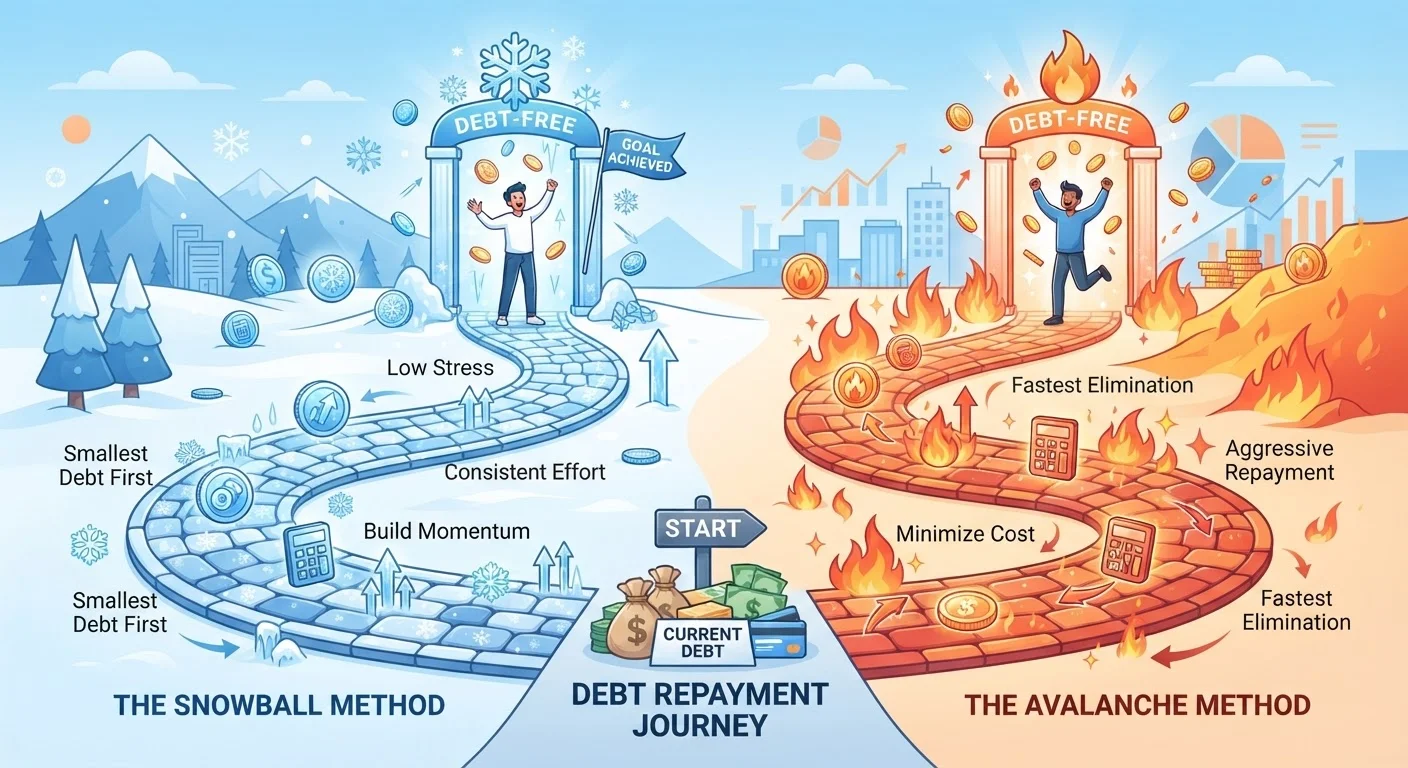
Debt Avalanche: You rank your debts by interest rate, from highest to lowest. Every extra dollar goes toward the highest-rate balance first. Once that debt is eliminated, you redirect its payment to the next highest-rate account - and so on down the list. Because high-rate debt accumulates interest fastest, this sequencing reduces the total interest you pay.
Debt Snowball: You rank your debts by balance size, from smallest to largest, regardless of interest rate. Extra payments target the smallest balance first. Once it's cleared, you roll that freed-up payment to the next smallest balance. The growing payment amount is where the "snowball" name originates.
Understanding how interest compounds on unpaid balances is foundational to both strategies. If you haven't already, see why minimum payments extend debt far longer than most expect - the numbers often surprise people.
| Criterion | Debt Avalanche | Debt Snowball |
|---|---|---|
| Payoff order | Highest interest rate first | Smallest balance first |
| Total interest paid | Lower (in most scenarios) | Potentially higher |
| Time to first payoff | Longer (if high-rate debt is large) | Faster (smallest balance cleared first) |
| Motivational structure | Delayed reward; requires discipline | Early wins sustain momentum |
| Best when rates differ by | Several percentage points | Minimal difference between accounts |
| Complexity | Slightly more math to set up | Simple ranking by balance size |
The Real Cost Difference
The avalanche method saves money in nearly every scenario where interest rates differ meaningfully across accounts. Consider a simplified example: if you carry a $5,000 balance at 22% APR and a $2,000 balance at 8% APR, paying the high-rate debt first limits how quickly the larger balance grows. Paying the small balance first - as the snowball prescribes - leaves the 22% debt compounding longer, increasing your total interest cost.
The gap between the two methods widens when interest rates diverge significantly and when repayment timelines stretch over multiple years. In cases where all your debts carry nearly identical rates, the difference in total interest paid may be marginal.
It's worth noting that neither method changes the interest rates themselves. If you're considering restructuring your debt before choosing a payoff strategy, debt consolidation has real trade-offs worth understanding first.
The Psychology of Payoff: Why Behavior Matters
The mathematically superior strategy only delivers its advantage if you follow through consistently - and this is where the snowball earns serious attention. Research published in the Journal of Marketing Research has found that people are more motivated by progress toward smaller, achievable goals than by abstract long-term savings. Eliminating a debt account entirely, even a small one, produces a concrete sense of accomplishment that can sustain effort over time.
This matters practically. A reader who sticks to the snowball for three years will pay less total interest than someone who starts the avalanche but abandons it after six months. The best debt payoff strategy is the one you can realistically maintain.
If your budget is tight and finding any extra payment feels difficult, practical approaches for managing debt on a tight budget can help identify workable paths before you choose a sequencing method.
Choosing the Right Approach for Your Situation
Neither method is universally superior - both are evidence-based, structured alternatives to the unfocused approach of paying random amounts to different accounts each month. The decision comes down to two questions: How large is the interest rate spread across your debts? And how important is early momentum to your ability to stay the course?
If your highest-rate debt also happens to be your smallest balance, both methods point to the same account - in which case the distinction becomes irrelevant. Some people also use a hybrid approach: they clear one or two very small balances first for the psychological lift, then switch to avalanche sequencing for the remainder.
Once debt is under control, the monthly payment capacity you free up can be redirected toward building savings and long-term financial security. The Saving & Investing hub covers the core concepts for that next step. Wherever you start, committing to a clear, repeatable system gives you a stronger foundation than reacting month to month.
This article is for general informational and educational purposes only and does not constitute personalized financial advice. Consult a qualified financial professional for guidance specific to your situation.