

Key Takeaways
Simplifies multiple payments into one
Combining several debts into a single monthly payment reduces the risk of missed due dates and makes cash flow planning more straightforward.
May lower your effective interest rate
Borrowers with improved credit scores may qualify for a consolidation loan at a lower APR than their current credit card rates, reducing the total interest paid over time.
Fixed repayment timeline adds clarity
Unlike revolving credit card debt, a consolidation loan has a defined end date, which can provide a concrete payoff goal and psychological motivation.
Can reduce monthly payment amount
Extending the repayment term through consolidation may lower the required monthly outlay, freeing up short-term cash flow - though this can increase total interest paid.
Does not reduce the principal owed
Consolidation restructures debt but rarely eliminates any of it. The full balance, minus any fees, must still be repaid in full.
Fees can offset interest savings
Origination fees on personal loans, balance transfer fees (typically 3-5% of the amount moved), and prepayment penalties can erode the financial benefit of a lower rate.
Temporary negative impact on credit score
Applying for a consolidation loan triggers a hard credit inquiry, which can cause a short-term dip in your credit score - a factor worth weighing if you anticipate needing credit soon.
Risk of accumulating new debt on cleared accounts
Paying off credit cards through consolidation doesn't close those accounts. Continuing to use them can leave a borrower worse off than before consolidation.
Longer terms mean more total interest
Spreading payments over a longer period to lower the monthly amount can result in paying significantly more in interest over the life of the loan, even at a lower rate.
Our Verdict
Debt consolidation is a legitimate financial tool that can reduce complexity and, in some cases, lower the cost of carrying debt. However, it works best as part of a broader strategy that includes a realistic budget and a commitment to not adding new debt. It restructures what you owe - it does not reduce it.
Best suited for borrowers who have multiple high-interest debts, a stable income, and a clear plan to avoid accumulating additional balances after consolidating.
What Debt Consolidation Actually Does
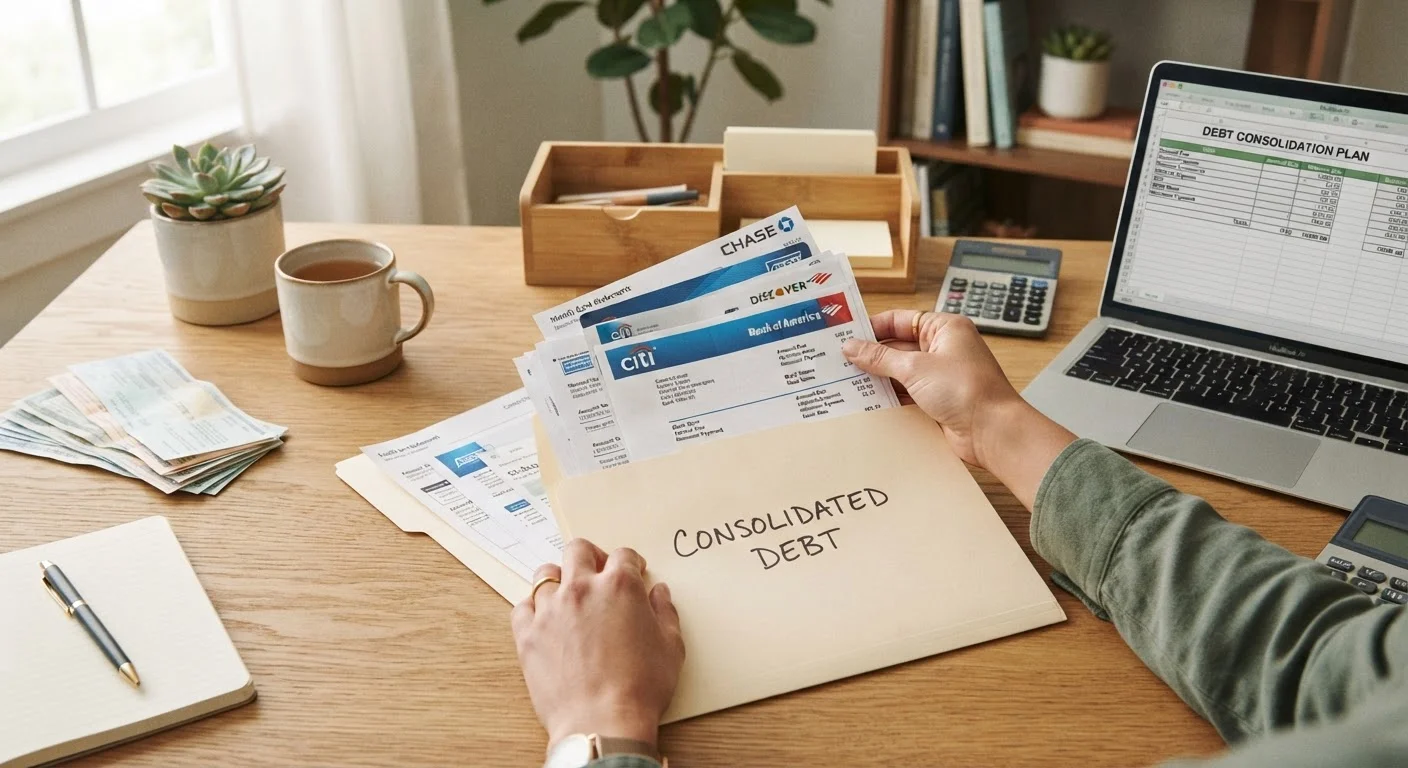
Debt consolidation is the process of combining multiple outstanding debts - typically credit card balances, medical bills, or personal loans - into a single new loan or repayment plan. The goal is usually to simplify your finances and potentially secure a lower interest rate than what you're currently paying across scattered accounts.
There are two primary methods: a debt consolidation loan, which is a personal loan used to pay off existing debts, and a balance transfer credit card, which moves balances onto a single card, often with a promotional low or zero-percent APR for a set period. Some borrowers also work through nonprofit credit counseling agencies that negotiate a debt management plan (DMP) with creditors on the borrower's behalf.
What consolidation does not do is reduce the principal balance you owe. The total debt typically remains the same - it's just restructured. If you owe $18,000 across five credit cards, a consolidation loan doesn't make that $18,000 smaller. It moves it into a new container with different terms. Understanding this distinction is the foundation for evaluating whether consolidation makes sense for your situation. For a refresher on common credit terminology, see key credit and debt terms.
The Advantages Worth Considering
For the right borrower, debt consolidation offers genuine benefits that go beyond mere convenience.
Simplifies multiple payments into one
Combining several debts into a single monthly payment reduces the risk of missed due dates and makes cash flow planning more straightforward.
May lower your effective interest rate
Borrowers with improved credit scores may qualify for a consolidation loan at a lower APR than their current credit card rates, reducing the total interest paid over time.
Fixed repayment timeline adds clarity
Unlike revolving credit card debt, a consolidation loan has a defined end date, which can provide a concrete payoff goal and psychological motivation.
Can reduce monthly payment amount
Extending the repayment term through consolidation may lower the required monthly outlay, freeing up short-term cash flow - though this can increase total interest paid.
20%+
Average credit card APR in recent years
According to the Federal Reserve's consumer credit data, average credit card interest rates have exceeded 20% APR, underscoring the cost of carrying revolving balances.
3-5%
Typical balance transfer fee
Most balance transfer offers charge a fee of 3 to 5 percent of the transferred amount, which should be factored into any interest-savings calculation.
Consolidation can also make budgeting more predictable. Managing five or six due dates with different minimum payments is error-prone. A single monthly payment reduces the mental load and lowers the risk of a missed payment damaging your credit score. This simplicity can be especially helpful for households managing shared finances - a topic explored further in our guide on budgeting as a couple.
The Disadvantages You Shouldn't Ignore
Consolidation comes with real trade-offs, and they aren't always obvious upfront.
Does not reduce the principal owed
Consolidation restructures debt but rarely eliminates any of it. The full balance, minus any fees, must still be repaid in full.
Fees can offset interest savings
Origination fees on personal loans, balance transfer fees (typically 3-5% of the amount moved), and prepayment penalties can erode the financial benefit of a lower rate.
Temporary negative impact on credit score
Applying for a consolidation loan triggers a hard credit inquiry, which can cause a short-term dip in your credit score - a factor worth weighing if you anticipate needing credit soon.
Risk of accumulating new debt on cleared accounts
Paying off credit cards through consolidation doesn't close those accounts. Continuing to use them can leave a borrower worse off than before consolidation.
Longer terms mean more total interest
Spreading payments over a longer period to lower the monthly amount can result in paying significantly more in interest over the life of the loan, even at a lower rate.
Perhaps the most significant hidden risk is behavioral. When credit card balances are paid off through consolidation, those accounts still exist - and some borrowers resume using them, effectively doubling their debt load. Consolidation addresses the structure of your debt, not the habits that created it. If overspending is the root cause, consolidation alone won't solve the problem. For readers whose budgets leave little room to maneuver, managing debt on a tight budget offers more targeted strategies.
How It Compares to Other Debt Payoff Approaches
Debt consolidation is one tool among several, and it isn't always the most efficient path to becoming debt-free.
The debt avalanche method - directing extra payments toward the highest-interest balance first - typically minimizes total interest paid over time without requiring a new loan or credit application. The debt snowball method targets the smallest balance first, building momentum through early wins. Both strategies can be pursued without the fees or credit inquiries associated with consolidation. See a detailed comparison in our article on debt avalanche and debt snowball strategies.
Consolidation makes the most sense when the new loan carries a meaningfully lower interest rate than your current debts and when you have the discipline to avoid adding new balances. If your existing rates are already low, the math may not favor the switch. It's also worth understanding how minimum payments compound the cost of carrying debt over time - something covered in depth in why minimum payments keep you in debt longer.
When to Involve a Nonprofit Credit Counselor
If you're struggling to qualify for a consolidation loan or balance transfer due to credit challenges, a nonprofit credit counseling agency may be able to help. These organizations, many of which are affiliated with the National Foundation for Credit Counseling (NFCC), can negotiate reduced interest rates with creditors through a debt management plan. Unlike for-profit debt settlement companies, nonprofit counselors typically charge modest fees and do not ask creditors to accept less than the full amount owed. Always verify an agency's credentials and fee structure before enrolling.
This article is for general informational purposes only and does not constitute personalized financial or legal advice. Consult a qualified financial professional before making decisions about your debt or credit situation.