

Key Takeaways
How Minimum Payments Are Actually Calculated
Credit card issuers set minimum payments using one of two common methods: a flat percentage of your outstanding balance (typically 1-3%), or a small fixed dollar amount - often $25 or $35 - whichever is greater. On a $3,000 balance at 2%, that's $60 per month. Of that $60, the majority goes toward interest, not principal.
At a 20% APR, monthly interest on a $3,000 balance is approximately $50. That means your $60 minimum payment reduces the actual balance by only $10. The next month's minimum is slightly lower, and the cycle continues - slowly. This structure is not accidental; minimum payment formulas keep balances revolving longer, which benefits issuers through sustained interest income.
20%+
Average credit card APR in recent years
The Federal Reserve has tracked average credit card interest rates consistently above 20% in recent reporting periods, making minimum-only payments especially costly.
~10+ years
Estimated payoff time on $3,000 at minimum only
A $3,000 balance at 20% APR, with a 2% minimum payment floor, can take over a decade to repay and nearly double the original balance in total interest paid.
1-3%
Typical minimum payment as % of balance
Most major credit card issuers set their minimum payment at 1-3% of the outstanding balance or a flat dollar floor, whichever is greater.
Understanding this math is the foundation for changing behavior. If your goal is to reduce debt, the minimum payment is where your strategy starts - not where it ends.
The Real Cost of Playing It Safe Each Month
Many cardholders pay the minimum because it keeps the account in good standing and avoids late fees. Both are valid outcomes - but they come at a significant long-term cost. Carrying a balance means interest compounds daily. Each day, your card issuer applies a small fraction of the APR to whatever principal remains.
Minimum Payments Don't Stop Interest From Compounding
Many cardholders assume that paying on time keeps the balance from growing. That's only true if you pay the full statement balance. When you carry a balance and pay only the minimum, interest accrues daily on the remaining principal. Over months, that compounding effect means your actual debt reduction is minimal, even though you are technically current on your account.
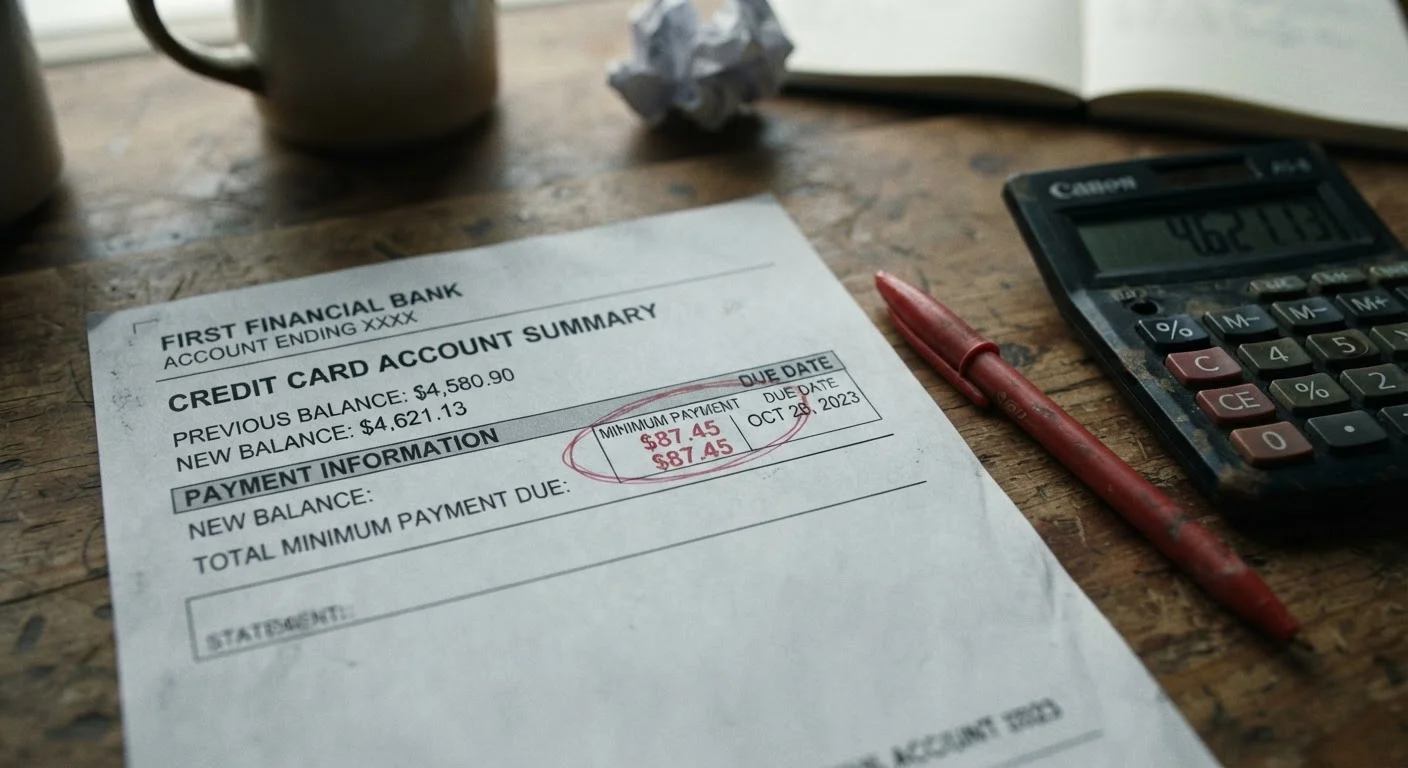
Federal regulations require that your credit card statement show a minimum payment warning - a box that explicitly states how long repayment will take and how much you'll pay in total if you only make minimum payments. This disclosure is easy to overlook, but it contains some of the most important numbers on your statement. If you've never read it, do so now.
Required Disclosure Most People Skip
Federal law requires credit card issuers to include a minimum payment warning on every statement. This disclosure shows how long payoff would take - and the total interest owed - if you only make the minimum each month. Review this section of your statement carefully. The numbers are often startling and can be a powerful motivator to pay more.
For readers juggling multiple obligations, our guide on managing debt on a tight budget outlines practical approaches when every dollar is already accounted for.
Common Mistakes That Keep the Cycle Going
Minimum payments alone rarely create a path out of debt - they mostly maintain the status quo. The mistakes below are the most common reasons cardholders stay stuck longer than necessary.
Treating the minimum payment as the recommended payment rather than the floor.
Why it happens: Credit card statements present the minimum payment prominently, and avoiding a late fee can feel like the goal is met. Many cardholders assume the issuer's suggested amount reflects a reasonable repayment pace.
Ignoring how daily compounding interest erodes each payment's impact on the principal.
Why it happens: Most people think in terms of annual interest rates, which makes 20% APR feel abstract. In practice, interest accrues daily - roughly 0.055% per day at 20% APR - so the clock never stops between payments.
Continuing to use a card while only making minimum payments on its balance.
Why it happens: Cardholders in tight financial situations often need the credit line for ongoing expenses, creating a cycle where new charges outpace the tiny principal reduction each payment delivers.
Underestimating how many years minimum-only repayment adds to the timeline.
Why it happens: Without a concrete comparison, it's difficult to feel the difference between five years and fifteen years of payments. The abstract nature of long timelines makes it easy to underestimate the true cost.
Spreading extra dollars across multiple cards equally instead of concentrating payoff effort.
Why it happens: Paying a little extra on every card feels fair and balanced, but it dilutes the impact. Interest continues accumulating on each card's full balance simultaneously.
What Paying More Actually Changes
The impact of paying even a modest amount above the minimum is not linear - it's proportionally much larger. On a $3,000 balance at 20% APR, raising the monthly payment from $60 to $150 can cut the repayment timeline from roughly ten years to under two years, and reduce total interest paid by thousands of dollars.
If your interest rate itself is the problem, it may be worth exploring whether restructuring the debt changes the math. Our overview of debt consolidation trade-offs explains what that process can and cannot accomplish.
It's also worth knowing that carrying a balance month to month is not necessary to build credit history. That's one of several misconceptions explored in our article on credit score myths. Paying your statement balance in full each month avoids interest entirely while still demonstrating responsible use.
This article is for general informational purposes only and does not constitute personalized financial or legal advice. Consult a qualified financial professional for guidance specific to your situation.