

Key Takeaways
Why Batteries Die Without Warning
A dead battery rarely announces itself. One morning the car starts fine; the next, you turn the key and hear nothing. That sudden failure almost always has a slow-building cause - something that quietly pulled charge away over days, weeks, or months.
Understanding what drains a car battery isn't just trivia. It helps you spot a problem early, avoid unnecessary replacements, and make smarter decisions about your vehicle. For a fuller picture of how long batteries typically last and what warning signs to watch for, see our guide on car battery lifespan and warning signs.
Below are the most common culprits - and a plain-English explanation of how each one works.
Parasitic Draw From Electronics
Every modern car has modules - computers, clocks, alarm systems, keyless entry receivers - that stay active even with the ignition off. This background power consumption is called parasitic draw, and a small amount is completely normal. The problem starts when a module malfunctions and draws far more current than it should.
A healthy vehicle typically draws less than 50 milliamps at rest. A faulty body control module, a stuck relay, or an aftermarket accessory wired incorrectly can push that into the hundreds of milliamps - enough to flatten a battery overnight. Diagnosing it requires a multimeter and a process of pulling fuses one by one, which is a job most mechanics can handle quickly.
A single faulty module can draw enough current to flatten a battery overnight.
Lights Left On
Interior dome lights, trunk lights, or glove box lights that fail to shut off are a classic battery drain. Unlike parasitic draw from electronics, this one is straightforward: a light bulb pulling continuous current until the battery is dead. A trunk latch that doesn't fully close, for example, can keep the trunk light on indefinitely without the driver ever noticing.
Modern vehicles often have automatic shutoffs for interior lighting, but these systems can fail. If your battery goes flat while the car is parked, checking every interior light is a logical first step.
A trunk light left on overnight can be enough to prevent your car from starting the next morning.
Extreme Temperature Exposure
Car batteries are electrochemical devices - they generate electricity through a chemical reaction between lead plates and sulfuric acid electrolyte. Temperature directly affects how efficiently that reaction runs.
Extreme heat accelerates internal corrosion and causes electrolyte to evaporate, permanently reducing capacity. Cold weather doesn't destroy cells the same way, but it slows the chemical reaction significantly - meaning a battery that tests fine in summer may not have enough power to crank a cold engine in January. A battery weakened by heat often reveals its true condition once winter arrives.
Heat quietly destroys battery capacity; cold simply exposes damage that was already done.
Short Trips That Never Fully Recharge
Your car's alternator - the device that generates electricity while the engine runs - recharges the battery as you drive. But recharging a depleted battery takes time. A five-minute errand draws more from the battery to start the car than the alternator can return during that short trip.
Drivers who take many short trips without occasional longer drives gradually run a deficit. Over weeks, the battery never reaches full charge, and a partially charged battery sulfates faster - meaning lead sulfate crystals form on the internal plates, reducing capacity permanently. This is one maintenance reality worth checking against common misconceptions covered in our car maintenance myths guide.
Repeated short trips create a charging deficit the alternator never gets a chance to correct.
Age and Internal Degradation
A standard lead-acid car battery has a finite number of charge and discharge cycles. With each cycle, the lead plates shed small amounts of material, which settles at the bottom of the battery case. Eventually enough material accumulates to short-circuit cells, or the plates simply can't hold a charge effectively anymore.
Most batteries reach this point somewhere between three and five years of use, though climate, driving patterns, and build quality all influence that range. An aging battery may test acceptable on a basic voltage check but still fail under the load of actually starting a cold engine. Load testing - not just voltage checks - is the reliable way to assess an older battery.
Age alone is a legitimate cause of battery failure, regardless of how the battery tests at rest.
Corroded or Loose Terminals
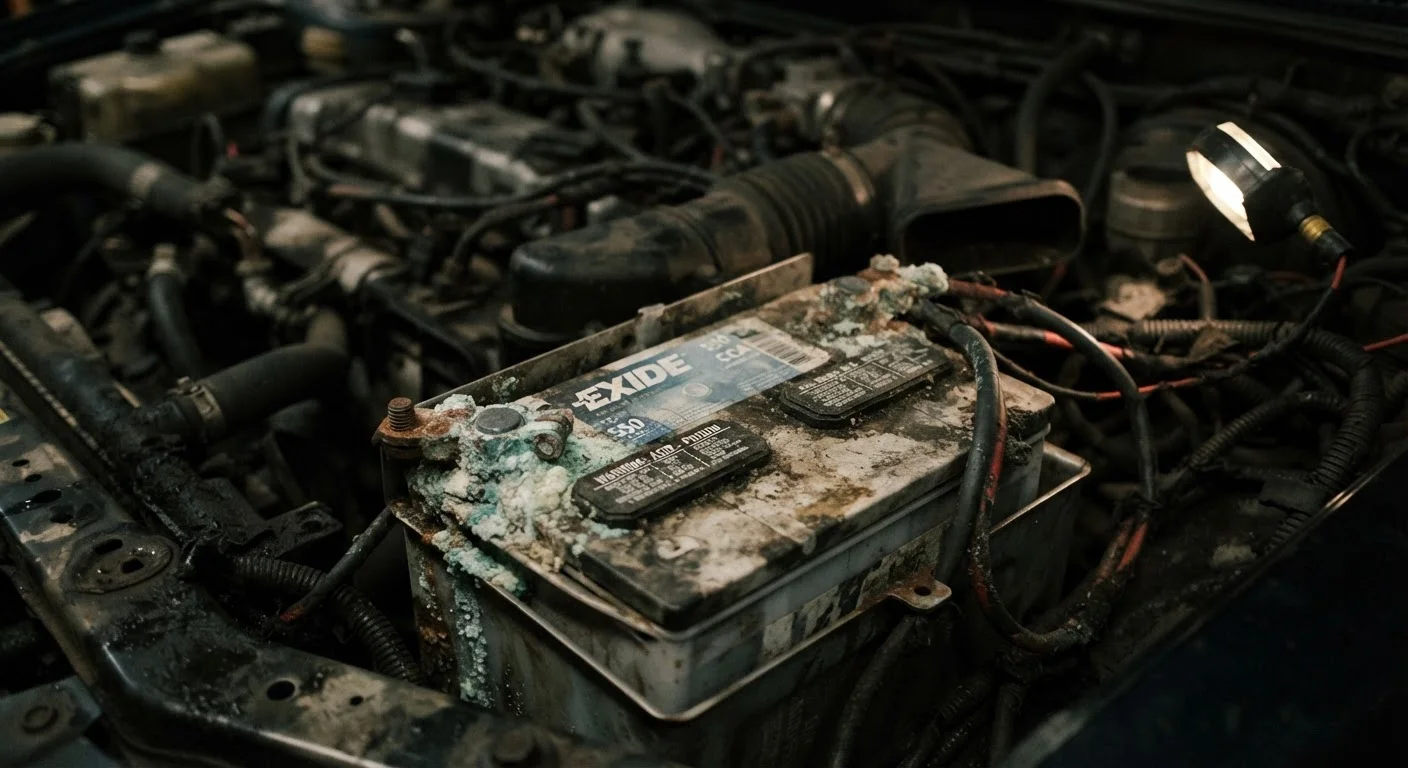
Battery terminals are the physical connection points between the battery and the rest of the vehicle's electrical system. Corrosion - that chalky white or blue-green buildup you may have seen - increases electrical resistance at the connection. High resistance means less current can flow, which strains both the battery and the starter motor.
A loose terminal creates an intermittent connection that can cause random stalling, starting failures, or electrical glitches that are easy to misdiagnose as a faulty alternator or dead battery. Cleaning terminals and ensuring they're properly tightened is one of the simplest maintenance steps a driver can take - and one of the most overlooked. Always disconnect the negative terminal first and reconnect it last to reduce the risk of accidental shorts.
Corroded terminals increase resistance enough to prevent starting even when the battery holds a full charge.
Keeping Your Battery Healthy Longer
When to Have Your Battery Tested
If your car is three or more years old, ask for a battery load test during your next routine service visit. Unlike a simple voltage check, a load test reveals how the battery performs under actual starting conditions. Many shops offer this at no charge, and catching a weakening battery before it fails completely is far less stressful than a roadside breakdown.
Most battery problems are preventable with basic awareness. If your car sits unused for extended periods, the natural self-discharge of the battery combined with small parasitic draws can deplete it within a few weeks. Our article on maintaining a car you rarely drive covers this situation in detail.
It's also worth remembering that battery health connects to broader maintenance habits. Many of the same neglected routines that shorten engine life also stress the electrical system - a point worth exploring in our piece on maintenance habits that quietly shorten a car's life. When in doubt about your battery's condition, have a qualified mechanic test it - most auto shops can do this quickly and inexpensively.