

Key Takeaways
Why Shopping Rights Myths Persist
Most shoppers approach a store with a set of assumptions they've never actually verified: that a wrong price on the shelf must be honored, that a defective item guarantees a full refund, or that some universal consumer law covers every transaction. These assumptions feel reasonable - but many are simply wrong, or only partially true depending on the state and the circumstances.
Understanding the difference between what you believe you're entitled to and what the law actually guarantees can save you time, frustration, and money. The myths below are among the most consequential - the kind that leave consumers without recourse precisely when they need it most.
For a broader look at how misplaced assumptions lead to costly surprises, see our article on common rights misconceptions renters make.
The Most Damaging Myths - and What's Actually True
The following myth-and-fact pairs address the most frequently misunderstood areas of U.S. consumer shopping rights. Each one reflects a gap between widespread belief and legal or practical reality.
Myth
Stores are legally required to accept returns on any item within a reasonable period.
Fact
In most U.S. states, retailers have no general legal obligation to accept returns on non-defective merchandise. Return policies are set by the retailer, not mandated by federal law.
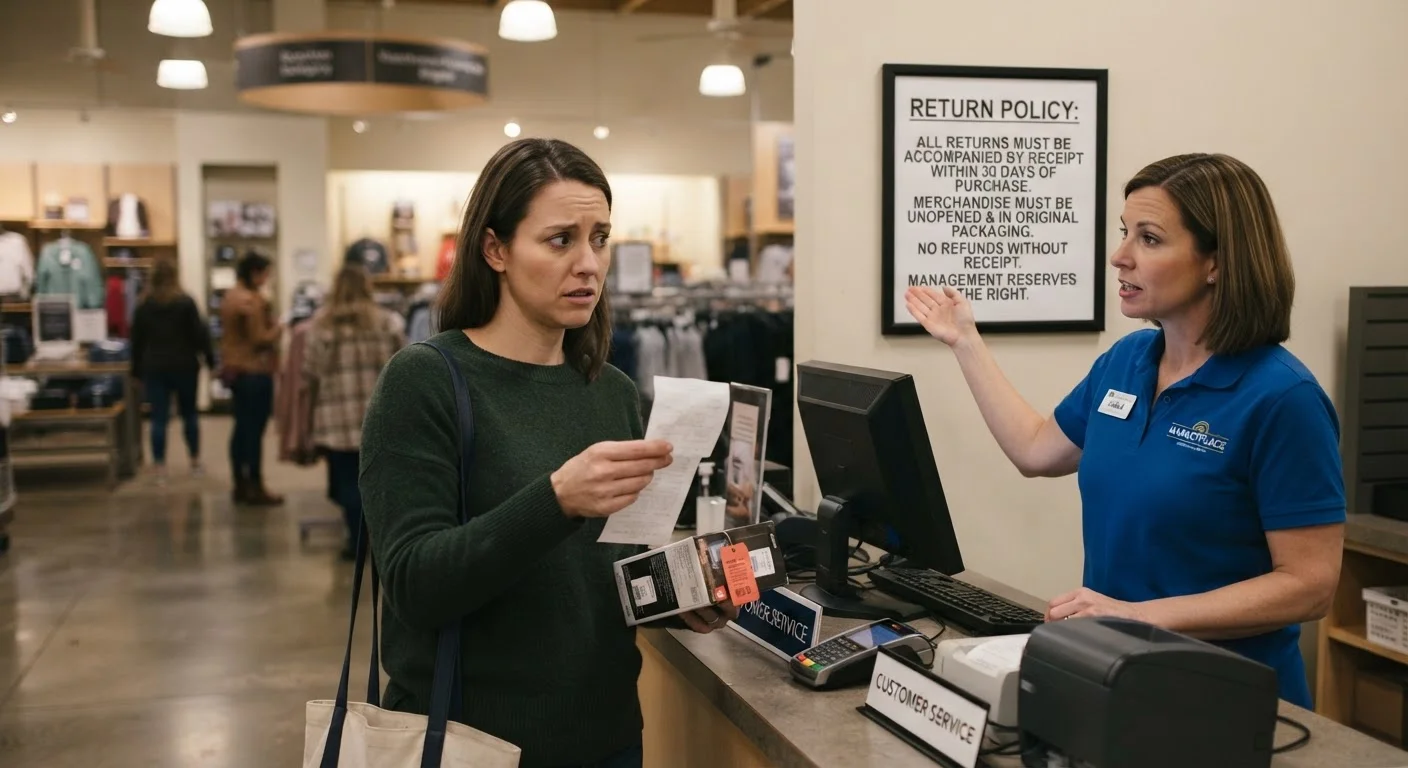
This is one of the most deeply held - and costly - shopping misconceptions. Federal law does not require stores to accept returns on items that work as intended. What stores are required to do in many states is clearly disclose their return policy at the point of sale. If no policy is posted, some states default to a specific return window (commonly 30 days), but that is the exception, not the rule. Always check the return policy before completing a purchase, especially on higher-value or final-sale items.
Myth
If a shelf tag or advertised price is wrong, the store must sell you the item at that price.
Fact
Retailers generally are not legally required to honor a posted price that was listed in error, though some states have pricing accuracy laws that add requirements around disclosure or correction.
A price tag is typically considered an "invitation to deal" rather than a binding contract. If the register rings up a higher price, the store can correct it at checkout and decline to sell at the shelf price. Where pricing accuracy laws do exist - as in some U.S. states - they tend to require that stores correct the error promptly and may offer a small courtesy discount, but they do not universally compel the sale at the wrong price. The safest approach is to flag the discrepancy before completing the transaction and ask to speak with a manager.
Myth
You have a legal right to cancel any purchase within three days.
Fact
The FTC's "Cooling-Off Rule" applies only to specific sales situations - primarily door-to-door sales of $25 or more, and certain off-premises transactions. It does not apply to ordinary retail store purchases.
The Federal Trade Commission's Cooling-Off Rule grants consumers three business days to cancel purchases made in their home, at a temporary commercial location (such as a hotel seminar), or in certain other off-premises contexts. It specifically excludes purchases made at a seller's permanent retail location, purchases of real estate, motor vehicles, credit, and several other categories. Some states have extended similar protections to other contexts, but a general three-day cancellation right for standard retail transactions does not exist under federal law.
Myth
"All sales final" means you have absolutely no recourse if something goes wrong.
Fact
An 'all sales final' policy limits voluntary returns but does not override implied warranty protections, which exist by operation of state law regardless of what a sign says.
Implied warranties - particularly the implied warranty of merchantability - mean that a product must work for its ordinary purpose. A retailer cannot simply post a sign and strip away these state-law protections. If a product is defective or fails to function as a reasonable consumer would expect, you may still have recourse through the manufacturer's warranty, a chargeback with your card issuer, or a small claims court filing. "All sales final" is most legitimately applied to items like used goods, clearance merchandise, or items described as-is - and even then, misrepresentation of a defect can void the policy entirely.
Myth
Online purchases have stronger automatic return rights than in-store purchases.
Fact
There is no federal law granting broader automatic return rights for online purchases. Some states have specific distance-selling disclosure rules, but online retailers set their own policies just as physical stores do.
This myth likely stems from awareness of European consumer law, which does require cooling-off periods for online purchases. In the United States, no equivalent federal rule applies. Online retailers are generally required to disclose their return policies, and the FTC does have rules about prompt shipping and refunds when orders cannot be fulfilled - but these are not blanket return rights. Credit card protections and implied warranties still apply online, and many major online retailers voluntarily offer generous return windows, but those are business decisions, not legal requirements.
Myth
If a company goes bankrupt, consumers automatically get their money back.
Fact
Consumers who are owed refunds or hold gift cards are generally unsecured creditors in bankruptcy proceedings, which means they are among the last paid - and often receive little or nothing.
When a retailer files for bankruptcy, its assets are distributed according to a legal priority order. Secured creditors (such as banks with collateral claims) and certain administrative expenses are paid first. Unsecured creditors - which typically includes customers holding gift cards, store credits, or outstanding refund claims - are at the back of the line. Payment in full is rare. If you hold a retailer gift card and news breaks of financial distress, using the balance promptly is a practical - though not guaranteed - way to reduce exposure. Paying by credit card for large purchases can also provide a chargeback path if goods are never delivered.
Knowing where implied protections actually exist - and where they don't - is the foundation of smart consumer behavior. Our guide on your rights after buying a defective product goes deeper on warranty law and what to do when something breaks.
What Consumers Can Actually Rely On
While many assumed rights don't hold up legally, several genuine protections do exist - and knowing them gives you real leverage.
- Implied warranties: Even when a store posts an "all sales final" sign, implied warranties - the legal expectation that a product will do what it's supposed to do - typically survive under state law. A blender that won't blend is likely still covered regardless of the store's stated policy. See what 'all sales final' actually means for a closer look at where this policy has limits.
- Credit card chargebacks: If a merchant fails to deliver goods or services, or if a charge was unauthorized, your card issuer may be able to reverse the transaction. This is a formal process with documentation requirements and deadlines. Our explainer on when chargebacks apply covers eligibility clearly.
- State-level consumer protection laws: Many states go further than federal baseline rules on issues like deceptive pricing and return disclosure requirements. Checking your state attorney general's consumer protection page is a reliable starting point.
Return policies themselves vary enormously - by retailer, product type, and channel (in-store vs. online). Our breakdown of return policies across common retail situations can help you know what questions to ask before you buy. And if you want to decode the fine print once you've got a policy in hand, see the anatomy of a return policy.
The most effective consumer protection is knowing your actual rights before a dispute arises - not after the receipt is lost and the window has closed.