

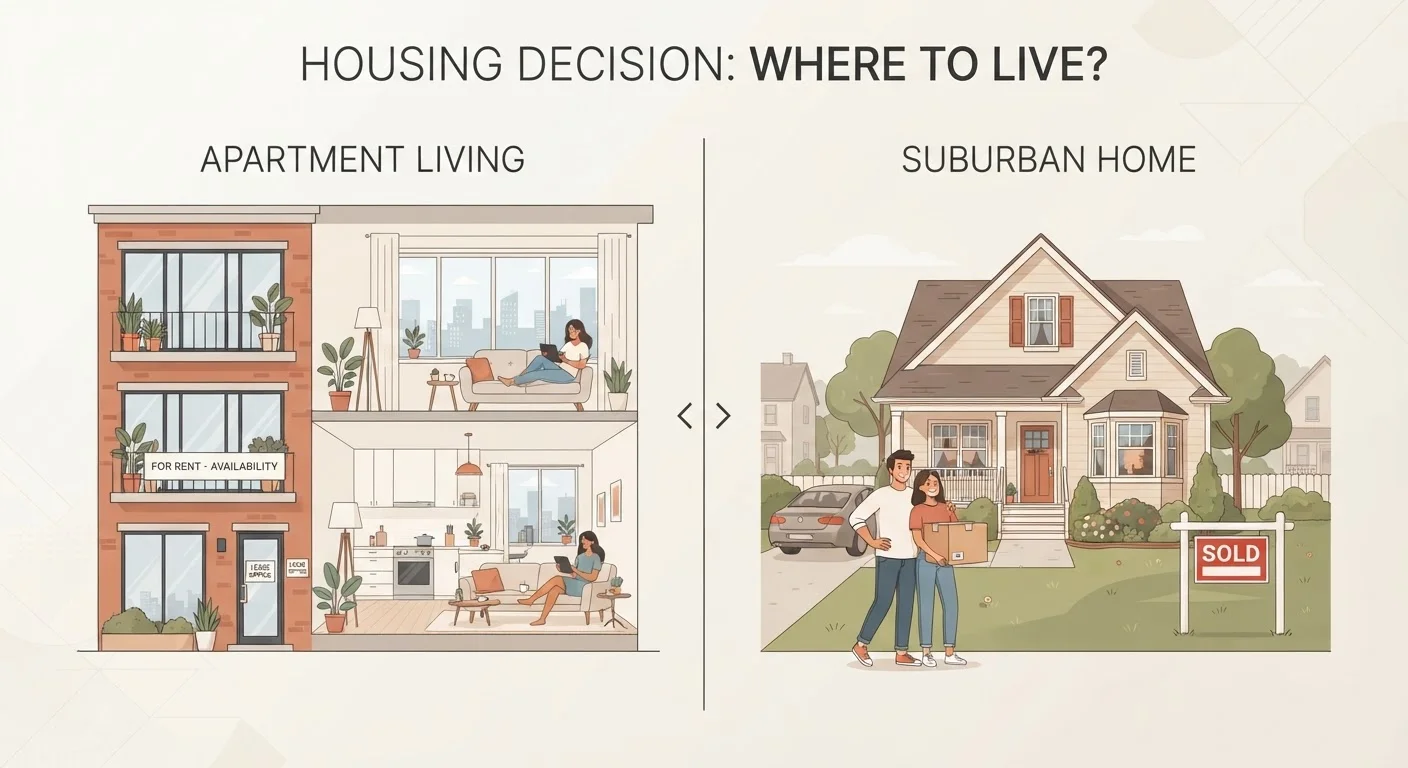
Key Takeaways
Lower barrier to entry than buying
Renting typically requires a security deposit and first month's rent - far less capital than a down payment and closing costs on a home purchase.
Geographic flexibility for life or career changes
A lease can be ended or transferred with relatively limited financial consequences, whereas selling a home involves significant transaction costs and timeline uncertainty.
No maintenance or repair liability
Landlords are generally responsible for major repairs and appliance replacements, protecting renters from unexpected large expenses that homeowners must absorb.
Easier to test a neighborhood before committing
Renting in an area before buying gives you firsthand knowledge of commute times, neighbors, noise levels, and amenities - reducing the risk of an expensive buyer's remorse.
Significant upfront costs to purchase
A conventional home purchase typically requires a down payment of 5-20% of the purchase price, plus closing costs of 2-5%, which can total tens of thousands of dollars.
Maintenance and repair costs fall to the owner
Homeowners are responsible for all upkeep - from routine maintenance to major systems like roofing and HVAC - and should generally budget 1-2% of the home's value annually for these costs.
Reduced mobility once purchased
Selling a home takes time and involves agent commissions, closing costs, and market uncertainty - making it costly to move quickly if circumstances change.
Early mortgage payments are heavily interest-weighted
On a standard amortizing mortgage, a large share of early payments goes toward interest rather than principal, meaning equity builds slowly in the initial years of ownership.
Our Verdict
Buying a home can build long-term wealth and stability, but it demands financial readiness, a long time horizon, and tolerance for maintenance responsibilities. Renting offers genuine advantages - flexibility, predictable short-term costs, and lower barriers to entry - that make it the smarter path in many situations. This isn't a question of which option is objectively better; it's a question of which fits where you are right now.
Buying tends to suit those with stable income, a solid down payment, low existing debt, and plans to stay in one place for at least five to seven years; renting suits those who value mobility, are still building savings, or are in transitional life stages.
Why This Decision Is More Complex Than It Looks
The renting-vs.-buying question gets oversimplified on both sides. Homeownership is often treated as an unambiguous financial milestone, while renting gets dismissed as "throwing money away." Neither framing holds up under scrutiny.
Rent payments cover shelter, maintenance, and flexibility - they're not inherently wasteful. Mortgage payments, meanwhile, include interest, insurance, and taxes that don't build equity at all, especially in the early years of a loan. The real comparison is far more nuanced, and it starts by separating financial factors from lifestyle ones.
For a deeper look at what renting actually costs beyond your monthly check, see the full picture of renting costs. If you're leaning toward a purchase, our homebuying resource hub covers what buyers need to know before signing anything.
The Case for Renting
Renting offers advantages that get undervalued in popular discourse, particularly for people in transitional life stages or high-cost markets.
Lower barrier to entry than buying
Renting typically requires a security deposit and first month's rent - far less capital than a down payment and closing costs on a home purchase.
Geographic flexibility for life or career changes
A lease can be ended or transferred with relatively limited financial consequences, whereas selling a home involves significant transaction costs and timeline uncertainty.
No maintenance or repair liability
Landlords are generally responsible for major repairs and appliance replacements, protecting renters from unexpected large expenses that homeowners must absorb.
Easier to test a neighborhood before committing
Renting in an area before buying gives you firsthand knowledge of commute times, neighbors, noise levels, and amenities - reducing the risk of an expensive buyer's remorse.
One underappreciated factor is optionality. If your job, relationship, or city preferences change, a lease can be exited with far less friction than selling a home. That flexibility carries real economic value. If your situation requires leaving a rental before the term ends, understanding your options matters - subletting versus lease transfer covers two paths with very different implications.
Renters also benefit from predictable short-term costs. A fixed-term lease locks in your payment for the lease period, making budgeting more straightforward than homeownership, where a burst pipe or failing HVAC can cost thousands unexpectedly.
The Case for Buying
Homeownership offers tangible financial and personal benefits - provided the conditions are right for the buyer.
Significant upfront costs to purchase
A conventional home purchase typically requires a down payment of 5-20% of the purchase price, plus closing costs of 2-5%, which can total tens of thousands of dollars.
Maintenance and repair costs fall to the owner
Homeowners are responsible for all upkeep - from routine maintenance to major systems like roofing and HVAC - and should generally budget 1-2% of the home's value annually for these costs.
Reduced mobility once purchased
Selling a home takes time and involves agent commissions, closing costs, and market uncertainty - making it costly to move quickly if circumstances change.
Early mortgage payments are heavily interest-weighted
On a standard amortizing mortgage, a large share of early payments goes toward interest rather than principal, meaning equity builds slowly in the initial years of ownership.
Equity accumulation is real. Over a 30-year mortgage, the principal portion of each payment gradually builds an ownership stake in an appreciating asset (though appreciation is never guaranteed and varies significantly by market). Owners also gain stability: fixed-rate mortgages lock in a payment that won't rise the way rents sometimes do. For more on how mortgage structures affect long-term costs, see fixed-rate vs. adjustable-rate mortgages.
Ownership also confers control - over renovations, pets, paint colors, and long-term plans. For buyers who intend to stay in place for many years, that stability can outweigh the costs and constraints of the purchase process.
~43%
Share of US households that rent
According to U.S. Census Bureau data, roughly 43% of occupied housing units in the United States are renter-occupied, reflecting how common renting is across income levels and life stages.
5-7 years
Typical break-even horizon for buying
Real estate economists generally estimate that homeowners need to stay in a purchased property for at least five to seven years to recoup transaction costs through equity and appreciation.
2-5%
Closing cost range as share of purchase price
The Consumer Financial Protection Bureau notes that closing costs on a home purchase typically range from 2% to 5% of the loan amount, an often-underestimated upfront expense.
The Financial Factors That Actually Matter
Several concrete financial variables should anchor this decision:
- Time horizon: Buying typically requires five to seven years of ownership to recoup transaction costs (closing costs, agent commissions, moving expenses). Shorter timelines often favor renting.
- Down payment and cash reserves: A conventional mortgage generally requires 5-20% down, plus closing costs of 2-5% of the purchase price - and you'll want cash reserves for post-purchase emergencies. Depleting savings to close on a home carries real risk.
- Debt-to-income ratio: Lenders evaluate your total monthly debt obligations against your gross income. High existing debt - student loans, car payments - can affect what you qualify for.
- Local price-to-rent ratio: In some markets, buying is far more expensive relative to renting the equivalent home. Comparing the annual cost of ownership to annual rent in your target area gives useful perspective.
Price-to-Rent Ratio: A Simple Market Check
The price-to-rent ratio compares a home's purchase price to the annual cost of renting a comparable property. Divide the home's listed price by the annual rent for an equivalent unit. A ratio below 15 generally suggests buying may be cost-competitive; above 20 often favors renting in pure cost terms. This is a screening tool, not a definitive answer - local market conditions, interest rates, and individual finances all affect the real outcome.
Financial readiness connects to broader saving and investing priorities. If you're also weighing whether to build an emergency fund or invest, those decisions and this one share important overlaps.
How to Frame Your Own Decision
No formula produces a universal answer, but a few questions cut through the noise:
- How long do you realistically plan to stay in this area?
- Do you have a down payment, closing costs, and cash reserves - without draining your financial cushion?
- Is your income stable enough to absorb a mortgage plus maintenance costs?
- Does renting in your target area give you equivalent or better housing for a materially lower monthly outlay?
- Are you buying because it aligns with your life plans, or because you feel social pressure to own?
The last question matters more than it might seem. Homeownership works well when it's chosen deliberately, not when it's treated as an obligation. The same critical thinking that applies to any major financial commitment - weighing long-term value against upfront cost - applies here. That framework is worth reviewing before committing to either path.
This article is for general informational purposes only and does not constitute financial, legal, or real estate advice. Readers should consult a qualified financial advisor or real estate professional regarding their specific circumstances.