

Key Takeaways
Option A
Fixed-Rate Mortgage
The predictable, set-it-and-forget-it loan structure.
Best for: Buyers who plan to stay long-term and want a consistent monthly payment regardless of market movement.
Option B
Adjustable-Rate Mortgage (ARM)
The flexible, potentially lower-cost option tied to market rates.
Best for: Buyers who expect to move or refinance within a few years and can tolerate some payment variability.
If you plan to stay in the home for 10 or more years
Fixed-Rate Mortgage
Long-term owners benefit most from rate stability. A fixed mortgage protects you from rate increases over decades of ownership.
If you expect to sell or refinance within five to seven years
Adjustable-Rate Mortgage (ARM)
You may pay less interest during the introductory fixed period and sell before the adjustable phase begins, limiting exposure to rate swings.
If you are buying on a tight monthly budget with no room for payment increases
Fixed-Rate Mortgage
Payment certainty is critical when your budget has little flexibility - a rising ARM payment could create financial stress.
If interest rates are historically elevated and expected to fall
Adjustable-Rate Mortgage (ARM)
An ARM can allow your rate to decline with the market, though rate forecasts are never guaranteed and refinancing is always an alternative to consider.
How Each Mortgage Type Is Structured
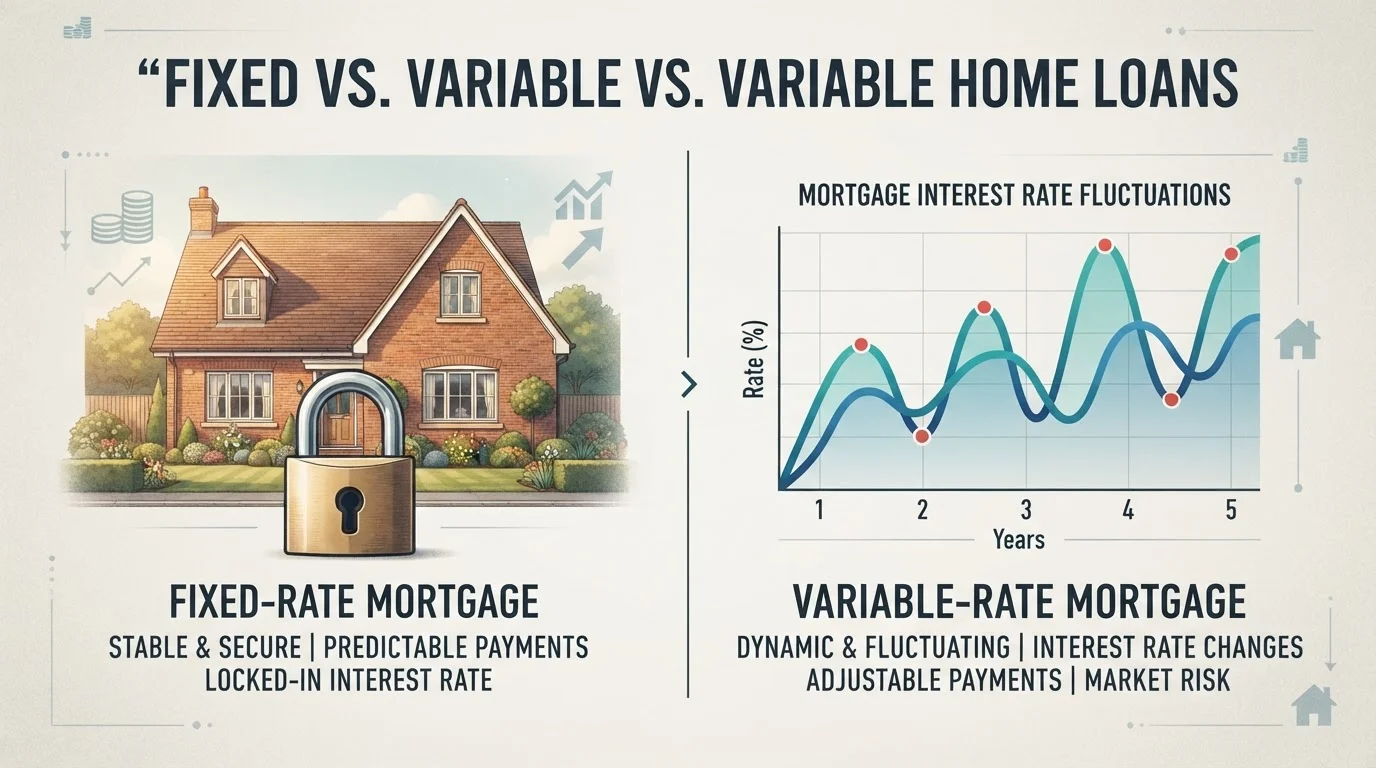
A fixed-rate mortgage carries the same interest rate from the first payment to the last. Whether your term is 15, 20, or 30 years, your principal-and-interest payment never changes. That consistency makes it easier to plan long-term housing costs alongside other fixed and variable expenses in your household budget.
An adjustable-rate mortgage (ARM) is more layered. It begins with an introductory fixed-rate period - commonly 5, 7, or 10 years - after which the rate resets at regular intervals (typically once a year) based on a benchmark index such as the Secured Overnight Financing Rate (SOFR). The shorthand notation matters: a 5/1 ARM means the rate is fixed for 5 years, then adjusts annually. A 7/6 ARM adjusts every six months after a 7-year fixed window.
ARMs include built-in rate caps - limits that control how much the rate can move. A typical cap structure might be written as 2/2/5, meaning the rate can increase no more than 2 percentage points at the first adjustment, 2 points at any subsequent adjustment, and 5 points above the initial rate over the loan's lifetime. These caps provide a ceiling on worst-case scenarios, but rates can still rise meaningfully within those bounds.
| Criterion | Fixed-Rate Mortgage | Adjustable-Rate Mortgage (ARM) |
|---|---|---|
| Interest rate | Locked for entire loan term | Fixed initially, then adjusts periodically |
| Initial rate level | Typically higher | Typically lower during intro period |
| Payment predictability | Fully predictable | Variable after introductory period |
| Rate caps | Not applicable | Per-adjustment and lifetime caps apply |
| Best time horizon | Long-term (10+ years) | Short-to-medium term (5-7 years) |
| Risk exposure | Low - no rate change risk | Moderate - rate can rise after fixed period |
| Refinancing need | Optional | Often needed to lock in stability |
Cost Trade-Offs Over Time
ARMs almost always start at a lower rate than comparable fixed-rate loans. That gap varies with market conditions, but during periods when lenders are actively competing for borrowers, the introductory ARM rate can be meaningfully lower - translating into hundreds of dollars in monthly savings early in the loan. For buyers who are certain they will sell or refinance before the adjustment period begins, those savings can be real and substantial.
The risk arrives when life doesn't follow the plan. If you remain in the home past the fixed window and rates have risen, your payment can climb - sometimes sharply within a few adjustment cycles, even within cap limits. On a $400,000 loan balance, a 3-percentage-point rate increase raises a monthly payment by roughly $600 or more, depending on remaining term. That's a material shift in housing cost that fixed-rate borrowers never face.
Fixed-rate loans typically cost more in interest over their early years precisely because you're paying for certainty. Whether that premium is worth it depends heavily on your time horizon and risk tolerance - factors no single formula can fully resolve for every buyer. If you're still weighing whether homeownership makes sense at all, our overview of renting versus buying walks through that foundational question.
30 years
Most common fixed-rate mortgage term in the US
The 30-year fixed-rate mortgage has historically been the most widely used home loan product among American borrowers, according to Federal Reserve and Freddie Mac data.
~8-12%
Share of mortgage applications that are ARMs
ARM applications typically represent a small fraction of total mortgage activity but rise when fixed rates are elevated, according to the Mortgage Bankers Association.
2/2/5
Typical ARM rate cap structure
A 2/2/5 cap limits the first adjustment to 2 points, subsequent adjustments to 2 points each, and the lifetime increase to 5 points above the starting rate.
Factors That Should Drive Your Decision
How long you'll stay matters most. If you have strong reasons to believe you'll move within five to seven years - a job transfer, a growing family that will need more space, or a planned relocation - an ARM's introductory period may align well with your actual ownership window. If you're buying your forever home or a property you intend to hold through retirement, the stability of a fixed rate typically wins on risk-adjusted grounds.
Home values also play a role indirectly. In appreciating markets, many ARM borrowers refinance into fixed-rate loans once they've built equity, locking in gains before the adjustable phase triggers. But refinancing isn't free - closing costs, appraisal fees, and market timing add uncertainty. Don't build a plan that depends on a future refinance going smoothly.
Rate environment context matters, with caveats. When fixed rates are at historic highs, ARMs look more attractive because the spread between introductory ARM rates and fixed rates may be larger. When fixed rates are already low, giving up that certainty for a modest ARM discount makes less sense. That said, rate forecasting is notoriously unreliable - financial professionals regularly caution against making major loan decisions based on interest rate predictions alone.
Finally, consider your income stability. A borrower with a variable income, a self-employed individual, or someone navigating career transitions may find that a fixed payment reduces financial complexity at a time when other costs are already unpredictable.
This article is for general informational and educational purposes only and does not constitute personalized financial or mortgage advice. Consult a licensed mortgage professional or financial adviser before making decisions based on your specific circumstances.