

Key Takeaways
Monetary Policy & Property Values
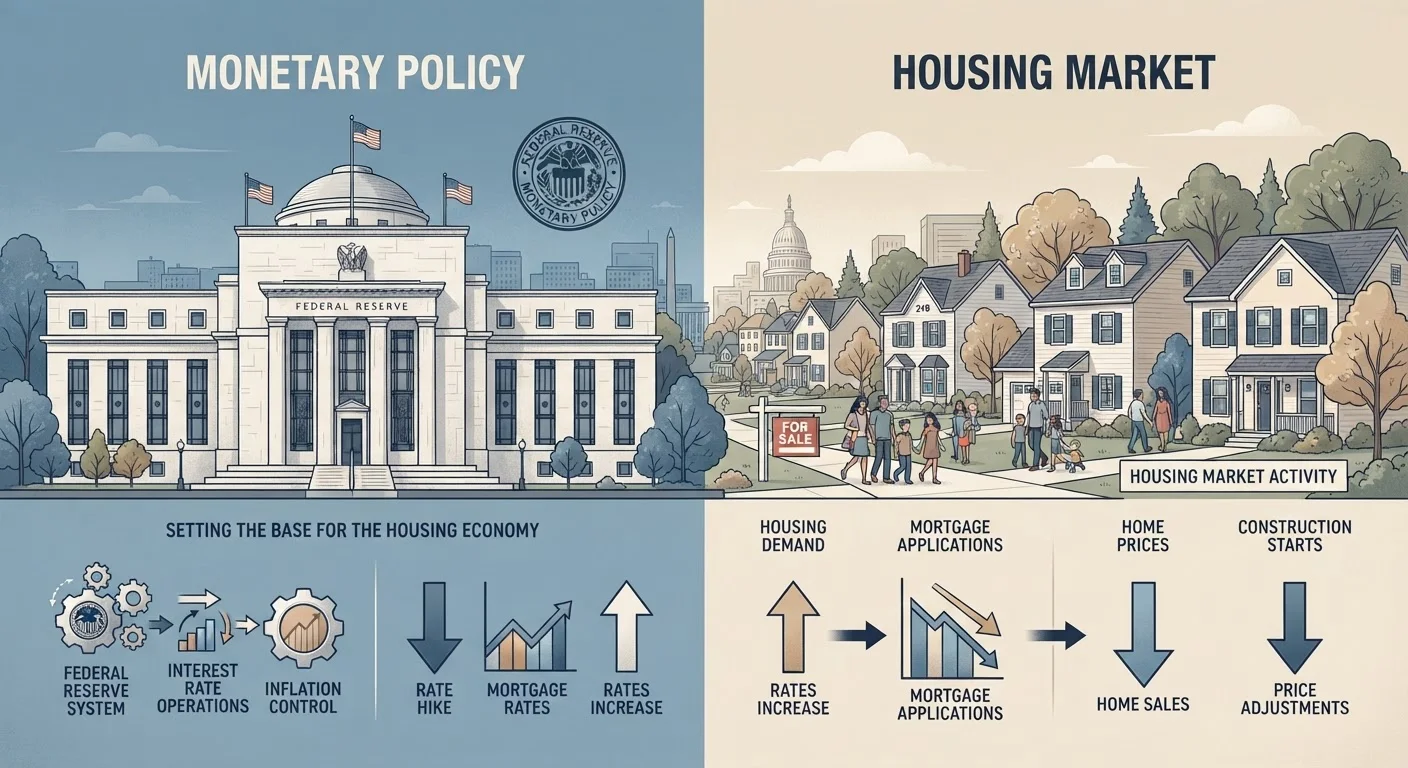
Monetary policy refers to the decisions a central bank - in the U.S., the Federal Reserve - makes about interest rates and the money supply. When the Fed raises or lowers its benchmark rate, borrowing costs across the economy shift, including the mortgage rates that buyers pay to finance a home purchase. Because most buyers rely on mortgages, those rate changes directly influence how much home a buyer can afford, which in turn affects what sellers can reasonably charge and what the market will bear.
The Fed does not set mortgage rates directly; it sets the federal funds rate, which influences short- and long-term lending benchmarks. Mortgage rates track more closely with 10-year U.S. Treasury yields, though both are shaped by Fed policy expectations.
The Transmission Mechanism: From the Fed to Your Mortgage
When the Federal Reserve raises its benchmark federal funds rate, it becomes more expensive for banks to borrow money overnight. Those higher costs cascade through the financial system, nudging up rates on auto loans, credit cards, business credit - and mortgages. While 30-year fixed mortgage rates track 10-year U.S. Treasury yields most closely, both are heavily influenced by the market's expectations of Fed policy.
The practical effect on homebuyers is straightforward: a one-percentage-point increase in a mortgage rate meaningfully raises the monthly payment on any given loan amount. According to commonly cited mortgage math, a 1% rate increase on a $400,000 loan adds roughly $240 or more to the monthly payment. For buyers working within a budget, that arithmetic forces a difficult choice - accept a higher payment, lower the target purchase price, or step back from the market entirely.
Understanding this mechanism is a foundational piece of reading the housing market. For a broader look at what else shapes what a home is worth, see what actually determines your home's value.
How Affordability Shifts Drive Demand - and Prices
Home prices in a free market are ultimately shaped by supply and demand. Interest rates enter the equation primarily through the demand side. When rates rise and monthly payments become less manageable, some prospective buyers are priced out entirely, others downsize their ambitions, and still others choose to rent and wait. The pool of qualified, motivated buyers shrinks.
With fewer competing offers, sellers face more pressure to negotiate. Days on market extend, list prices get cut, and bidding wars fade. Over time - typically several months to over a year - this reduced demand is reflected in softer transaction prices.
The reverse is equally true. When the Fed cuts rates, mortgage payments fall for the same purchase price. Buyers who were previously sidelined can re-enter the market. Demand rises, inventory tightens, and upward price pressure builds. This dynamic was visible in the low-rate environment of 2020-2021, when mortgage rates fell to historic lows and home prices surged in many U.S. markets.
~$240
Estimated monthly payment increase per 1% rate rise
Based on standard mortgage calculations for a $400,000 loan; actual figures vary by loan type, term, and lender.
6-18 months
Typical lag before rates fully affect home prices
Economic research generally finds home price responses to rate changes unfold over this window, not immediately.
~65%
Share of U.S. homes purchased with a mortgage
According to U.S. Census Bureau housing survey data, the majority of home transactions involve financed purchases, amplifying rate sensitivity.
Supply constraints complicate this picture. In cities where zoning restrictions, geographic limits, or construction costs keep new housing scarce, even meaningful demand pullbacks may not translate into sharp price declines. The interaction of rates, demand, and local supply is why national trends don't always match what's happening in a specific neighborhood. Neighborhood-level dynamics play a significant independent role in how these forces land locally.
Seller and Investor Behavior in a Rate-Shifting Market
Rate changes don't only affect buyers. Sellers holding existing mortgages at low rates face a dilemma when rates rise sharply: listing their home means giving up a favorable loan to finance the next purchase at a higher rate. This so-called "lock-in effect" reduces the number of homes that come to market, constraining supply even as demand softens - a tension that can prevent prices from falling as much as pure demand math would suggest.
Real estate investors run their own calculations. Higher borrowing costs compress the cash-flow margins on rental properties, making some acquisitions unprofitable at current prices. When institutional and individual investors pull back, that further reduces transaction volume and can soften prices in investment-heavy markets.
Think Beyond the Rate Headline
When evaluating how rate changes affect your local market, look at inventory levels alongside interest rate trends. A rate increase in a supply-constrained market behaves very differently than the same increase in a market with abundant listings. Both pieces of information together give you a more accurate read on where prices may be headed.
For buyers weighing how to structure financing in different rate environments, understanding the trade-offs between loan types matters. Fixed-rate vs. adjustable-rate mortgages behave very differently when rates are rising versus falling, and the right choice depends on how long you plan to hold the property.
Reading Rate Trends as Part of a Broader Market Picture
Interest rates are one of the most powerful levers acting on property values, but they operate alongside employment trends, population growth, housing construction levels, consumer confidence, and local economic conditions. A market with strong job growth and limited new construction may hold values firm even as national rates rise. A market with weak demand and oversupply may see prices fall even when rates are relatively low.
Tracking how home values have moved historically - and understanding the indexes used to measure them - helps put rate-driven shifts in context. How home values are tracked over time covers the major measurement tools, from the Case-Shiller Index to local assessor data, that analysts rely on to separate signal from noise.
For anyone new to thinking about property values as a concept, a first-timer's primer on home values offers a plain-language foundation before diving into macro forces like monetary policy.
This article is for general informational and educational purposes only and does not constitute financial, investment, or legal advice. Consult a licensed financial advisor or mortgage professional before making decisions based on your specific circumstances.