

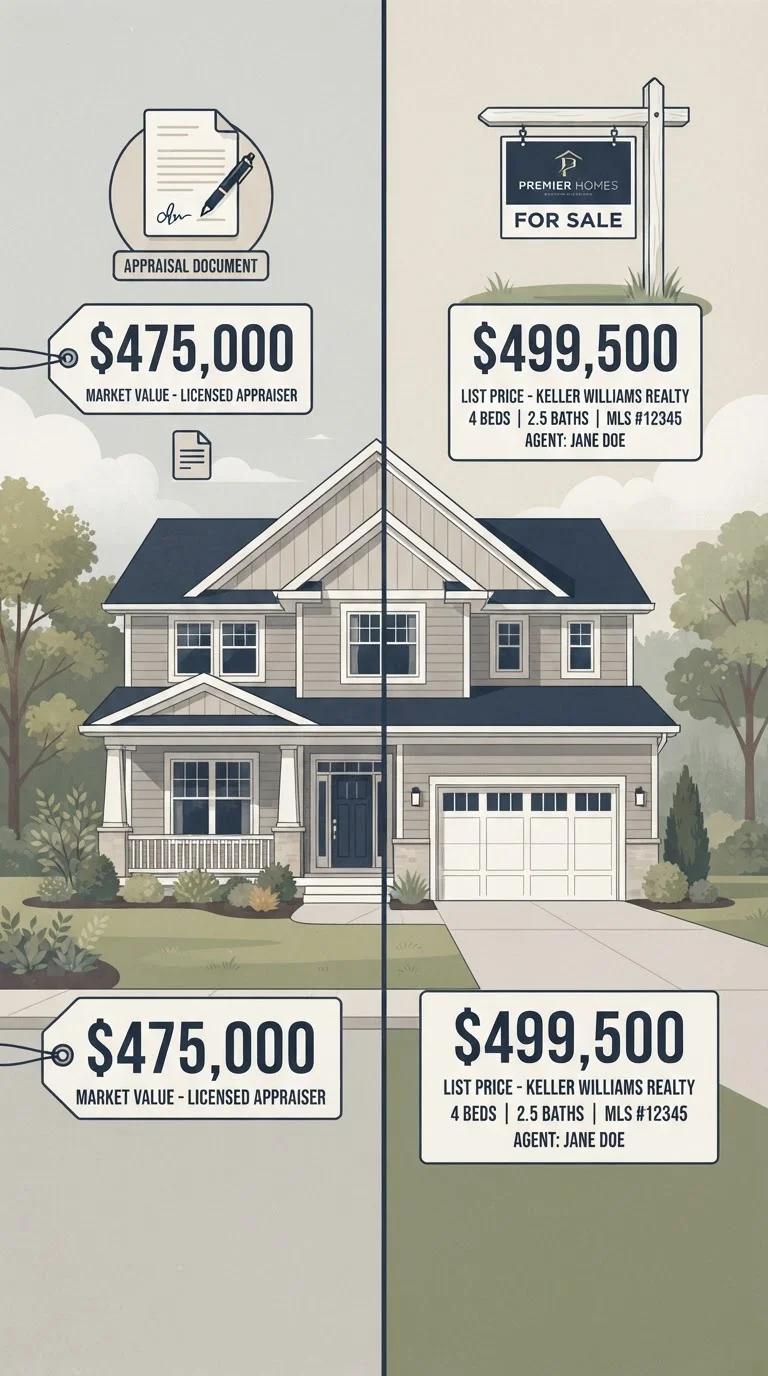
Key Takeaways
Option A
Appraised Value
The lender's objective, licensed estimate of a property's worth.
Best for: Mortgage qualification, refinancing, and estate or tax-related transactions requiring a formal, defensible valuation.
Option B
Market Value
The price a willing buyer and seller agree on in an open, competitive market.
Best for: Setting a listing price, making an offer, and gauging neighborhood demand in real-time.
If you are applying for a mortgage or refinancing
Appraised Value
Lenders base loan-to-value ratios on the appraised figure. Market enthusiasm does not affect what a lender will underwrite.
If you are pricing a home to sell competitively
Market Value
Buyers shop by comparison. A price anchored to recent comparable sales (comps) attracts serious offers and reduces time on market.
If you are a buyer deciding how much to offer
Market Value
Understanding what similar homes have sold for helps you make a competitive but informed offer without overpaying.
If an appraisal comes in below the agreed purchase price
Appraised Value
The gap defines your problem: the lender will only finance based on appraised value, so buyers and sellers must close the difference through renegotiation or additional funds.
Two Different Questions, Two Different Numbers
When a home is bought or sold, at least two valuations typically enter the conversation - and they often disagree. Appraised value is a formal, licensed estimate of what a property is worth based on condition, comparable sales, and established methodology. Market value is the price a motivated buyer and a motivated seller would agree on through arm's-length negotiation in a competitive market.
These definitions sound similar, but they are measuring different things. Appraised value answers: What would a reasonable, informed buyer pay for this property under normal conditions? Market value answers: What did buyers actually pay for comparable homes recently, and what does that signal about this one? For a deeper look at the forces behind either number, see what actually determines your home's value.
The distinction matters because each figure serves a different stakeholder. Sellers and buyers negotiate around market value. Lenders underwrite loans based on appraised value. When those two numbers align, transactions proceed smoothly. When they diverge, deals get complicated.
How Each Value Is Determined
Appraised value is produced by a state-licensed or state-certified appraiser, typically hired by - and working independently of - the lender. The appraiser physically inspects the property, evaluates its condition, square footage, age, and features, then applies a structured methodology (most often the sales comparison approach) using recent, nearby comparable sales. The result is documented in a standardized report, commonly the Fannie Mae Form 1004 for single-family homes.
Because the process is regulated and the appraiser is bound by the Uniform Standards of Professional Appraisal Practice (USPAP), the figure is designed to be objective and reproducible. That said, appraisers exercise professional judgment - two appraisers working from the same data can reach modestly different conclusions. For a detailed walkthrough of the process, see what to expect from a professional home appraisal.
Market value, by contrast, emerges from the interaction of supply and demand. Real estate agents use a comparative market analysis (CMA) - a review of active listings, pending sales, and recently closed comparable properties - to recommend a list price or evaluate an offer. Unlike an appraisal, a CMA is not a licensed opinion of value; it is an analytical tool. You can learn to read one yourself: reading a CMA without a real estate license.
| Criterion | Appraised Value | Market Value |
|---|---|---|
| Who determines it | Licensed, independent appraiser | Buyers and sellers in the open market |
| Primary purpose | Mortgage underwriting and formal transactions | Pricing, negotiation, and listing strategy |
| Methodology | Standardized USPAP-governed appraisal report | Comparative market analysis (CMA) or offer data |
| Regulatory backing | State-licensed; governed by USPAP | No licensing required; market-driven |
| Reflects emotion or urgency | No - designed to exclude bidding wars | Yes - can rise with competition and demand |
| Who pays for it | Typically the buyer (via closing costs) | No direct cost - embedded in negotiation |
| When it matters most | Mortgage approval, refinancing, estate settlement | Setting list price, making or evaluating offers |
What Happens When the Numbers Diverge
An appraisal gap occurs when a home's appraised value falls below the agreed purchase price. This is a concrete problem in financed transactions: a lender will typically loan only up to the appraised value (based on the agreed loan-to-value ratio). If the purchase price is $420,000 but the appraisal comes back at $395,000, the lender's maximum loan is calculated on $395,000 - leaving the buyer to cover the $25,000 difference in cash, renegotiate the price with the seller, or walk away if the contract includes an appraisal contingency.
Appraisal Contingencies Protect Buyers
Most standard purchase contracts include an appraisal contingency, which allows buyers to exit the deal - typically without losing their earnest money deposit - if the appraised value falls short of the purchase price. In competitive markets, some buyers waive this contingency to strengthen their offer, but doing so eliminates a key financial safeguard. Review any contingency waiver carefully with your real estate attorney or agent before signing.
Sellers facing a low appraisal have options too: accept the renegotiated price, challenge the appraisal by providing the appraiser with overlooked comparable sales data, or order a second appraisal (though lenders control which reports they accept). None of these paths are guaranteed to resolve the gap.
In competitive markets, sellers sometimes receive offers above asking price - and above likely appraised value. Buyers in those situations may pre-emptively waive the appraisal contingency or commit to covering a gap up to a specified amount. This carries real financial risk and should be approached with full awareness of the exposure involved. It is worth distinguishing appraised and market value from a third figure that often causes confusion - assessed value, which is used for property tax purposes and operates under entirely different rules. See the difference between appraised, market, and assessed value for a complete breakdown.
Which Number Should Guide Your Decisions?
Neither value is universally more important - the right one depends on your role and what decision you face. Buyers benefit from understanding both: market value tells you whether you're paying a fair price relative to the competition; appraised value tells you whether your lender will support that price.
Sellers should price with market value in mind but anticipate the appraisal. A listing price that dramatically exceeds supportable comparable sales invites a gap - and a stalled deal. Pricing in line with recent comps reduces that risk.
It is also worth noting that online automated valuation models (AVMs) - the estimates generated by real estate portals - are neither appraised values nor true market values. They are statistical approximations with variable accuracy. Understand their limitations before relying on them: online home value estimators: useful tool or rough guess?.
Ultimately, the relationship between appraised and market value reflects a broader principle: price and value are not the same thing. For a broader treatment of that distinction, see price vs. value in everyday decisions. In real estate, understanding both numbers - and the gap between them - is what separates informed participants from those caught off guard at the closing table.