

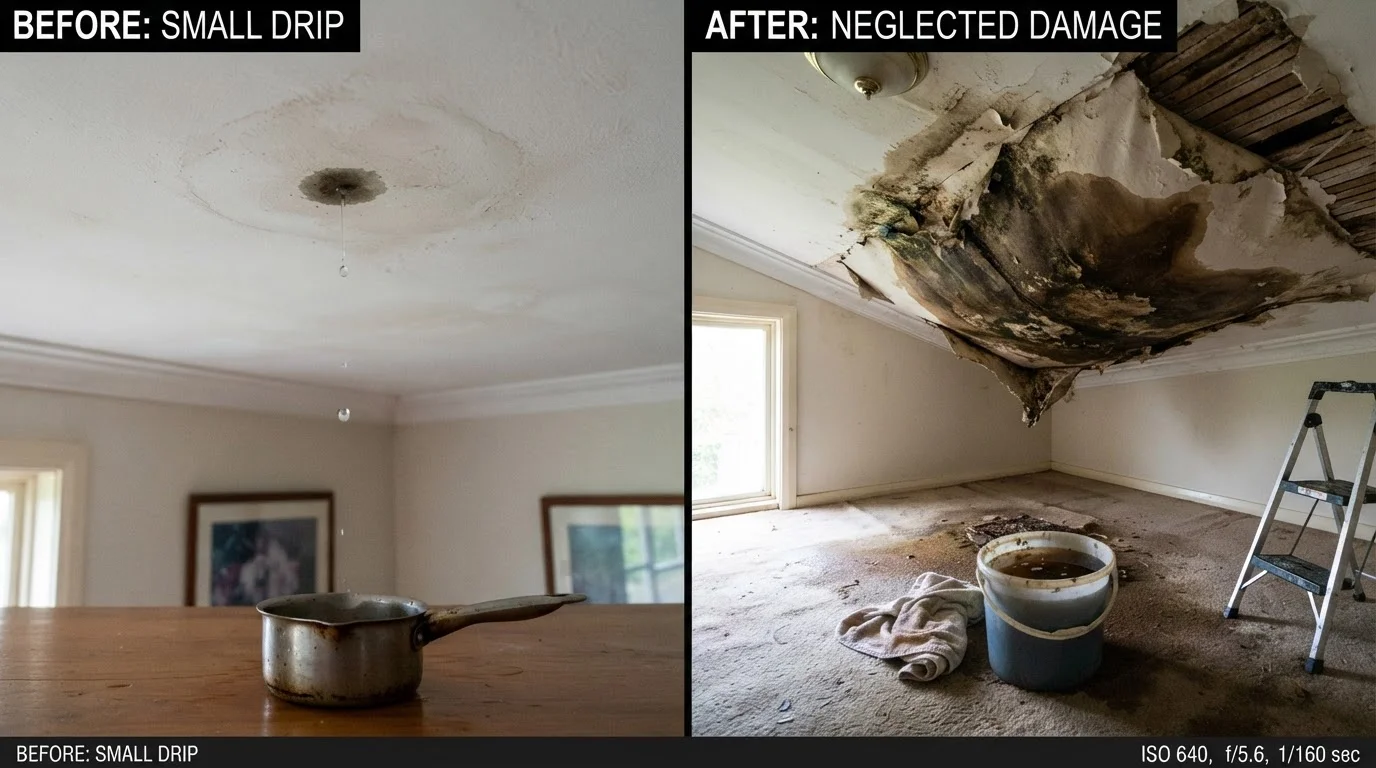
Key Takeaways
Deferred Maintenance
Deferred maintenance refers to repairs and upkeep tasks that are knowingly postponed rather than addressed on schedule. It happens when homeowners delay routine work - caulking a window, cleaning gutters, or servicing an HVAC unit - often due to cost, time, or simple oversight. Over time, these small deferrals compound, causing minor issues to escalate into expensive structural or system failures.
In property management and real estate appraisal, deferred maintenance is formally assessed as a measurable depreciation factor that reduces a property's market value.
Why Small Problems Don't Stay Small
Most deferred maintenance doesn't announce itself as a crisis. It starts quietly - a missing shingle, a slow drain, a hairline crack in exterior caulk. Homeowners often set these aside intending to get back to them. The problem is that homes operate as interconnected systems, and a failure in one area rarely stays contained.
Take a clogged gutter as an example. Left uncleared, water backs up and pools against the fascia board and roof edge. Over one or two seasons, that standing moisture rots the wood, creates an entry point for water into the attic, and may cause ice dams in cold climates. What started as a $150 gutter cleaning can evolve into a $4,000 to $10,000 repair involving roofing, framing, and interior ceiling work.
This pattern - where a small, inexpensive fix becomes a large, expensive one through delay - is the defining characteristic of deferred maintenance costs. The longer the delay, the more systems become involved, and the more the final bill climbs.
1-3%
Annual home value to budget for maintenance
This is a widely used rule of thumb among housing professionals to help homeowners build an adequate maintenance reserve.
10x+
Cost multiplier for delayed water damage repairs
Home inspectors and contractors commonly observe that water damage repairs grow by an order of magnitude when moisture intrusion goes unaddressed for multiple seasons.
$15,000+
Median cost of major deferred maintenance corrections
Real estate professionals note that buyers frequently request significant price reductions when inspections reveal accumulated deferred maintenance on a listed home.
The Compounding Cost Structure
Deferred maintenance costs follow a compounding logic similar to financial debt. Early-stage neglect may add only modest costs. But as damage spreads into adjacent materials or systems, repair scopes widen and labor complexity increases. Emergency or urgent repairs also typically carry premium pricing compared to scheduled maintenance work.
Consider HVAC servicing. Skipping annual filter changes and tune-ups doesn't immediately break a system, but it forces the unit to work harder. Over several years, that strain degrades components - first the capacitor, then the blower motor, eventually the compressor. A $150 annual service visit that was skipped for five years can result in a $3,000 to $6,000 compressor replacement - or full system replacement if the unit is near the end of its lifespan.
Water intrusion follows a similar arc. A $200 caulking repair around a window frame, if ignored, allows moisture to enter wall cavities. Mold growth can follow within weeks in humid climates. Remediation, drywall replacement, and repainting can run well into the thousands - and mold issues may also complicate future insurance claims or resale disclosures.
For a broader look at how overlooked costs accumulate, see our guide to hidden ownership costs.
High-Risk Areas Every Homeowner Should Monitor
While any system can suffer from neglect, several areas of a home carry disproportionate risk when maintenance lapses:
- Roof and flashing: Damaged or missing shingles and deteriorated flashing around chimneys and vents are among the most common entry points for water damage.
- Foundation and grading: Soil that slopes toward the home directs rainwater into the foundation. Cracks left unsealed allow moisture intrusion that weakens structural integrity over time.
- Plumbing connections and supply lines: Braided steel supply lines and washing machine hoses have finite lifespans. A burst hose can cause tens of thousands of dollars in water damage in minutes.
- Electrical panels and wiring: Outdated or overloaded panels, and deteriorating insulation on older wiring, are fire risks that inspectors and insurers take seriously.
- HVAC filters and drainage lines: A clogged condensate drain line on a central air system can overflow and damage ceilings, insulation, and drywall in finished spaces.
Staying ahead of these systems is the core purpose of a structured maintenance calendar. Our seasonal home maintenance calendar breaks down exactly what to check and when throughout the year.
The Real-World Financial Impact
Quantifying the cost of deferred maintenance in precise terms is difficult because it varies widely by home age, climate, and the specific systems involved. However, industry professionals and home inspectors consistently observe that deferred maintenance accelerates depreciation and inflates repair costs across the board.
One widely referenced budgeting benchmark suggests homeowners set aside between one and three percent of their home's value annually for maintenance and repairs. A $350,000 home would warrant $3,500 to $10,500 per year - not as a guaranteed spend, but as a reserve against the inevitable needs of an aging structure. Homeowners who consistently defer maintenance often face irregular but very large repair bills instead.
Beyond direct repair costs, there are downstream financial consequences. Deferred maintenance can reduce a home's appraised value, weaken negotiating position during a sale, or disqualify a home from certain financing programs. Insurers may also deny claims for damage attributed to neglect rather than a covered sudden loss. The true cost of ownership checklist offers a useful framework for accounting for upkeep costs before making major home purchases or upgrades.
This article is for general informational purposes only. Repair costs and outcomes vary significantly by region, home condition, and contractor. Consult a licensed contractor or home inspector for guidance specific to your property.