

Key Takeaways
How to Read a Foundation Crack Before Calling Anyone
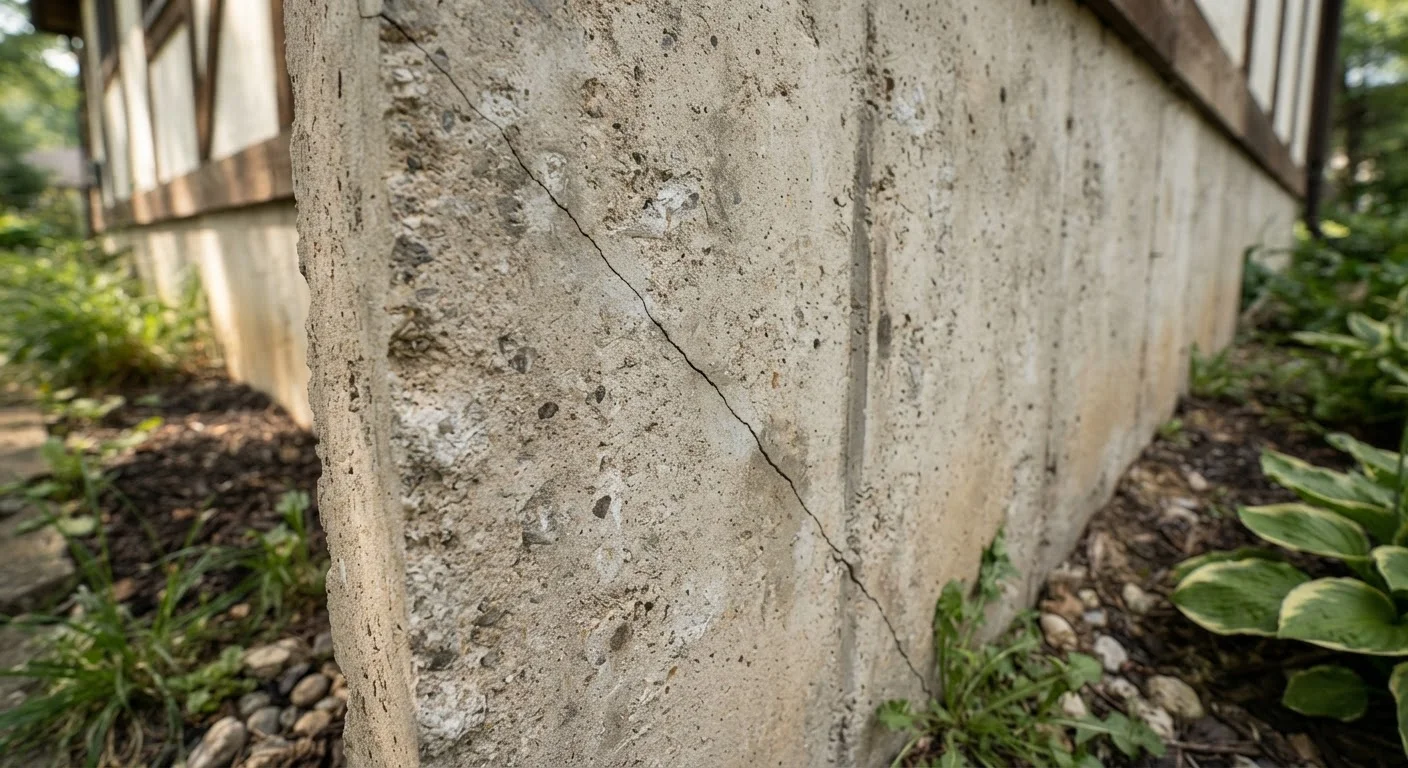
When you spot a crack in your foundation, resist the urge to either panic or ignore it. Your first step is gathering basic information: width, orientation, length, and whether any displacement is visible. These four observations will guide every decision that follows.
Width is your most immediate indicator. A crack thinner than 1/16 inch - roughly the width of a credit card edge - is almost always a cosmetic shrinkage crack in poured concrete. Anything approaching 1/4 inch or wider demands closer scrutiny. Orientation matters enormously: vertical cracks tend to be less serious than horizontal ones, and diagonal cracks fall somewhere in between depending on their pattern. Displacement - where one side of the crack sits higher or lower than the other - is a red flag regardless of width, because it indicates the foundation has actually shifted.
Finally, note any associated symptoms: water seeping through the crack, white powdery deposits (called efflorescence), or nearby doors and windows that have started sticking. These details help a structural engineer or foundation contractor understand what's driving the cracking, not just where it is.
Myth
Any crack in my foundation means the house is structurally unsafe and needs major repairs right away.
Fact
Most foundation cracks - especially narrow, vertical hairlines - are cosmetic results of normal concrete shrinkage and do not compromise structural integrity.
Concrete shrinks slightly as it cures, and that process almost always produces minor cracking. Vertical hairline cracks (thinner than 1/16 inch) in poured concrete walls are extremely common in homes of all ages and are typically categorized as shrinkage cracks. They rarely penetrate the full depth of the wall and don't affect load-bearing capacity. The key is monitoring: measure the crack with a ruler or use a crack gauge, mark the ends with a pencil date stamp, and check it every few months. If it stays the same width and length, it's cosmetic.
Myth
A crack that's been there for years is obviously not serious - if it were, something would have failed by now.
Fact
Age alone doesn't make a crack safe. Some structural cracks progress slowly over years before triggering noticeable damage.
Slow-moving soil settlement, gradual changes in drainage patterns, or seasonal freeze-thaw cycles can widen a crack incrementally over a long period. A crack that has been stable for a decade can begin progressing again if site conditions change - for example, if a new downspout concentrates water near the foundation, or if drought causes the soil to shrink and shift. Periodic measurement is more reliable than elapsed time as a safety indicator.
Myth
Horizontal cracks are just as harmless as vertical ones - cracks are cracks.
Fact
Horizontal cracks are the most structurally concerning type in a basement wall and often indicate significant lateral soil or hydrostatic pressure.
A horizontal crack running across a concrete block or poured concrete basement wall signals that the wall may be bowing inward under pressure from the surrounding soil or groundwater. Unlike vertical shrinkage cracks, horizontal ones suggest the wall is being pushed rather than simply settling. This can escalate to wall failure if left unaddressed. If you see a horizontal crack - especially one running across multiple block courses - treat it as a priority inspection item and consult a structural engineer. Just as with your roof, catching problems early matters: see our guide on spotting structural warning signs early.
Myth
Stair-step cracks in a brick or block foundation are purely decorative issues.
Fact
Stair-step cracks following mortar joints often indicate differential settlement - meaning one part of the foundation is sinking more than another.
When soil beneath a foundation settles unevenly, the structure responds by cracking along the weakest path - typically the mortar joints in a concrete block or brick foundation. The resulting stair-step pattern is a tell-tale sign. Small, tight stair-step cracks (hairline width, minimal separation) may simply reflect past settling that has since stabilized. But if the crack shows separation wider than 1/4 inch, displacement between adjoining blocks, or continues to grow, differential settlement may still be active and should be evaluated by a foundation specialist.
Myth
I can determine if a foundation crack is serious just by looking at it once.
Fact
A single observation tells you very little; monitoring change over time is what reveals whether a crack is stable or active.
Professionals use several tools to assess cracks accurately: they measure width with a crack comparator gauge, note whether edges are sharp or rounded (sharp suggests recent movement), look for displacement (one side higher than the other), and check for efflorescence (white mineral deposits indicating water infiltration). Most importantly, they return to measure again. Homeowners can adopt the same principle with a simple pencil line drawn at each end of a crack marked with the date. If the crack grows beyond your marks or widens measurably between inspections, it's time for a professional evaluation.
Keeping Cracks Cosmetic: Maintenance That Prevents Escalation
Many foundation cracks that start cosmetically become structural because of preventable water and drainage problems. The soil surrounding a foundation exerts far less pressure when it stays consistently dry. Here's where routine maintenance pays off.
Patching Alone Won't Fix Structural Problems
Filling a crack with hydraulic cement or epoxy injection can seal out moisture temporarily, but it does not address the underlying cause. If the soil, drainage, or structural load issue driving the crack isn't corrected, the crack will return - often larger. Always diagnose before you patch, and consult a professional when the cause is unclear.
- Grade your yard away from the foundation. The soil surface should slope downward at least 6 inches over the first 10 feet away from the house. Flat or inward-sloping grades funnel rainwater directly toward the footing.
- Extend downspouts. Gutters that discharge at the foundation wall concentrate enormous volumes of water in exactly the wrong place. Extensions that carry runoff at least 4-6 feet away from the house significantly reduce hydrostatic pressure.
- Check window wells. Basement window wells that fill with water during rain can transmit moisture directly through the wall. Ensure wells have gravel drainage at the bottom and covers if necessary.
- Monitor trees and large shrubs. Roots seeking moisture can destabilize the soil around footings over time. Large plantings within 10 feet of the foundation deserve periodic attention.
These are the same categories of preventive maintenance that protect other home systems, too. Just as drainage problems can damage a foundation gradually, unaddressed moisture vulnerabilities affect your roof and structure - our article on catching roof problems before they escalate illustrates a similar early-detection approach.