

Key Takeaways
Compound Interest
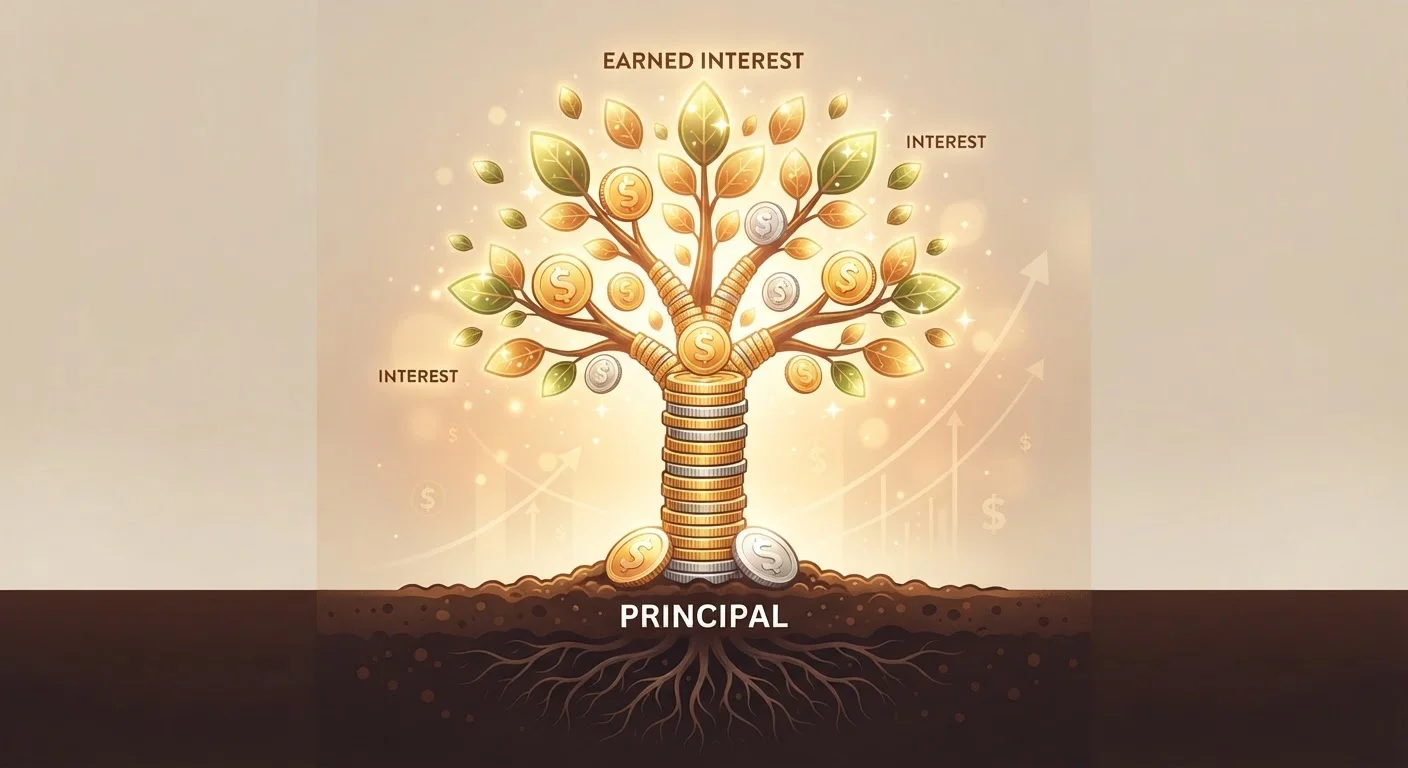
Compound interest is interest calculated on both your original deposit (the principal) and the interest that has already accumulated. Unlike simple interest - which only grows your principal - compounding means your earnings themselves earn more money over time. The longer your money stays invested or saved, the more powerful this effect becomes.
Compounding frequency matters: interest can compound daily, monthly, quarterly, or annually. More frequent compounding periods produce slightly higher effective annual yields, captured by the Annual Percentage Yield (APY) figure.
How Compound Interest Actually Works
At its core, compound interest is interest earning interest. Start with $1,000 in a savings account at a 5% annual rate. After year one, you earn $50 in interest, bringing your balance to $1,050. In year two, that 5% rate applies to the full $1,050 - not just the original $1,000 - so you earn $52.50. The following year, interest is calculated on $1,102.50, and so on.
That gap between what simple interest would produce and what compounding actually generates seems small at first. But extend the timeline to 20 or 30 years, and the difference becomes dramatic. This is why financial educators consistently emphasize time as the most important ingredient in compounding - more so than the rate itself in many cases.
The standard formula behind this is: A = P(1 + r/n)nt, where A is the final amount, P is the principal, r is the annual interest rate, n is the number of times interest compounds per year, and t is the number of years. For most everyday savers, the exact math matters less than the underlying principle: leave money alone, and it grows on its own momentum.
“Compound interest is the eighth wonder of the world. He who understands it, earns it; he who doesn't, pays it.”
— Widely attributed to Albert Einstein, Often cited in financial education contexts - original attribution unverified, but the principle it describes is mathematically sound
The Role of Time and Rate
Two variables drive compounding results more than any other: time and rate. Consider two savers - one who invests $5,000 at age 25 and another who invests $10,000 at age 45, both earning a hypothetical 6% annual return. Despite the second saver putting in twice as much money, the first saver's earlier start gives compounding more runway, often producing a larger balance by retirement age. This is a widely cited illustration in personal finance education, and it underscores why starting early - even modestly - tends to outperform waiting to invest a larger lump sum.
Rate matters too, but chasing a higher return often means accepting more risk. For everyday savers, the practical takeaway is to place money in accounts or investments that offer the best available yield for a given level of risk - and then leave it there. See how specific account types work in practice with our breakdown of high-yield savings accounts.
72
The Rule of 72: years to double your money
Divide 72 by your annual interest rate to estimate how many years it takes for your principal to double - a widely used shorthand in personal finance education.
Daily
Most common compounding frequency for savings accounts
Many U.S. savings accounts compound interest daily and credit it monthly, which is why APY - the effective annual yield - is the most accurate number to compare between accounts.
$0
Minimum needed to start benefiting from compounding
Compounding requires no minimum threshold to work - any deposited amount begins generating interest-on-interest immediately, making starting early more important than starting large.
When Compounding Works Against You
Compound interest is a wealth-building tool when it applies to savings and investments. When it applies to debt, the same mathematics work in reverse - accelerating what you owe rather than what you own.
Credit card debt is a particularly common example. When a balance carries over month to month, the card issuer charges interest on the unpaid balance - which already includes prior interest charges. Over time, a manageable balance can balloon, especially if only minimum payments are made. Our article on why minimum payments keep you in debt longer walks through exactly how that math plays out.
Understanding compounding in both directions is important. It reframes debt repayment as urgent - not just because you owe money, but because that balance is actively growing. It also reinforces why carrying high-interest debt while trying to save is often financially counterproductive: the compounding loss on one side typically exceeds the compounding gain on the other.
Putting Compounding Into Practice
The most reliable way to harness compound interest is to make saving a consistent habit - ideally automated so it happens without relying on willpower. Regular contributions, even small ones, combined with compounding returns create a powerful combination over time. Our guide on setting up an automatic savings habit covers how to structure that kind of system.
Within retirement accounts such as 401(k)s and IRAs, compounding can be particularly effective because earnings grow tax-deferred - meaning they aren't reduced by taxes each year, allowing the full amount to compound. Understanding how compounding fits into your broader financial picture, including your savings rate and net worth, helps you measure real progress over time. The numbers worth tracking article covers these metrics in plain terms.
For a complete grounding in how savings and investing work together, see our end-to-end guide to savings and investing fundamentals.
This article is for general informational and educational purposes only and does not constitute personalized financial, investment, or tax advice. Consult a qualified financial professional for guidance specific to your situation.