

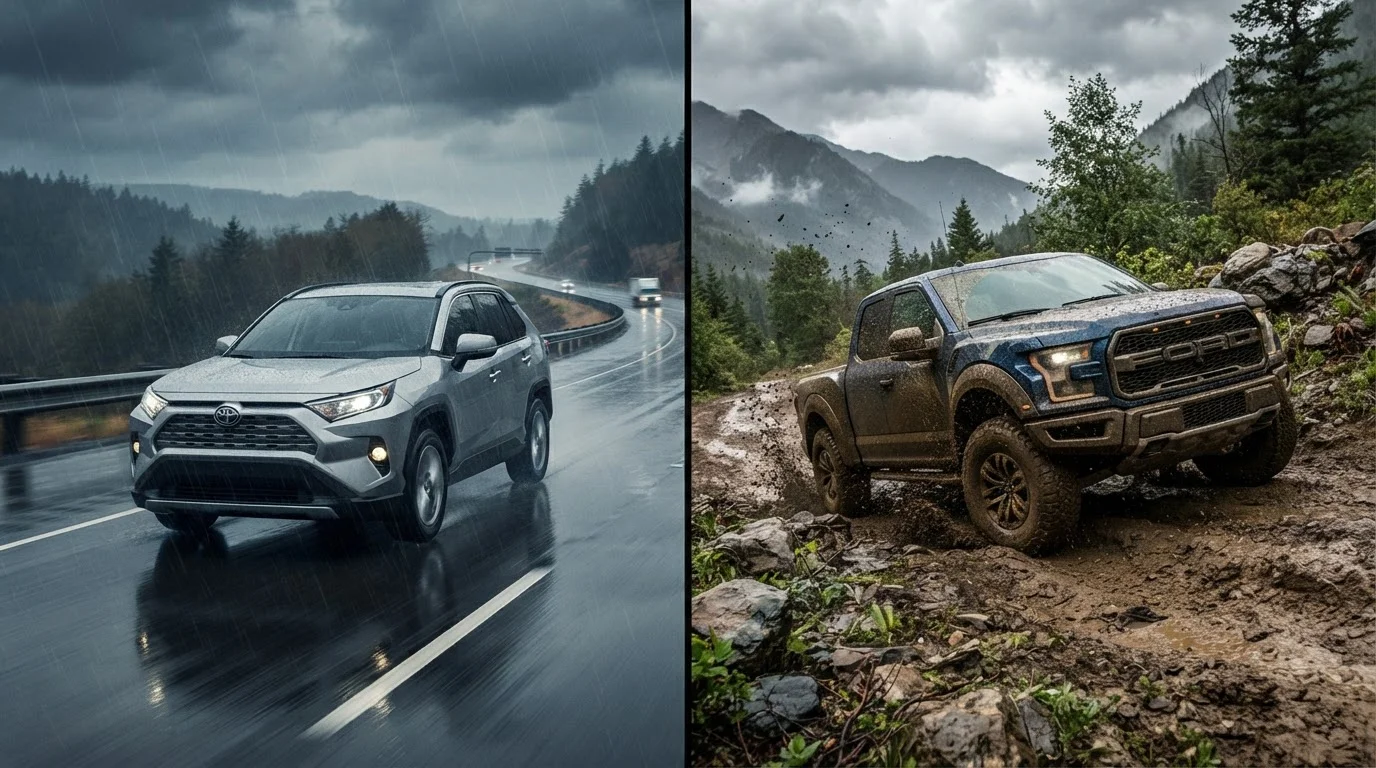
Key Takeaways
Option A
All-Wheel Drive (AWD)
The always-on, everyday traction system.
Best for: Drivers who want improved grip on wet, slippery, or lightly snowy pavement without any extra steps.
Option B
Four-Wheel Drive (4WD)
The switchable, heavy-duty off-road system.
Best for: Drivers who regularly tackle serious off-road terrain, deep snow, mud, or steep unpaved surfaces.
If you drive mostly on paved roads in rainy or lightly snowy regions
All-Wheel Drive (AWD)
AWD provides seamless, automatic traction on slick pavement without any driver input, making it well suited to everyday commuting in variable weather.
If you regularly go off-road, haul heavy loads, or navigate deep snow and mud
Four-Wheel Drive (4WD)
4WD's locked axle modes deliver maximum pulling and climbing power in situations where AWD systems can be overwhelmed.
If you want capability without thinking about it
All-Wheel Drive (AWD)
AWD requires no driver activation and adjusts traction automatically, which is ideal for drivers who don't want to manage a drivetrain system manually.
If you tow a trailer or drive a full-size truck or traditional SUV
Four-Wheel Drive (4WD)
Most 4WD vehicles are built on heavier platforms engineered for high towing capacity and rugged durability in ways AWD crossovers are not.
How Each System Actually Works
The confusion between AWD and 4WD is understandable - both put power to all four wheels. But the mechanics, the purpose, and the right conditions for each are meaningfully different.
All-Wheel Drive (AWD) operates continuously and automatically. A center differential - a mechanical or electronic device that divides power between the front and rear axles - monitors wheel slip and redistributes torque (rotational force) in real time. Most AWD systems run primarily in front-wheel drive under normal conditions and quietly shift power rearward when a wheel loses grip. The driver does nothing. This makes AWD well suited to highways, wet roads, and light snow.
Four-Wheel Drive (4WD) traditionally works differently. It uses a transfer case - a separate gearbox that locks the front and rear driveshafts together - so both axles spin at the same speed. Many 4WD systems offer a low-range setting (often labeled 4Lo) that multiplies torque for crawling over rocks, climbing steep grades, or pulling through deep mud. Older systems require a full stop to engage 4WD; newer ones allow on-the-fly switching. Using 4WD on dry pavement, however, can stress drivetrain components and cause handling problems, so it's meant to be engaged only when traction is genuinely poor.
For a broader look at how drivetrain terms relate to other automotive concepts, see our guide to automotive terms new drivers frequently misunderstand.
| Criterion | AWD | 4WD |
|---|---|---|
| Activation | Automatic, always-on | Driver-controlled (most systems) |
| Best terrain | Wet roads, light snow, highway | Mud, deep snow, rocks, off-road |
| Typical vehicles | Cars, crossovers, some SUVs | Trucks, body-on-frame SUVs |
| Low-range gearing | Generally not available | Available on most systems (4Lo) |
| Use on dry pavement | Safe for normal driving | Avoid in locked 4WD mode |
| Fuel economy impact | Modest reduction vs. 2WD | Larger reduction, especially off-road |
| Driver input required | None | Must engage/disengage manually |
The Traction Myth: What Neither System Can Do
Here's the misconception that causes real accidents: many drivers assume AWD or 4WD makes their vehicle safer to drive fast in bad weather. It does not. Both systems help your vehicle accelerate on slippery surfaces - they do nothing to shorten your stopping distance.
Braking is controlled by your tires and your brakes, not your drivetrain. An AWD sedan and a rear-wheel drive sedan with identical tires will take roughly the same distance to stop on ice. The AWD car just got up to speed more confidently - which can actually lead to overconfidence and higher speeds before a driver needs to brake.
This is especially worth understanding in winter driving. Common driving myths - including ones about 4WD in snow - continue to give drivers a false sense of security. Traction-enhancing drivetrain systems are a complement to good tires and sensible speed, not a substitute. For more on adjusting your behavior in challenging weather, see how to adapt your driving habits for rain, fog, and snow.
~25%
AWD/4WD share of new U.S. vehicle sales
Industry sales tracking has consistently shown roughly one in four new vehicles sold in the U.S. features some form of AWD or 4WD, reflecting growing demand across all vehicle segments.
0 ft
Reduction in braking distance from AWD/4WD
Neither AWD nor 4WD affects stopping performance; braking distance is determined by tires, brake systems, and speed - not drivetrain configuration.
1-3 mpg
Typical fuel economy penalty for AWD vs. 2WD
The U.S. EPA's vehicle testing data generally shows AWD variants of the same model returning one to three fewer miles per gallon than their two-wheel drive counterparts.
Fuel Economy, Cost, and Everyday Trade-Offs
Both systems add mechanical complexity - and complexity has costs. AWD adds weight and drivetrain components that slightly reduce fuel economy compared to a two-wheel drive version of the same vehicle. However, modern electronically controlled AWD systems are relatively efficient because they disengage or reduce power to non-driven axles during normal conditions.
4WD systems on trucks and traditional SUVs tend to be heavier and less fuel-efficient overall, partly because the vehicles themselves are larger. When 4Lo is engaged, fuel consumption rises noticeably. For day-to-day city or highway driving, 4WD vehicles generally cost more to fuel than comparable AWD crossovers.
Maintenance costs are also worth considering. AWD systems typically require differential fluid changes at specified intervals. 4WD transfer cases need their own fluid service. If either system is neglected or used incorrectly - for example, running a part-time 4WD system on dry pavement for extended periods - internal component wear can become expensive. A qualified mechanic can walk you through the service schedule for your specific vehicle.
Understanding how your drivetrain connects to other vehicle systems - like your transmission - can also be useful. See how manual, automatic, CVT, and DCT transmissions differ for related context.