

Key Takeaways
Graduated Driver Licensing (GDL)
Graduated Driver Licensing - often abbreviated GDL - is a phased system that introduces new drivers to full driving privileges over time rather than all at once. Instead of handing a teenager a full license after passing a single test, GDL breaks the process into stages, each with its own restrictions that are gradually lifted as the driver gains experience. All 50 U.S. states and the District of Columbia have some form of GDL in place.
GDL programs are typically structured around three stages: a supervised learner's permit phase, an intermediate or provisional license phase with specific restrictions, and a full unrestricted license. The specific age thresholds and restriction details vary significantly by state.
The Core Problem GDL Is Solving
New drivers crash at rates far higher than experienced ones - and the problem isn't mostly about the driving test. It's about what happens in the months after passing it. A teenager who just earned a license has demonstrated basic competence under controlled conditions, but they haven't yet developed the automatic, reflexive judgment that comes from thousands of hours behind the wheel.
The situations that trip up new drivers aren't usually the obvious ones. It's the combination of factors - driving at night while tired, with a car full of friends, on an unfamiliar road - that dramatically elevates risk. GDL programs are built specifically to limit exposure to those combinations until a driver has enough experience to handle them more safely.
For a deeper look at the specific situations where errors tend to cluster, see where new drivers are most likely to make errors.
How the Three-Stage Structure Works
Most GDL systems follow a three-stage framework, though the details differ considerably from state to state.
Stage 1: The Learner's Permit
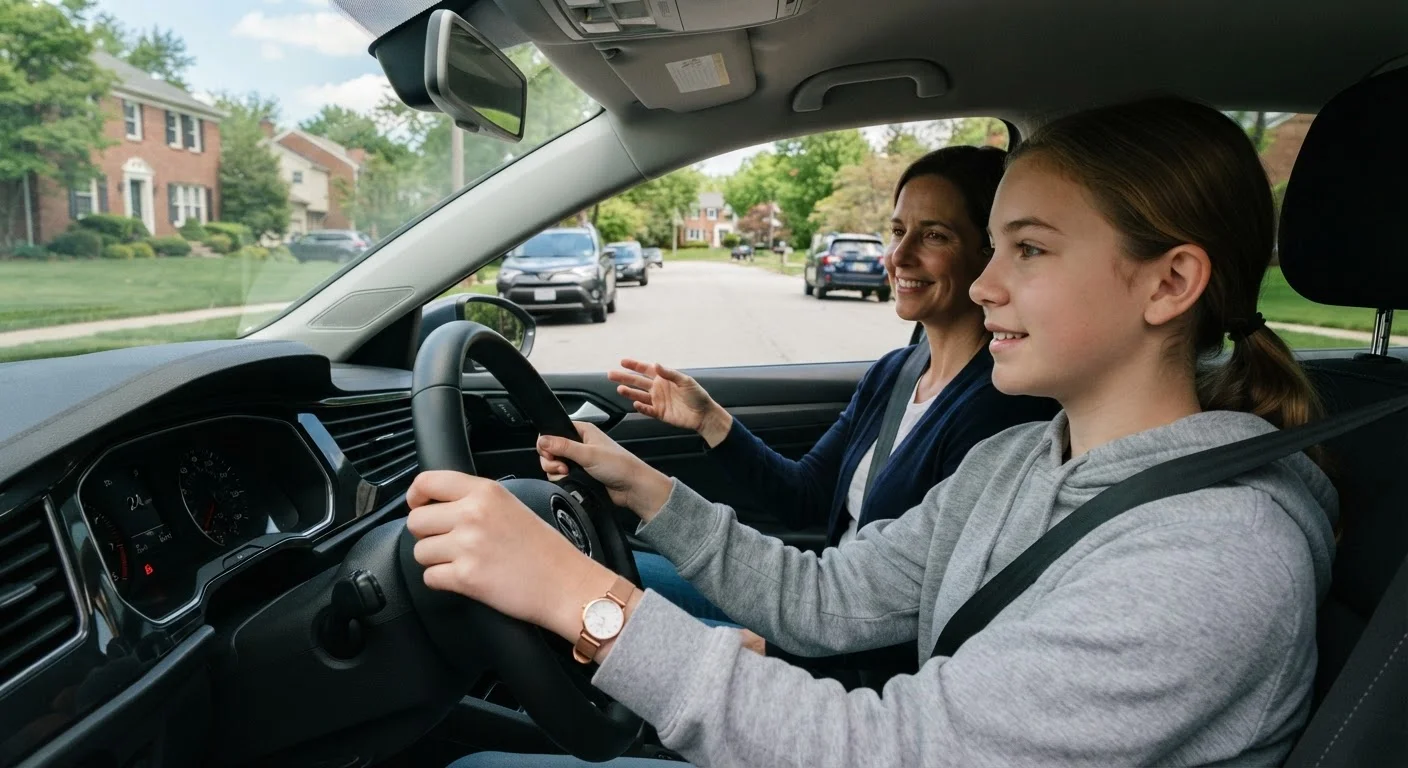
In the first stage, a new driver - typically age 15 or 16 - earns a learner's permit after passing a written knowledge test. This permit requires a licensed adult (usually age 21 or older) to be in the vehicle at all times. Many states specify a minimum number of supervised driving hours - often 50 or more - before the driver can advance. This phase is about building basic vehicle control in a lower-stakes environment.
Stage 2: The Provisional or Intermediate License
After passing a road skills test and meeting the supervised hours requirement, the driver earns an intermediate license that allows unsupervised driving - with restrictions. The most common restrictions include a nighttime driving curfew (often no driving between 10 p.m. and 5 a.m.) and limits on the number of teen passengers allowed in the vehicle. Some states also prohibit cell phone use entirely for provisional license holders, even hands-free.
Stage 3: Full Licensure
After completing the intermediate phase without violations - typically six to twelve months - drivers can apply for a full, unrestricted license. The exact age and time requirements vary by state.
~3x
Higher crash rate for 16-year-olds vs. experienced drivers
The IIHS reports that 16-year-olds crash at roughly three times the rate of drivers aged 20 and older per mile driven.
50 states
States with some form of GDL
All 50 U.S. states and the District of Columbia have implemented graduated driver licensing systems, though program strength varies.
6+ months
Typical minimum learner's permit phase
Most states require new drivers to hold a supervised learner's permit for at least six months before advancing to a provisional license.
Why the Restrictions Are Designed the Way They Are
Each GDL restriction maps to a specific, identifiable risk factor rather than being arbitrary rule-making. Nighttime restrictions address reduced visibility and the higher prevalence of impaired drivers during late hours. Passenger restrictions address the distraction effect of peer social dynamics, which research has linked to increased crash risk. Cell phone restrictions address divided attention - a hazard for any driver, but particularly dangerous for one still developing automatic driving responses.
The underlying logic is that new drivers don't yet have the mental bandwidth to manage complex, high-stakes situations. Experienced drivers handle familiar road conditions largely on autopilot, freeing up mental resources for unexpected events. New drivers are still consciously managing the basics, which leaves less capacity for anything out of the ordinary. GDL buys time for that automatic processing to develop before the highest-risk situations are introduced.
This connects directly to the habits that separate safe drivers from dangerous ones - see our overview of defensive versus aggressive driving for more on how experience shapes those tendencies.
How GDL Varies Across States - and Why It Matters
Not all GDL programs are equally comprehensive. A state might require only 30 supervised driving hours while another requires 65. Nighttime curfews might start at 9 p.m. in one state and midnight in another. Some states have strong enforcement mechanisms; others rely almost entirely on parental oversight.
Highway safety researchers and organizations like the Insurance Institute for Highway Safety (IIHS) have noted that states with stronger, more comprehensive GDL programs tend to show better outcomes for teen driver safety than states with weaker programs. This doesn't mean the system is perfect - critics have pointed out that teens in rural areas face real hardship when nighttime restrictions conflict with work or school schedules - but the overall framework is well-supported by available evidence.
If you're a parent or new driver, it's worth looking up your specific state's GDL requirements directly through your state's DMV rather than assuming the rules match what you've heard from others. The variation is real and the details matter.
For a broader picture of safe driving principles that apply at every experience level, see The Complete Guide to Safe Driving in America.