

| Governing standard | Manual on Uniform Traffic Control Devices (MUTCD), published by the FHWA (Federal Highway Administration) |
| Number of sign shape categories | 8 primary shapes used in the U.S. system (MUTCD) |
| Color categories in use | 9 (red, yellow, orange, green, blue, brown, white, black, fluorescent yellow-green) (MUTCD) |
| Only sign shape reserved for a single sign | Octagon - used exclusively for Stop signs (MUTCD) |
| Construction zone fines | Most states double standard fines in active work zones (Varies by state law) |
| Retroreflectivity requirement | All U.S. road signs must meet minimum nighttime retroreflectivity standards (FHWA retroreflectivity rule) |
Why Shape and Color Come Before Words
The U.S. road sign system is built around a simple principle: you should be able to understand a sign before you finish reading it. That's why the MUTCD - the federal manual that standardizes signs nationwide - assigns specific shapes and colors to specific categories of information. Even if a sign is partially obscured, faded, or in a language you don't read, its shape and color still communicate something useful.
This lookup guide breaks down both dimensions so you can internalize the system, not just memorize individual signs. For a broader picture of safe driving practices, see The Complete Guide to Safe Driving in America.
| Governing standard | Manual on Uniform Traffic Control Devices (MUTCD), published by the FHWA (Federal Highway Administration) |
| Number of sign shape categories | 8 primary shapes used in the U.S. system (MUTCD) |
| Color categories in use | 9 (red, yellow, orange, green, blue, brown, white, black, fluorescent yellow-green) (MUTCD) |
| Only sign shape reserved for a single sign | Octagon - used exclusively for Stop signs (MUTCD) |
| Construction zone fines | Most states double standard fines in active work zones (Varies by state law) |
| Retroreflectivity requirement | All U.S. road signs must meet minimum nighttime retroreflectivity standards (FHWA retroreflectivity rule) |
Sign Shapes and What They Signal
Shape is your first layer of information, readable even at distance before colors or text register.
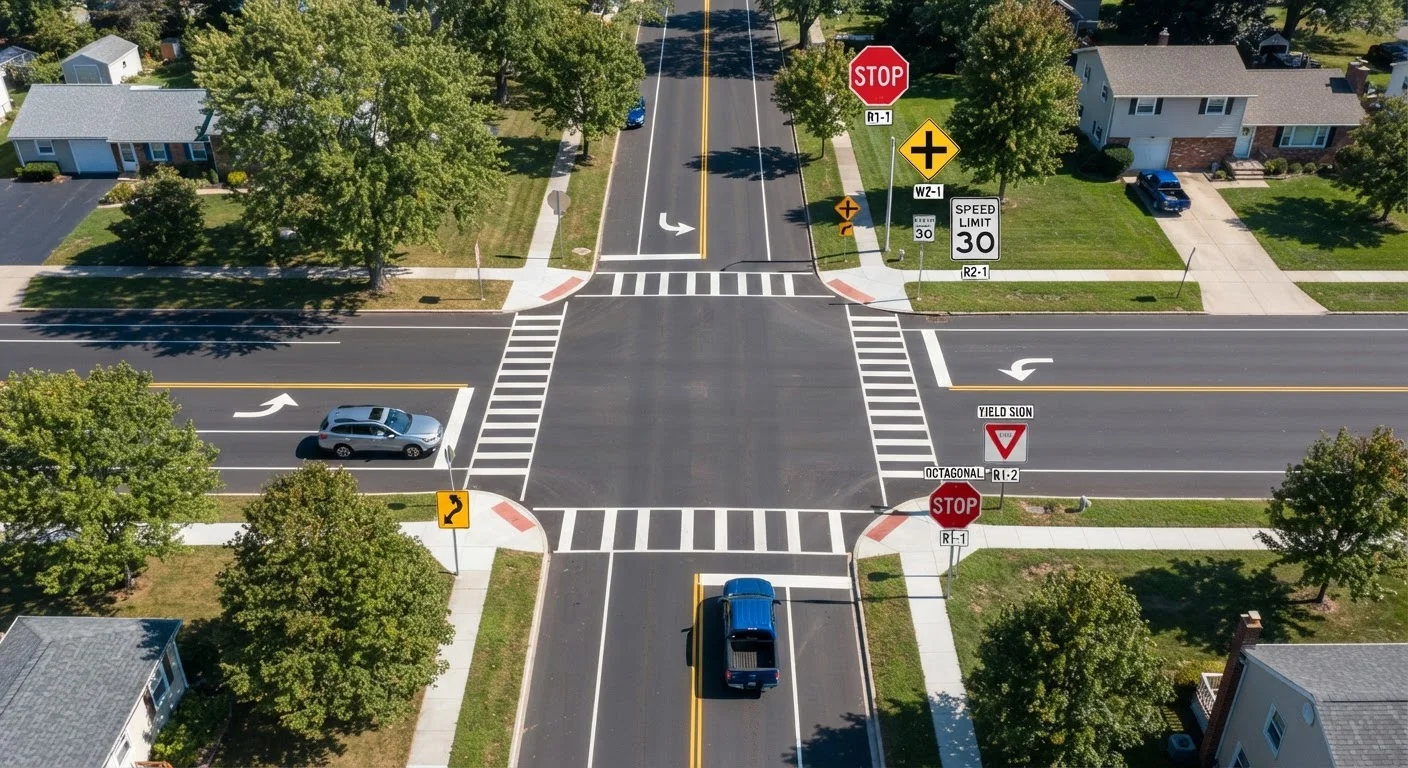
- Octagon (8 sides): Stop only. No other U.S. sign uses this shape, making it unmistakable.
- Triangle (inverted, pointing down): Yield. You must slow and give the right-of-way to conflicting traffic.
- Diamond: Warning. Something ahead requires increased attention - a curve, a merge, an animal crossing, a signal ahead.
- Rectangle (vertical): Regulatory. These signs state the law: speed limits, turn restrictions, lane-use rules.
- Rectangle (horizontal): Guide or informational. Distance markers, route confirmations, and directional signs use this orientation.
- Pentagon (5 sides, point up): School zone or school crossing. Reserved exclusively for this purpose.
- Round: Railroad crossing warning when paired with an X symbol. Also used for some recreational signs.
- Pennant (triangle pointing right): No-passing zone, placed on the left side of the road.
Understanding shapes helps especially in low-visibility conditions - fog, heavy rain, or night driving - when color may be harder to distinguish quickly.
Sign Colors and Their Meanings
Color carries meaning independently of shape. Together, the two create a redundant system that's more reliable than either alone.
MUTCD
The Manual on Uniform Traffic Control Devices, published by the Federal Highway Administration. It sets the national standards for all road signs, signals, and markings used on U.S. public roads.
Regulatory sign
A sign that communicates a legal requirement - such as a speed limit or turn restriction. Disobeying a regulatory sign can result in a traffic violation.
Warning sign
A sign that alerts drivers to a potentially hazardous condition ahead, such as a sharp curve or a railroad crossing. Warning signs are advisory in nature, though failing to respond appropriately can be dangerous.
Advisory speed
A recommended speed for a specific road feature, such as a curve or ramp, posted on a yellow placard. It is not a legal speed limit but reflects the speed engineers consider safe for that location.
Retroreflectivity
A sign's ability to reflect light back toward its source - critical for nighttime visibility. Federal standards require all road signs to maintain minimum retroreflectivity levels over time.
Work zone sign
An orange sign indicating temporary changes to normal traffic patterns due to construction or maintenance activity. Speed limits posted in work zones are legally enforceable.
| Color | Meaning | Common Examples |
|---|---|---|
| Red | Stop, prohibition, or do-not-enter | Stop sign, Wrong Way, No Turn on Red |
| Yellow | General warning | Curve ahead, pedestrian crossing, signal ahead |
| Orange | Temporary - construction or work zone | Road work ahead, lane closed, detour |
| Green | Permitted movement or guidance | Highway exits, distance markers, directional signs |
| Blue | Motorist services | Rest area, hospital, gas, food, lodging |
| Brown | Recreation and cultural interest | National parks, campgrounds, historic sites |
| White | Regulatory (background) | Speed limit, lane-use signs |
| Fluorescent yellow-green | High-emphasis pedestrian or bike warning | School zones, bike crossings |
Orange is worth a specific mention: any orange sign means conditions ahead have changed temporarily, and the posted speed limits in construction zones are legally enforceable - often with doubled fines.
Common Signs Drivers Often Misread
Even experienced drivers can misinterpret certain signs. A few that come up often:
- Yield vs. merge: A yield sign means you must legally give way. A merge sign (typically a warning diamond) is advisory - it alerts you that lanes are combining ahead so you can prepare.
- Advisory speed vs. speed limit: A yellow placard with a speed number - often posted below a curve warning - is an advisory, not a law. It's the recommended safe speed for that condition, not the legal maximum.
- Fluorescent yellow-green signs: These aren't just bright yellow. This specific color is reserved for high-risk pedestrian and school environments and should trigger extra caution.
- Wrong Way vs. Do Not Enter: Both use red and white, but they appear in different locations. "Do Not Enter" faces drivers at the entry point of a one-way road. "Wrong Way" is positioned further down the road if you've already entered incorrectly.
If your vehicle is giving you other signals to pay attention to, dashboard warning lights work on a similar decode-at-a-glance principle - our companion guide explains what each one means.