

How Time Zones Actually Work
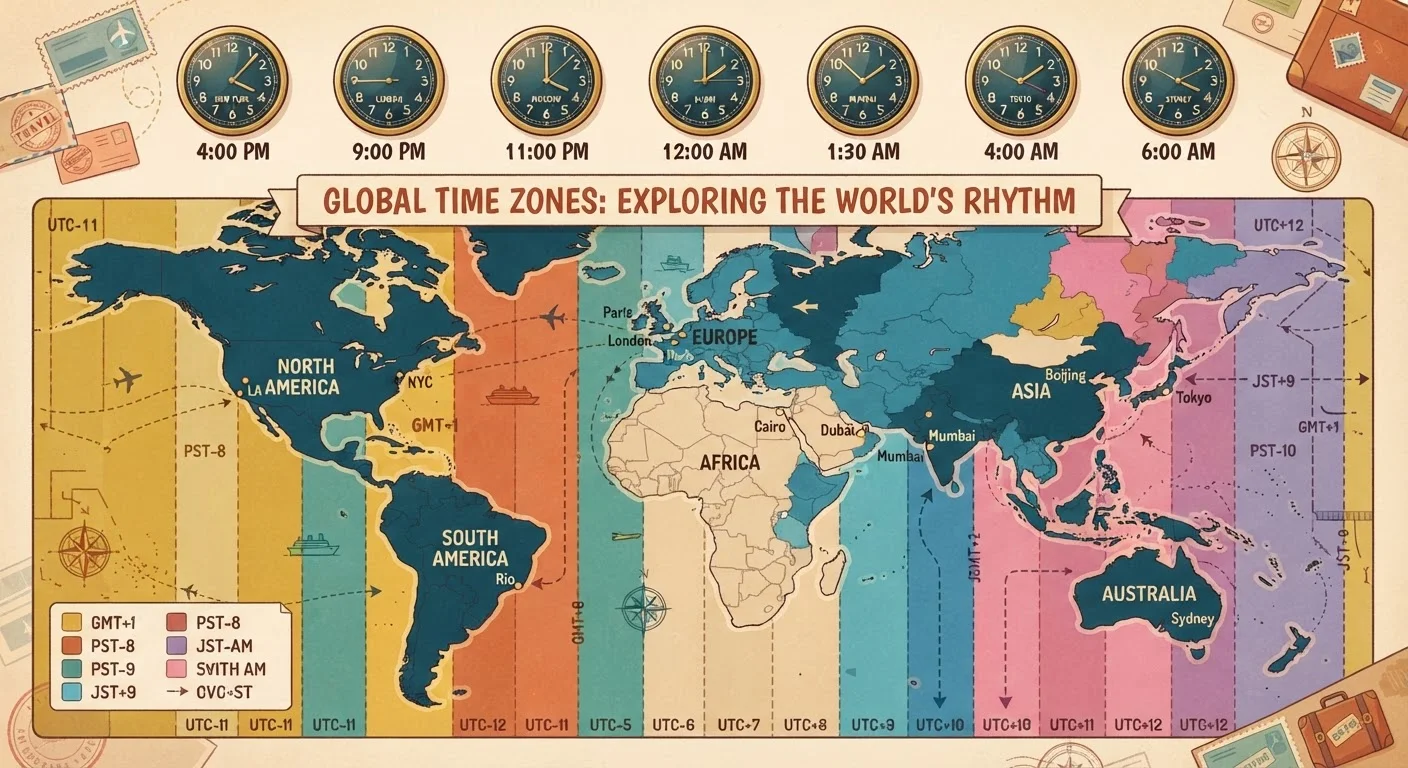
The Earth is divided into roughly 24 standard time zones, each representing one hour of the planet's 24-hour rotation. In theory, every 15 degrees of longitude equals one time zone - but political boundaries, economic ties, and national convenience have bent those lines considerably. China, for example, spans five geographic time zones yet operates entirely on a single national time (UTC+8). India runs on a half-hour offset (UTC+5:30). And the state of Arizona mostly skips Daylight Saving Time while neighboring states observe it.
All time zones are expressed relative to Coordinated Universal Time (UTC) - the modern successor to Greenwich Mean Time. When you see "UTC−5," it means the local clock is five hours behind UTC. New York in winter is UTC−5; Paris in summer is UTC+2.
For a deeper dive into how time coordination fits into trip planning overall, see our guide to building a travel itinerary that actually works.
Daylight Saving Time: Who Follows It and Who Doesn't
Daylight Saving Time (DST) shifts clocks forward one hour in spring and back one hour in fall - the classic "spring forward, fall back" mnemonic. The goal is to align waking hours with daylight during longer summer days. In the United States, most states move clocks forward on the second Sunday in March and back on the first Sunday in November. The European Union follows a similar calendar but on different specific dates, which means there are short windows each year where the offset between the U.S. and Europe shifts by an extra hour.
Roughly 40% of the world's countries observe some form of DST, but the practice is far from universal. Countries near the equator - where daylight hours are consistent year-round - typically skip it altogether. Japan, most of Africa, and much of Asia do not observe DST at all. This means that the time difference between your home city and a destination can change by an hour at certain times of year depending on whether both locations shift their clocks, only one does, or neither does.
This is one of the planning missteps that catch first-time international travelers off guard - assuming the time difference you looked up months ago still holds when you actually travel.
Practical Tools for Tracking Time Across Borders
Modern smartphones automatically adjust to local time when you land - provided your device settings allow automatic time zone detection and you have cellular or Wi-Fi access. That auto-update is a lifesaver for the device clock, but it can quietly shift your calendar app's appointments if those events were saved in your home time zone. Always verify flight times and check-in deadlines against the local time at your destination.
A few habits that prevent costly confusion:
- Book and save flights in the destination's local time. Airlines always publish departure and arrival times in the local time of each airport - not your home time zone.
- Use a world clock widget. Most phone operating systems allow multiple clocks on the home screen, so you can track home and destination simultaneously.
- Cross-reference UTC offsets for international calls. If you're scheduling a video call from New York (UTC−5) with someone in London (UTC+0) during winter, you're five hours apart. In summer, after both zones have shifted, that gap narrows to four hours - or widens again if their DST schedules diverge.
- Verify directly with your airline or hotel if you're traveling around DST transition dates. A booking made weeks in advance may have been calculated under a different offset.
Navigating border arrival times is its own category of confusion - our article on what first-time international travelers get wrong at the border covers how time-related missteps compound during customs and immigration.
International Date Line and Unusual Offsets
The International Date Line (IDL) runs roughly along the 180th meridian in the Pacific Ocean. Cross it heading west and you jump forward a calendar day; cross it heading east and you move back a day. This is why a flight from Los Angeles to Sydney can depart on a Monday and arrive on a Wednesday - even if the flight itself is under 15 hours.
Beyond the date line, some destinations run on offsets that don't fit the tidy one-hour increments most travelers expect. Nepal is UTC+5:45. The Chatham Islands (part of New Zealand) operate at UTC+12:45. These quirks exist because governments prioritized keeping an entire country or territory on a single time rather than splitting communities across multiple zones.
Understanding these realities helps you build more resilient plans. The trip planning hub has practical guidance for turning this kind of knowledge into a well-structured, stress-reduced itinerary.
Time zone rules, DST schedules, and offset details can change by government decision. Always verify current time zone information through official or authoritative sources before finalizing travel plans.