

Key Takeaways
Intra-Street Price Variation
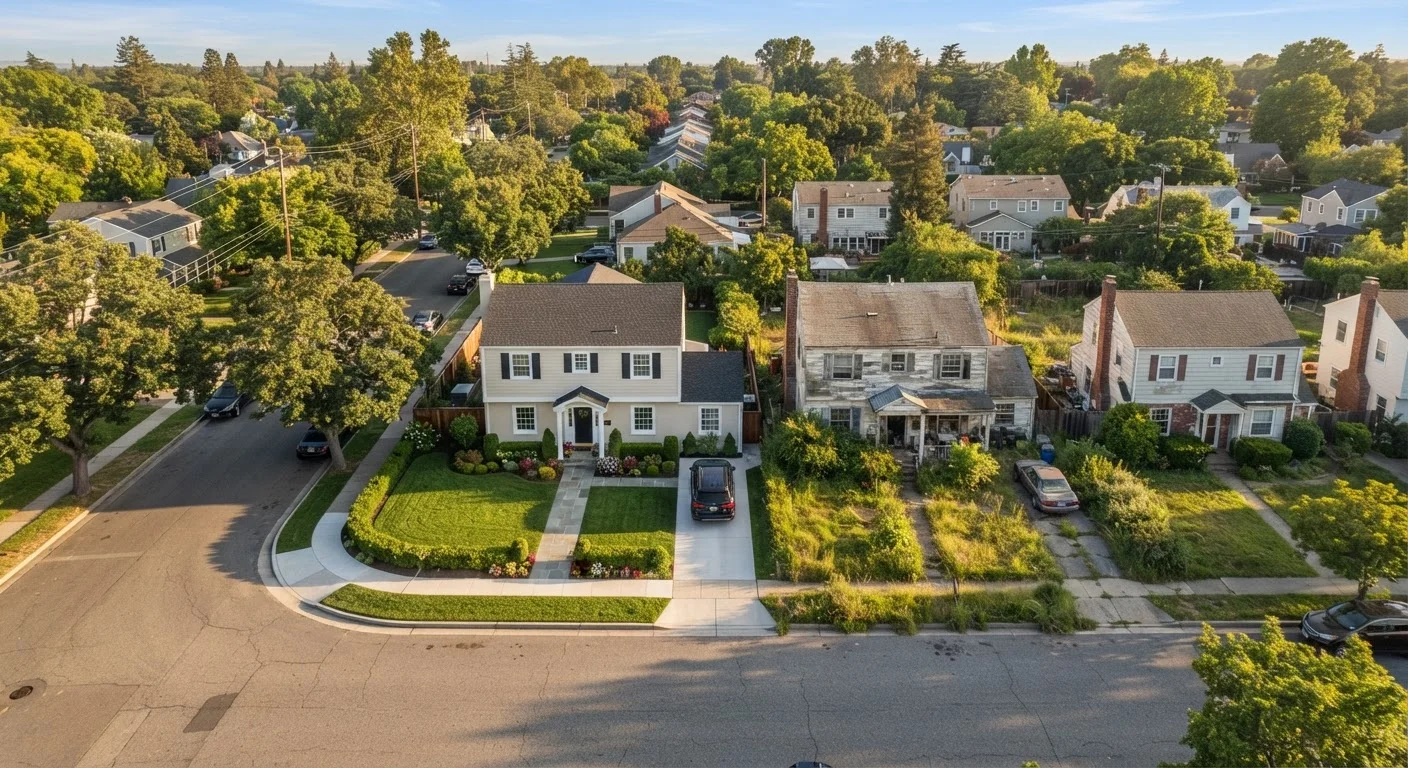
Intra-street price variation refers to the difference in sale prices between homes located on the same street or within the same block. Even when two houses share a zip code, a school district, and similar square footage, their market values can differ dramatically. Those gaps are driven by a combination of physical features, condition, lot characteristics, and buyer demand at the moment of sale.
Appraisers account for these differences through a process called sales comparison adjustment, where they add or subtract dollar amounts for specific features when comparing a subject property to nearby comparable sales ("comps").
The Myth of the Uniform Street
A common assumption among homeowners and first-time buyers is that properties on the same block should sell within a narrow price band. After all, they share the same neighborhood, the same schools, and often the same architectural era. But real estate professionals know that even modest physical or situational differences compound into substantial price gaps.
Understanding what actually creates those gaps is essential for anyone navigating the homebuying process or preparing to sell. The factors are more nuanced than square footage alone, and recognizing them can prevent costly misjudgments about what a property is actually worth. For a broader grounding in the subject, our guide on what determines home value covers the core framework appraisers and buyers use.
Condition and Deferred Maintenance
The single biggest source of price divergence between neighboring homes is physical condition. A house with a recently replaced roof, updated HVAC, and fresh interior paint communicates low immediate cost to a buyer. A structurally similar house with a 25-year-old roof and visible water stains tells the opposite story.
Buyers and their lenders price in anticipated repair costs. If a home needs a new roof (often $10,000-$20,000 depending on size and material), many buyers will adjust their offer accordingly - or walk away entirely, leaving the seller to accept a lower bid from a less risk-averse buyer. Deferred maintenance doesn't just reduce aesthetic appeal; it shifts the financial risk of ownership forward in a way that markets price in real time.
Evaluate Condition Before Setting Expectations
Before assuming your home will match a neighbor's recent sale price, do an honest condition assessment. Note the age of major systems - roof, HVAC, water heater, electrical panel - and compare your finishes and layout to what sold. Buyers and appraisers will make those comparisons anyway, and sellers who anticipate the adjustments tend to price more effectively from the start.
Renovation quality matters as much as renovation scope. As our article on home value myths explains, over-improving for the neighborhood or choosing low-quality finishes can leave money on the table even after significant investment.
Lot Position and Physical Site Characteristics
Lot characteristics are frequently underestimated by homeowners but are carefully evaluated by appraisers. Two homes with identical interiors can carry meaningfully different values based purely on where the lot sits.
~5-10%
Typical value discount for homes backing busy roads
Real estate appraisers commonly apply a negative adjustment of roughly 5-10% for properties backing arterial roads or commercial zones, depending on local market norms and traffic levels.
60-80%
Average cost recovery for mid-range kitchen remodels
According to Remodeling Magazine's Cost vs. Value analysis, mid-range kitchen remodels have historically recovered roughly 60-80% of their cost at resale, with significant variation by region and neighborhood price tier.
30-45 days
Market timing window that can shift comparable prices
Appraisers and real estate professionals generally consider comparable sales within the past 90 days most relevant; sales older than that may reflect materially different market conditions.
- Backing to a highway or commercial zone - even a quiet arterial road - typically depresses value due to noise, light, and reduced privacy. Buyers consistently report these as strong deterrents.
- Cul-de-sac positioning often commands a premium in family-oriented neighborhoods because it limits through traffic and increases perceived safety.
- Slope, drainage, and usable yard space all factor into how a buyer experiences outdoor living. A flat, usable backyard is more attractive than a steeply sloped lot of the same size.
Neighborhood-level dynamics, such as proximity to a commercial development or a new transit stop, layer on top of individual lot factors and can shift an entire micro-market in ways that affect some properties more than others.
Interior Layout and Functional Livability
Square footage is a blunt metric. Two 1,800-square-foot homes can feel radically different to live in based on how that space is arranged. Open floor plans, adequate bedroom and bathroom counts relative to the home's price tier, and functional storage all influence perceived value.
Appraisers refer to some layouts as having "functional obsolescence" - features that made sense when a home was built but no longer align with how buyers want to live. A four-bedroom home with only one bathroom, or a layout where the only path to the primary bedroom runs through a second bedroom, can suppress value relative to a comparable home with a more intuitive floor plan.
Understanding what buyers weigh when setting an offer helps clarify why layout carries so much psychological weight in the negotiation process.
The Timing Factor
Perhaps the least intuitive driver of price variation is one that has nothing to do with the homes themselves: when each sold. Mortgage rate environments, local inventory levels, and seasonal demand patterns shift the competitive landscape meaningfully from one quarter to the next.
A home that sold during a period of historically low rates and scarce inventory may have attracted multiple offers and closed well above asking. A nearly identical home sold 18 months later in a higher-rate environment with more competing listings may have sat on the market and sold at list price - or below. Neither outcome reflects a flaw in either property; it reflects the market conditions each seller faced.
This timing sensitivity is one reason pricing errors are so common before listing - sellers often anchor to a neighbor's sale price without accounting for how much conditions may have shifted.
This article is for general informational purposes only and does not constitute financial, legal, or real estate advice. Readers should consult a licensed real estate professional for guidance specific to their situation.