

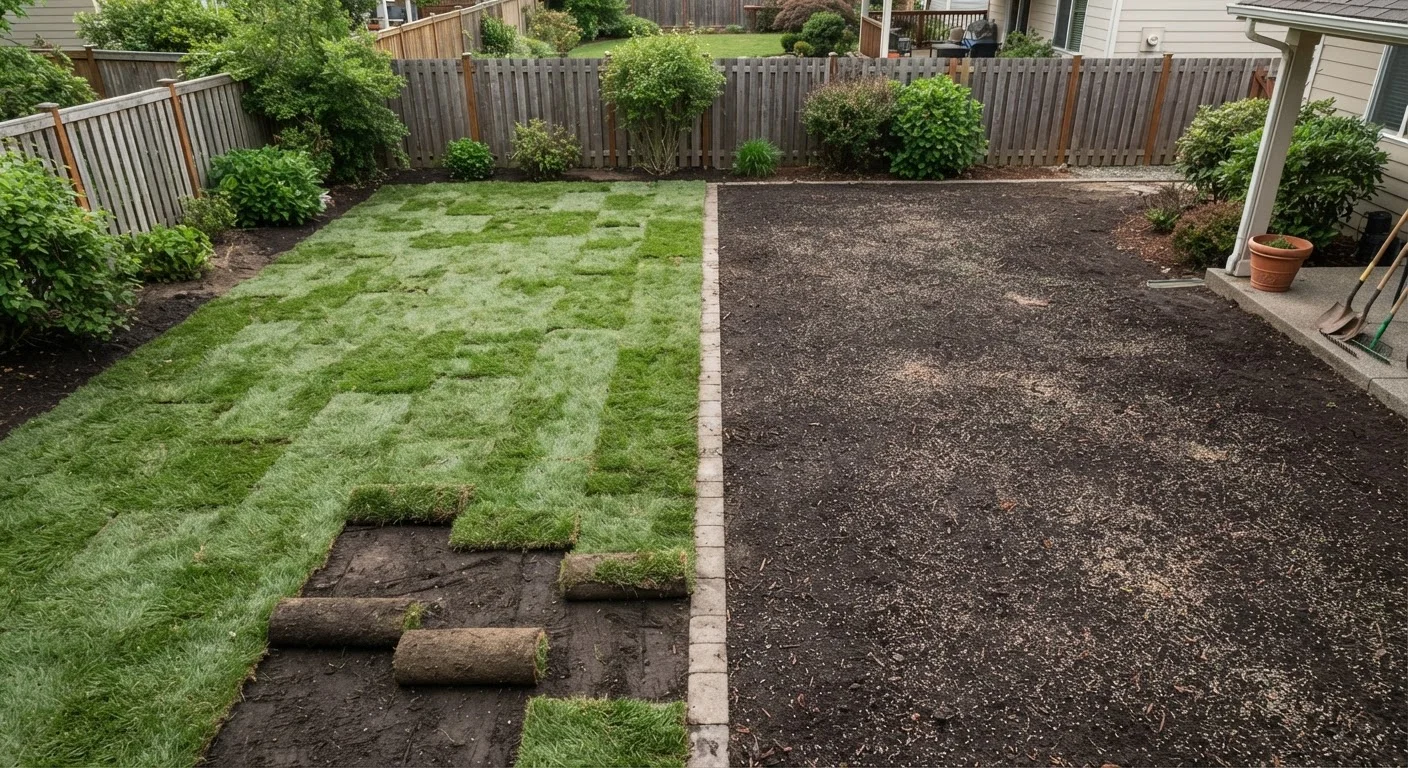
Key Takeaways
Option A
Grass Seed
The patient, budget-conscious path to a custom lawn.
Best for: Homeowners with flexible timing, a larger area to cover, and willingness to nurture growth over several weeks.
Option B
Sod
The fast, ready-made lawn with an immediate payoff.
Best for: Homeowners who need quick ground cover, are managing erosion, or want a finished look with minimal establishment wait time.
If you're covering a large area on a tight budget
Grass Seed
Seed is a fraction of the cost of sod per square foot, making it far more practical for yards over a few thousand square feet.
If you need a usable lawn quickly or are managing soil erosion
Sod
Sod knits into soil within a few weeks and holds the ground immediately, making it the stronger choice when time or slope stability is a concern.
If you want to select a specific grass variety for your region
Grass Seed
Seed is available in a far wider range of species and blends, letting you match the grass to your local climate, soil type, and light conditions precisely.
If you're a first-time homeowner with limited lawn care experience
Sod
Sod is more forgiving during establishment - it doesn't require the same strict watering schedule that young seedlings depend on to survive.
If you're restoring a lawn after significant damage or bare patches
Grass Seed
Overseeding or targeted reseeding integrates naturally with surrounding grass and avoids the visible seams or color variation that patched sod can leave behind.
The Core Trade-Off: Speed vs. Cost
Every decision between grass seed and sod comes down to one central tension: how fast do you need a lawn, and how much are you willing to spend to get there?
Sod delivers an almost-instant lawn. The rolled sections of pre-grown grass are cut from a farm, transported, and laid directly onto prepared soil. Within two to four weeks of proper watering and care, the roots anchor and you have a functional lawn. The trade-off is cost - sod typically runs several times more per square foot than seed, and that gap widens significantly as the square footage grows.
Grass seed, by contrast, demands patience. Depending on the species, germination can take anywhere from 5 to 30 days, and a lawn grown from seed often needs a full growing season before it can withstand regular foot traffic. But for homeowners with time and a larger yard to cover, seed is the more economical and often the more ecologically flexible choice.
| Criterion | Grass Seed | Sod |
|---|---|---|
| Upfront cost | Lower - fraction of sod cost | Higher - 5-10x more per sq ft |
| Time to usable lawn | Several weeks to a full season | 2-4 weeks after laying |
| Variety selection | Wide - many species and blends | Limited to what farms grow |
| Erosion control | Poor until established | Immediate ground coverage |
| Watering demands | Frequent, precise moisture needed | Regular but somewhat more forgiving |
| Best planting season | Fall or spring (species-dependent) | Any time ground isn't frozen |
| DIY difficulty | Moderate - timing is critical | Moderate - labor-intensive to lay |
For a fuller picture of how lawn establishment fits into your year-round maintenance calendar, see the complete year-round homeowner's guide.
Soil Preparation: The Step Neither Method Can Skip
Regardless of which approach you choose, the quality of your lawn starts below the surface. Poorly prepared soil will undermine both seed germination and sod establishment - and is one of the most common reasons new lawns fail.
Before laying either seed or sod, test your soil's pH and nutrient levels. Most grass varieties prefer a pH between 6.0 and 7.0. Amend accordingly with lime to raise pH or sulfur to lower it. Till the top four to six inches, break up compaction, remove debris and weeds, and grade the surface so it slopes gently away from your home's foundation to encourage drainage.
For sod, the soil surface should be level and firm - but not compacted - so the roots make full contact. For seed, a slightly rougher surface with some texture actually helps seeds settle and resist washing away. Either way, common lawn care myths include assumptions that either method will somehow compensate for bad soil. It won't.
Watering, Timing, and Establishment Care
Both seed and sod require more frequent watering during establishment than a mature lawn - but their demands look quite different.
Newly seeded areas need the top inch of soil kept consistently moist until germination completes, often requiring light watering once or twice daily in warm, dry weather. Allow the surface to dry out even briefly and you can lose germination progress. Once seedlings reach about two inches tall, you can begin transitioning to deeper, less frequent watering.
Sod also needs regular moisture in its first two weeks to help roots bond with the underlying soil. The difference is that sod enters the ground with an established root mass, making it somewhat more resilient to brief dry spells than bare seed.
Timing matters for both. Cool-season grasses (fescue, bluegrass, ryegrass) germinate and establish best when planted in early fall or early spring. Warm-season grasses (bermuda, zoysia, centipede) perform best when laid or seeded in late spring through early summer. Sod can be laid almost any time the ground isn't frozen, but fall and spring remain ideal. Learning to water efficiently once your lawn is established is just as important - see our guide on watering your lawn less but smarter for practical strategies.
5-30 days
Typical grass seed germination window
Germination time varies widely by species - fine fescues sprout quickly while Kentucky bluegrass can take up to a month under ideal conditions.
2-4 weeks
Sod root establishment timeframe
Under consistent watering, most sod varieties develop sufficient root contact with underlying soil within two to four weeks of installation.
6.0-7.0
Ideal soil pH range for most grasses
Both seed and sod perform best in slightly acidic to neutral soil; testing before laying either method helps avoid avoidable establishment failures.
Long-Term Results and What to Realistically Expect
A lawn grown from seed and one installed with sod can look nearly identical after a full growing season - but the paths to that result are very different, and each comes with distinct long-term considerations.
Seed-grown lawns often develop deeper, more extensive root systems over time because the grass adapts to the native soil from the very beginning. Sod is grown in a different soil profile and must essentially re-root into your yard's soil, which most varieties do successfully - but it can take a full season for sod to truly integrate.
Seeded lawns also give you broader variety selection. You can blend grass types to suit shaded areas, high-traffic zones, or drought-prone spots in ways that sod farms don't always offer. If your goal is a lawn tailored to local conditions, seed gives you more control. Understanding how to feed your lawn properly once it's established is another important layer - comparing fertilizer types can help you choose an approach that suits your lawn and soil goals.
Neither method produces a maintenance-free lawn. Both require consistent mowing, fertilization, aeration, and weed management. The establishment phase is just the beginning.