

Key Takeaways
Our Verdict
Neither home workouts nor gym training is objectively superior - both can produce meaningful fitness results when performed consistently. The deciding factors are practical: your available budget, living space, motivation style, and how much friction each option creates in your daily routine. Removing barriers to consistency matters more than optimizing for the 'ideal' environment.
| Best for | Recommended |
|---|---|
| Those working within tight budgets or unpredictable schedules | Home Workouts |
| Those who thrive on social motivation, variety, or need specialized equipment | Gym Training |
| Those seeking maximum flexibility without sacrificing either option entirely | Hybrid Approach |
Why This Decision Matters More Than Most People Realize
Choosing where to exercise might seem like a minor logistical detail, but it meaningfully shapes whether a fitness routine survives the first few months. Research in exercise psychology consistently identifies accessibility and enjoyment as two of the strongest predictors of long-term physical activity adherence - and both are heavily influenced by your training environment.
This isn't about which setting produces faster results on paper. It's about understanding the real-world trade-offs so you can choose the environment that supports habits you'll actually maintain. For a broader look at how different types of exercise affect your body, see our comparison of strength training and cardio.
The Real Costs - Financial and Otherwise
Cost is often the first consideration, but the full picture goes beyond a monthly membership fee.
Home workouts have a low financial floor. Bodyweight training requires no equipment at all, and a modest investment in resistance bands, a set of adjustable dumbbells, or a jump rope can expand options considerably. The main hidden costs are space and time - setting up, putting equipment away, and mentally separating "workout mode" from home life.
Gym memberships vary widely, from budget facilities to full-service clubs with pools, classes, and personal training. Beyond the fee, factor in commute time, gas or transit costs, and the mental energy required to leave the house. For some people, that commute becomes a meaningful transition ritual that helps them mentally prepare. For others, it's the reason they skip.
| Home Workouts | Gym Training | |
|---|---|---|
| Upfront cost | Low to moderate (equipment optional) | Membership fee required |
| Commute required | None | Yes - time and transport needed |
| Equipment variety | Limited without investment | Extensive - machines, free weights, cardio |
| Scheduling flexibility | Maximum - train anytime | Constrained by hours and crowds |
| Social motivation | Minimal | High - classes, community, trainers |
| Space needed | Varies - can be minimal | None at home required |
| Best for beginners | Possible with guidance | Structured environment can help |
Equipment, Space, and What You Can Actually Do
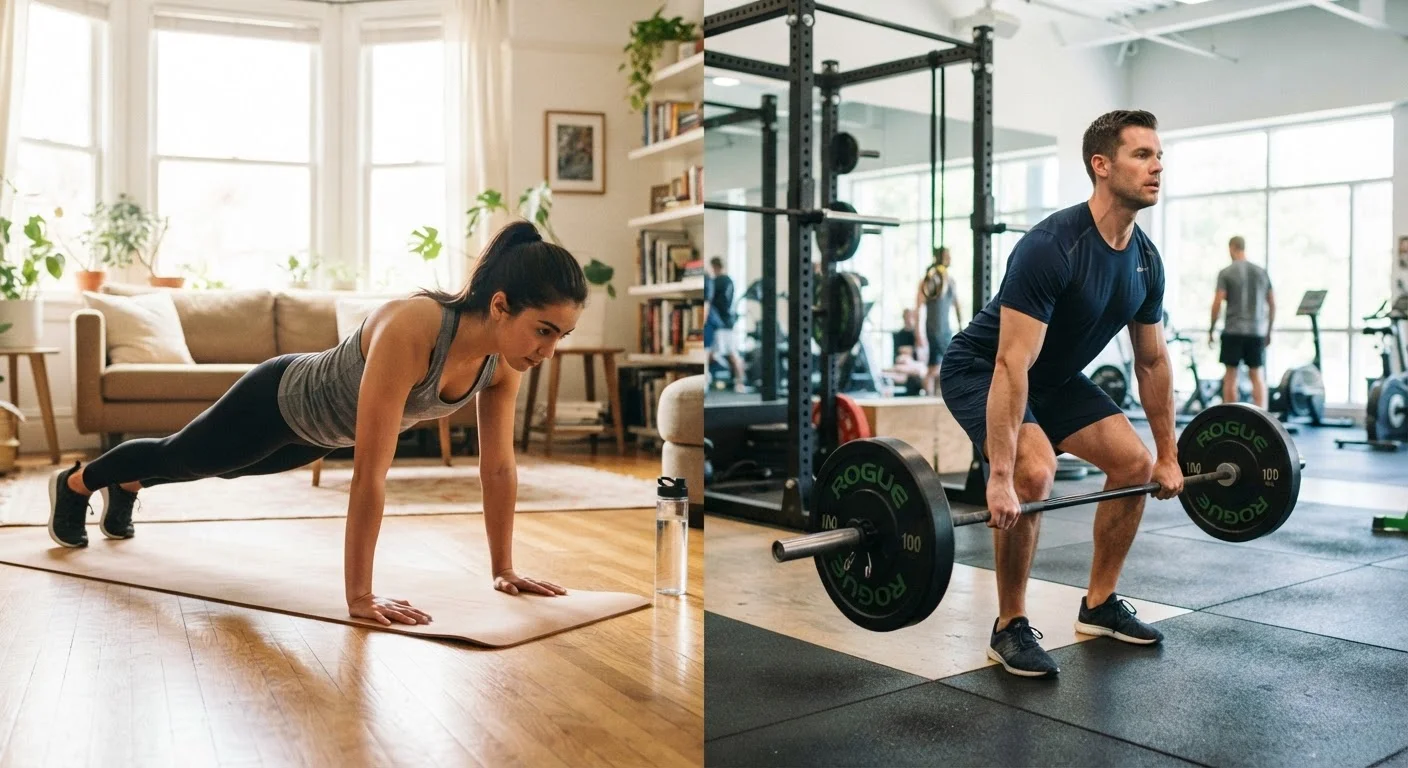
The equipment gap between home and gym has narrowed significantly, but it hasn't disappeared. A well-equipped gym gives access to barbells, cable machines, squat racks, cardio equipment, and specialty tools that would cost thousands of dollars to replicate at home and require substantial space.
That said, a wide range of effective training - including progressive resistance training - is achievable with minimal equipment. Bodyweight exercises like push-ups, lunges, and planks can be progressively challenged by changing leverage, tempo, or adding resistance bands. If your goals involve powerlifting, Olympic lifting, or sports-specific conditioning, a gym is likely necessary. If your goal is general fitness, strength maintenance, or cardiovascular health, a home setup can be genuinely sufficient.
Space is a real constraint for many Americans. A small apartment may limit what's practical. Conversely, a dedicated home gym room removes many of the friction points that cause people to skip sessions.
Motivation, Accountability, and the Social Factor
One of the gym's less-discussed advantages is its social environment. Being around others who are exercising can provide passive motivation - a phenomenon sometimes called social facilitation - and group fitness classes add structure and community that some people find essential to consistency.
Home training, by contrast, demands more intrinsic motivation. Without external cues - an instructor, a class start time, the quiet judgment of showing up - it's easier to rationalize skipping. Some people find this isolation freeing; others find it deflating. Honest self-knowledge here matters more than general advice.
If you're newer to exercise and haven't yet built a reliable fitness habit, the built-in structure of a gym environment may provide useful scaffolding. Our guide on building an exercise habit from scratch explores practical strategies that work in either setting.
Test Before You Commit
Most gyms offer trial periods or single-day passes. Use them to honestly assess whether the environment motivates or stresses you before signing up. Similarly, try a week of structured home workouts before assuming you need a gym. Your gut reaction after a few sessions is useful data.
Making a Realistic Choice - Or Combining Both
Many people assume this is a binary decision, but a hybrid approach is increasingly common and practical. You might use home workouts for shorter weekday sessions and visit a gym on weekends for heavier lifting or classes. Or maintain a basic home setup as a backup when life gets too busy for a gym trip.
The question to ask isn't "which is better?" but "which will I actually do consistently over the next six months?" That framing cuts through most of the noise. It's also worth periodically reassessing - your work schedule, living situation, and fitness goals change, and your training environment should be allowed to change with them.
It's also worth questioning assumptions you may hold about what "real" exercise looks like. Our piece on persistent fitness myths addresses several beliefs that can unnecessarily complicate this decision.
This article is for general informational and educational purposes only and is not a substitute for professional medical or fitness advice. Consult a qualified healthcare provider before beginning or significantly changing any exercise program, especially if you have existing health conditions.