

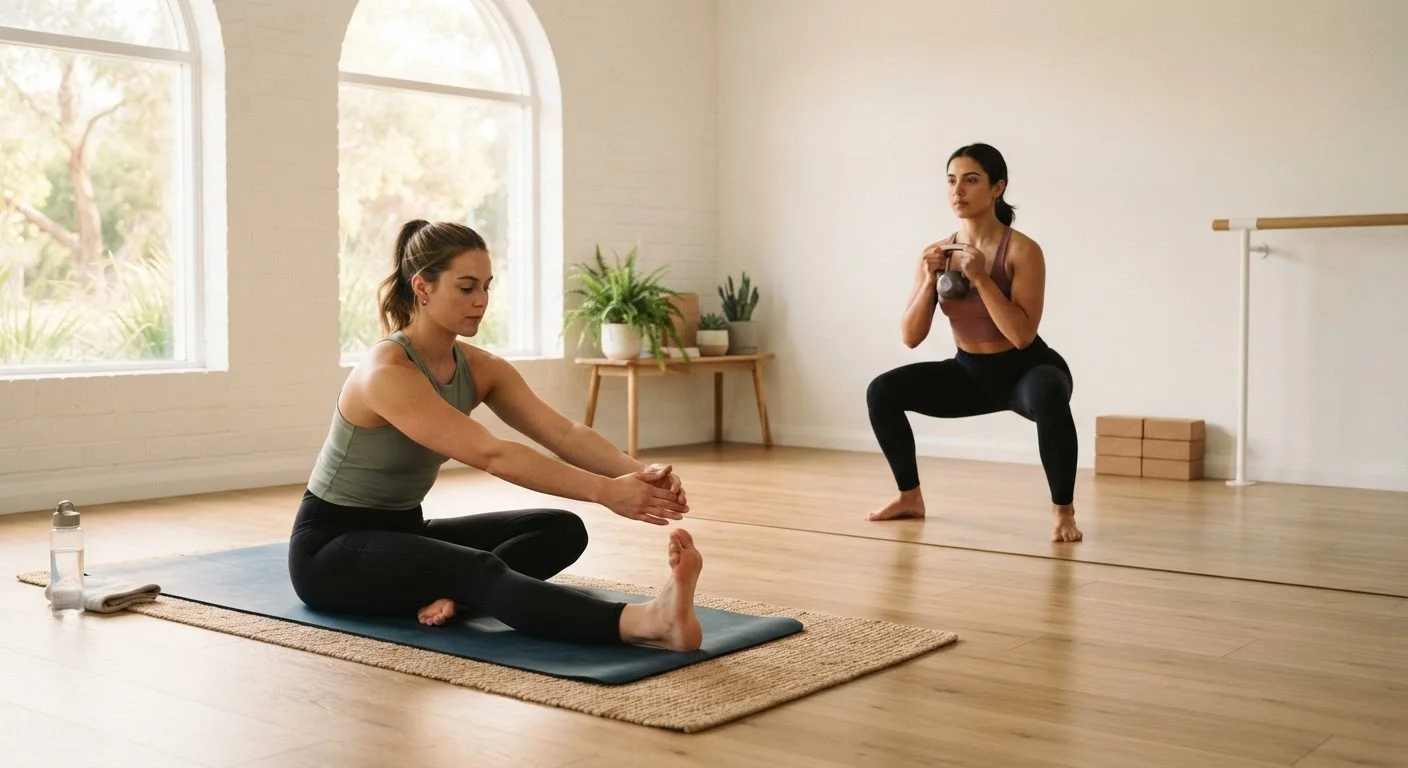
Key Takeaways
Option A
Flexibility
The passive range your muscles can reach.
Best for: People working to lengthen tight muscles and improve their passive range of motion through stretching.
Option B
Mobility
The active control you have through a full range of motion.
Best for: People who want to move more freely, reduce injury risk, and maintain functional strength throughout daily activities.
If you want to move through daily tasks - bending, squatting, reaching - with less strain
Mobility
Mobility training builds active control through a joint's full range, making functional movement safer and more efficient.
If you feel chronically tight or shortened in specific muscle groups
Flexibility
Targeted stretching can help lengthen muscles that have become shortened through sitting or repetitive movement patterns.
If you want a well-rounded physical fitness routine
Both
Combining flexibility work with mobility drills addresses both passive range and active control, supporting long-term joint health.
What Each Term Actually Means
The words flexibility and mobility get used interchangeably in gyms, wellness apps, and fitness articles - but they describe meaningfully different things. Understanding the distinction helps you train more intentionally and set realistic expectations.
Flexibility is a property of muscle and connective tissue. It describes how far a muscle can be elongated or stretched, typically measured passively - meaning with assistance from gravity, a strap, or another person. A classic example is the sit-and-reach test: you stretch forward and measure how far you can go. Your flexibility determines the outer boundary of that reach.
Mobility is a property of joints and the neuromuscular system working together. It describes how well you can move actively and with control through a range of motion. Someone with good hip mobility, for example, can move their hip through its full range under their own muscular effort - not just when pushed there passively.
Think of it this way: flexibility sets a ceiling, while mobility reflects how much of that ceiling you can actually use.
How They Differ in Practice
The gap between flexibility and mobility is best illustrated by a common scenario. A person who stretches regularly may be able to drop into a deep hamstring stretch - suggesting good flexibility. But if they cannot maintain a controlled squat or properly hinge at the hips during exercise, their mobility may still be limited. Passive range that you cannot actively control offers limited functional benefit.
| Criterion | Flexibility | Mobility |
|---|---|---|
| Definition | Passive muscle length and stretch capacity | Active joint control through a range of motion |
| Requires muscle effort? | No - passive measurement | Yes - active control required |
| Primary focus | Muscle and connective tissue | Joints and neuromuscular system |
| Typical training method | Static and dynamic stretching | Movement drills, strength through full range |
| Functional daily benefit | Moderate - supports range ceiling | High - directly improves usable movement |
| Can you have one without the other? | Yes - flexible but lacking active control | Somewhat - limited by flexibility ceiling |
This distinction matters because real-life movement - climbing stairs, lifting, reaching overhead - demands active control, not just passive length. That is why mobility training tends to have a more direct impact on how you move through daily life. It asks your muscles, joints, and nervous system to work together, not just stretch and hold.
That said, poor flexibility can cap mobility. If a muscle cannot lengthen at all, your active range through a joint will also be restricted. The two qualities interact - which is why a complete approach to physical wellness addresses both. See our guide to the major types of exercise for context on where flexibility and mobility fit within a broader fitness picture.
Training Each Quality - and Why Both Decline Over Time
Both flexibility and mobility are highly responsive to training, but they respond to different kinds of work.
To improve flexibility, static stretching is the most common approach - holding a lengthened position for 20 to 60 seconds to encourage muscle tissue to relax and lengthen over time. Dynamic stretching, which moves a joint through its range rhythmically, also builds flexibility while warming tissue for activity.
To improve mobility, the focus shifts to controlled movement drills: exercises like hip circles, deep squat holds with active engagement, or shoulder cars (controlled articular rotations) that ask you to own a range of motion rather than simply reach it passively. Strength training through a full range of motion - such as a properly executed squat or Romanian deadlift - is also a powerful mobility builder.
Both qualities tend to diminish with age and prolonged inactivity. Connective tissue becomes stiffer, joint fluid decreases, and habitual postures (like sitting for long hours) can shorten certain muscle groups while weakening others. However, research consistently supports that regular movement - across all ages - can maintain and meaningfully restore both flexibility and mobility.
A Word on Assessment
Self-assessing flexibility and mobility has limits. A physical therapist or certified strength and conditioning specialist can identify specific restrictions - whether in muscle length, joint structure, or motor control - that general stretching routines might miss. If movement limitations are affecting your daily life or causing discomfort, a professional evaluation is a worthwhile step.
This article is for general informational purposes and is not a substitute for personalized guidance from a qualified fitness professional, physical therapist, or healthcare provider. If you have an existing injury, joint condition, or chronic health concern, consult a professional before starting any new movement routine.