

Key Takeaways
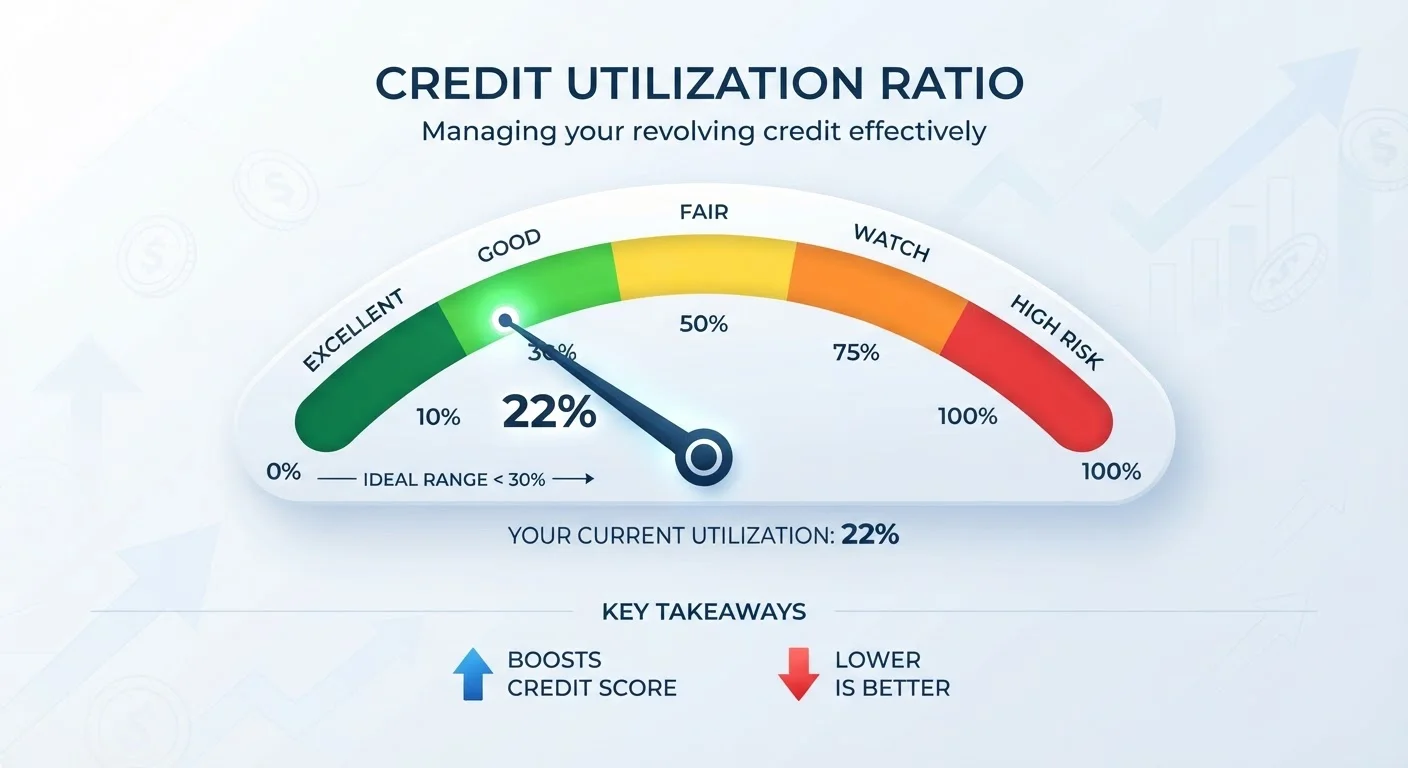
Credit Utilization Ratio
Credit utilization is the percentage of your available revolving credit - typically credit cards - that you're currently using. It's calculated by dividing your total credit card balances by your total credit limits, then multiplying by 100. For example, if you have $2,000 in balances across cards with a combined $10,000 limit, your utilization is 20%.
Scoring models like FICO and VantageScore evaluate utilization both in aggregate across all revolving accounts and individually per card. High utilization on a single card can hurt your score even if your overall ratio looks healthy.
Why Utilization Carries So Much Weight
Of all the factors that shape a credit score, credit utilization is the one that surprises people most - because it can swing dramatically in a short period and it's entirely within a borrower's control. Under the FICO scoring model, amounts owed (which includes utilization) accounts for roughly 30% of your score, trailing only payment history. For anyone trying to build or repair credit, that's a significant lever.
The reason scoring models pay close attention to utilization is rooted in risk. When a borrower is using a high percentage of their available credit, lenders interpret that as a potential sign of financial strain or over-reliance on debt. Conversely, low utilization suggests a borrower isn't dependent on credit to cover everyday expenses, which is associated with lower default risk.
If you're new to how credit scoring works overall, our plain-language guide to credit covers the foundational concepts worth knowing before diving deeper.
~30%
Share of FICO score tied to amounts owed
According to FICO's published scoring breakdown, 'amounts owed' - which includes credit utilization - is the second-largest scoring factor after payment history.
<30%
Commonly recommended utilization threshold
Consumer finance educators widely cite staying below 30% utilization as a practical guideline, though lower ratios are generally associated with higher scores.
3 bureaus
Credit bureaus that receive balance reports
Equifax, Experian, and TransUnion each receive reported balance and limit data independently from card issuers, which is why your score may differ slightly across bureaus.
How the Calculation Actually Works
The basic formula is straightforward: divide your total revolving credit balances by your total revolving credit limits, then multiply by 100 to get a percentage. But there's an important nuance - scoring models don't only look at your aggregate utilization. They also assess utilization on each individual card.
This means that maxing out one card can hurt your score even if your overall ratio looks fine. If you have three cards with a combined limit of $15,000 and one card is sitting at 90% of its own limit, that card-level ratio gets factored in separately.
Here's a simplified example:
- Card A: $800 balance / $2,000 limit = 40% utilization
- Card B: $200 balance / $5,000 limit = 4% utilization
- Card C: $0 balance / $3,000 limit = 0% utilization
- Overall: $1,000 / $10,000 = 10% utilization
The overall ratio of 10% looks healthy, but Card A's 40% individual utilization could still negatively affect the score. Spreading balances more evenly - or paying down Card A first - would improve both metrics.
Common Mistakes That Push Utilization Higher
Several everyday financial decisions can quietly increase utilization without feeling like anything unusual has happened. Understanding these patterns helps you avoid unintentional score dips.
Closing unused cards: When you close a card, its credit limit disappears from your total available credit. If you're carrying balances elsewhere, your overall utilization ratio rises immediately. Our article on common credit score myths covers this and other widely misunderstood behaviors in detail.
Timing of large purchases: Putting a significant expense on a card right before the statement closes can spike your reported balance - and your utilization - for that billing cycle, even if you plan to pay it off promptly.
Not requesting credit limit increases: If your income and account standing have improved, a higher credit limit (without increased spending) lowers your utilization ratio automatically. Most issuers allow periodic requests.
Confusing utilization with payment behavior: Paying on time is essential, but it's a separate factor. You can pay every bill on time and still carry high utilization that drags your score. These two factors operate independently.
Practical Ways to Manage Your Ratio
Because utilization responds to current balances - not a long history - it's one of the more actionable parts of credit management. A few targeted steps can move the needle relatively quickly.
Pay down balances before the statement date: Your issuer typically reports your balance to the credit bureaus on or around your statement closing date, not your due date. Paying down your balance before the statement closes means a lower number gets reported.
Make multiple payments per month: If cash flow allows, splitting payments throughout the month keeps balances lower at any given reporting snapshot.
Prioritize high-utilization cards first: Even if the interest rate isn't the highest, reducing a card that's near its limit addresses both aggregate and per-card utilization simultaneously.
Ask about a credit limit increase: If you've maintained responsible use, contact your issuer. A higher limit with the same balance instantly lowers your ratio. Keep in mind that some issuers perform a hard inquiry when reviewing limit increase requests - something worth understanding before you ask. Our guide on hard vs. soft credit inquiries explains how that process works.
For a broader glossary of terms you'll encounter while managing credit, see our reference on key credit and debt terms.
This article is for general informational and educational purposes only and does not constitute personalized financial or credit advice. For guidance specific to your financial situation, consult a qualified financial professional.